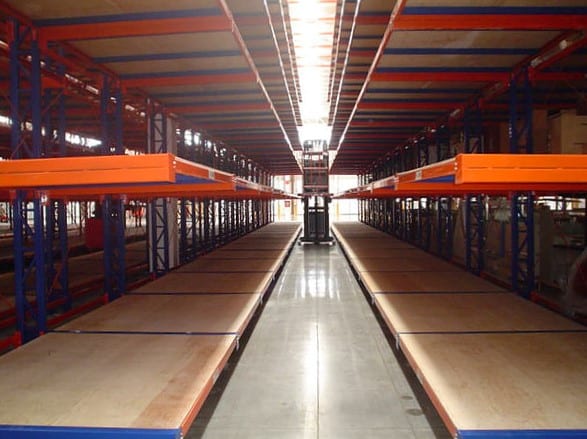
Cantilever racks offer a distinct advantage over selective racks with their unique design—vertical steel posts paired with heavy-duty horizontal arms. These arms support loads efficiently, enabling the storage of long, irregularly shaped non-conforming items without the obstruction of front posts. Additionally, their adaptable structure accommodates products of varying shapes, sizes, and materials, ensuring exceptional durability even for heavy loads.

Cantilever racking offers several advantages, making it an ideal storage solution for long, bulky, or irregularly shaped items. Whether you’re managing a warehouse or a manufacturing facility, cantilever racking provides an efficient and robust storage solution! Here are some key benefits:
Unlike traditional racking systems with front posts, cantilever racks provide open access, allowing for easy loading and retrieval.
Ideal for storing lumber, pipes, furniture, or sheet materials of varying sizes and weights.
The modular design allows for single- or double-sided storage, maximizing warehouse space efficiently.
Items can be accessed directly without moving others, streamlining operations.
Adjustable arms accommodate different load sizes, offering flexibility in storage configurations.
Designed to work seamlessly with forklifts and cranes, simplifying loading and unloading processes.
Built with heavy-duty steel construction, ensuring stability even for oversized loads.
Cantilever racking includes essential components and accessories that boost functionality, adaptability, and efficiency in warehouse storage. Here’s a breakdown of the essentials:
The main support structure, providing stability and weight-bearing capacity.
Attached to the bottom of uprights, ensuring balance and securing the system to the ground.
Extend horizontally from uprights, holding the stored items. They come in various lengths and load capacities.
Used to connect uprights for added structural integrity. Can be horizontal or diagonal, depending on load requirements.
Prevent items from rolling or slipping off the arms.
Used to create a continuous surface for storing smaller or irregularly shaped items.
Provide extra protection to uprights from forklift impact.
Reinforce the structure against collisions and enhance durability.
Allow customization for different load sizes and storage needs.
Assist in inventory management and organization.
Providing continuous training for personnel on safe heavy-load handling and equipment use.
Conducting regular inspections to check the integrity of components, especially arms and posts.
Monitoring load capacity per arm, avoiding exceeding the manufacturer’s recommended weight limit
Provides robust support for heavy and bulky loads.
Secure uprights, arms, and braces for structural integrity.
Keep the racking firmly attached to the floor, preventing tipping or shifting.
Prevent items from sliding off the arms, reducing the risk of falling objects.
Shield uprights from forklift or machinery impact.
Help maintain safe weight distribution by clearly displaying maximum load limits.
Horizontal and diagonal braces enhance stability and prevent away.
Allow for proper weight distribution and secure storage of different-sized items.
Workers must be trained in system operation to ensure compliance with current safety regulations.
Periodic inspections are necessary to check rollers, bearings, and other essential components.
Avoid exceeding the recommended weight capacity for each rack to prevent overload and structural damage.
Cantilever rack dimensions can be customized based on load size. They can be adjusted in height and width, making them a great option for both compact spaces and warehouses requiring high vertical capacity.
Cantilever racks are designed to support from 500 kg to several tons per arm, ensuring high durability for heavy loads.
The cantilever system is ideal for storing long and bulky loads, such as pipes, beams, profiles, and bars, particularly in warehouses with limited horizontal space and high product rotation.


 Racking
 Selective: Roll-Formed
 Selective: Structural
 Cantilever
 Dynamic: Carton-Flow
 Dynamic: Pallet-Flow
 Dynamic: Push-Back
 Pallet Shuttles (CS)
 Mezzanine | Pick Modules (CS)
 Rack Supported Buildings (CS)
 Gravity Conveyor (CS)
 Drive-In | Drive-Thru (CS)
 Shelving
 Shelving: Boltless Tab Rack
 Services