Introduction
In a market where every square foot matters, U.S. warehouses are under constant pressure to store more, move faster, and control costs. Push back racking is a high-density pallet solution that blends space optimization with operational speed — making it a top choice for distribution centers, 3PLs, and retail warehouses that need extra capacity without sacrificing accessibility. This blog explains how push back systems work, the efficiency gains they deliver, safety considerations, and how to assess whether they fit your operation.
What is Push Back Racking?
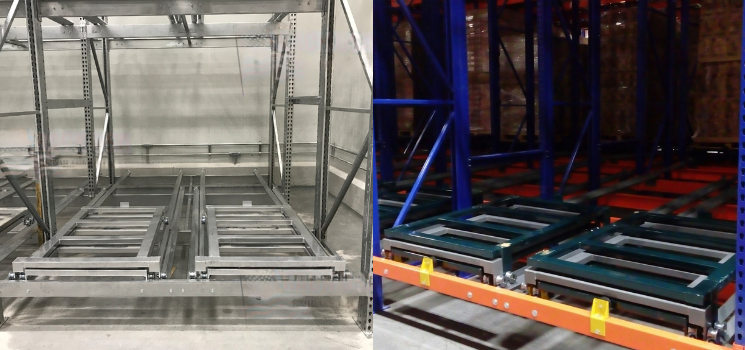
Push back racking stores pallets multiple positions deep on nested carts that roll on inclined rails. New pallets are loaded from the front and push the existing pallets back; when pallets are picked, the lanes roll forward for retrieval. Push back is a LIFO (Last-In, First-Out) system and typically supports 2–6 pallets deep per lane, depending on configuration and load weight.
Efficiency Advantages
Maximize Storage Density
By replacing selective single-deep lanes with push back lanes, facilities can
significantly increase pallet density and reduce the number of aisles required. That means more product stored in the same footprint — a direct saving on real estate and lease costs. In fact, push back racking can help you store up to 90% more pallets than selective racking
Faster Loading and Unloading
Operators load and pick from the same aisle face, reducing travel time and forklift maneuvering inside the racks. This not only speeds up throughput but also lowers fuel/electric consumption and equipment wear.
Better Aisle Utilization
Because push back needs fewer aisles for the same pallet count, floor space becomes available for value-added activities (kitting, staging) or simply to delay costly facility expansion.
Ideal for Medium-Turnover SKUs
Push back performs best with SKUs that require multiple pallet storage and medium turnover rates — e.g., retail cases, seasonal products, and many FMCG lines.
Safety & Maintenance
High-density storage raises safety expectations. Push back systems reduce some risks (less traffic inside the rack), but they also introduce specific requirements: proper cart speed control, regular rail and cart inspections, and strict loading procedures to avoid imbalances. Pair the system with operator training, clear load capacity labeling, and routine inspections to maximize uptime and safety. For detailed guidance, check out these
push back safety best practices
Typical U.S. Use Cases
- Retail distribution centers handling seasonal surges.
- 3PL operators that need flexible, dense storage for multiple clients.
- Food & beverage and packaged goods where multiple pallets of the same SKU are stored.
- Regional warehouses in high-rent metro areas where footprint efficiency is critical.
Cost Considerations & ROI
Push back racking costs more upfront than selective racking (rails, carts, installation), but its ROI comes from: lower leased area per pallet, reduced handling time, and deferred facility expansion. Run a simple ROI model comparing current leased $/sqft vs. projected pallet density gains and lower labor hours to estimate payback. For regulatory compliance info, always review the
OSHA warehousing standards.
Implementation Checklist
- Inventory analysis: Identify SKUs suited to LIFO and group by weight/size.
- Layout simulation: Model lanes, aisle widths, and forklift flow.
- Load testing: Verify pallet/load compatibility with carts and rails.
- Safety plan: Establish SOPs, training, and inspection cadence (align with OSHA standards).
- Integration: Confirm compatibility with WMS and any AMR routes.
Conclusion
Push back racking is a practical, high-density option for U.S. warehouses that need more capacity without the complexity of full automation. When specified and installed correctly, it delivers measurable space and productivity gains with manageable safety and maintenance needs.
At RackUSA, we go beyond selling racks.
We engineer storage systems customized to your operation’s real conditions, loads, and growth expectations — in full compliance with U.S. codes and OSHA safety standards
Frequently Asked Questions (FAQs)
Q1: Is push back compatible with automation?
A: Yes. Push back can be integrated with conveyors and certain AMR workflows, but lane access rules and AMR routing must be planned carefully.
Q2: When should I avoid using push-back racking?
A: Avoid push back for highly mixed pallet weights within the same lane or when strict FIFO rotation is required.
Q3: How often should push back racks be inspected for safety?
A: Inspections should be conducted regularly, at least quarterly, and after any significant incident or change in load patterns.

 Racking
 Selective: Roll-Formed
 Selective: Structural
 Cantilever
 Dynamic: Carton-Flow
 Dynamic: Pallet-Flow
 Dynamic: Push-Back
 Pallet Shuttles (CS)
 Mezzanine | Pick Modules (CS)
 Rack Supported Buildings (CS)
 Gravity Conveyor (CS)
 Drive-In | Drive-Thru (CS)
 Shelving
 Shelving: Boltless Tab Rack
 Services