Racking
 Selective: Roll-Formed
 Selective: Structural
 Cantilever
 Dynamic: Carton-Flow
 Dynamic: Pallet-Flow
 Dynamic: Push-Back
 Pallet Shuttles (CS)
 Mezzanine | Pick Modules (CS)
 Rack Supported Buildings (CS)
 Gravity Conveyor (CS)
 Drive-In | Drive-Thru (CS)
 Shelving
 Shelving: Boltless Tab Rack
 Services
Choosing between these two storage systems should not be a process of elimination. Both selective pallet racks and drive-in racks solve the problem of storing pallets on a steel structure, but they do so using completely opposite logistics logic. Selecting the wrong system compromises warehouse efficiency for years, and the mistake often goes unnoticed until the operational costs are already locked in.
The Core Difference Between the Two Systems
Selective racks provide direct access to every storage position from the aisle. Each pallet is independent: you can load or retrieve any specific load without moving another SKU. That accessibility defines the structure of the racks; they require travel aisles between modules, which consumes space that cannot be used for storing products.
Drive-in racks work the opposite way. They eliminate internal aisles and allow the forklift to drive directly into the racking structure through interior lanes, stacking pallets deep. This yields more storage positions per square foot, but with restricted access: you can only reach the pallet at the front of each lane. The rest of the load is blocked until you empty what is in front of it.
That access restriction is not a minor detail. It is the defining variable that determines whether high-density storage will actually work for your specific operation.
Inventory Turnover: The First Filter
Inventory turnover (or velocity) dictates which type of rack best solves your storage problem. In high-turnover warehouses, where constant access to various SKUs is required, selective racks are the natural choice. High velocity demands the ability to retrieve any pallet at any time, and limiting that access creates bottlenecks that disrupt the entire shipping flow.
For low-turnover operations, the accumulation storage logic of drive-in racks makes perfect sense. Drive-in systems are designed to move full batches of loads, not for frequent picking of highly varied SKUs. If your products cycle in and out seasonally or in homogenous blocks, the storage density offered by these racks far outperforms selective racking in maximizing available space.
The rule is straightforward: high turnover points to selective racks; low turnover opens the door for drive-in racks.
FIFO, LIFO, and Inventory Control
Selective racks are compatible with any inventory rotation method. You can apply FIFO (First-In, First-Out) or LIFO (Last-In, First-Out) depending on the SKU, which greatly facilitates inventory control in warehouses managing many SKUs with different expiration dates. This access flexibility is one of the biggest differentiators of selective racking versus high-density systems.
Drive-in racks operate primarily on LIFO: the last load placed in a lane is the first one to come out. For products with expiration dates, this creates a major inventory problem with no easy workaround.
The drive-through variant solves this by allowing access from both ends of the lane, which enables a First-In, First-Out flow. However, it requires available aisle space on both sides of the racking structure and a different overall warehouse layout.
If you handle food, pharmaceuticals, or any load that demands strict rotation by date, selective racks or a drive-through system are your viable alternatives. For homogenous products with no expiration constraints, standard drive-in racks work seamlessly.
How Many SKUs Can You Manage with Each System?
Selective racks have no practical limit on SKUs. You can dedicate different storage positions to each SKU, reorganize as your product mix changes, and manage varied turnover rates within the same warehouse without operational friction.
Drive-in racks have a very real limit. Each lane must be dedicated to a single type of load for the storage logic to function. If your warehouse footprint allows for 8 drive-in lanes, you can only efficiently manage 8 SKUs in that storage zone.
The practical threshold: drive-in racks are highly effective when managing a few high-volume SKUs, generally fewer than 10 active SKUs in the high-density zone. Beyond that number, the complexity of inventory management begins to cancel out the density benefits.
The Hidden Cost: Rack Damage
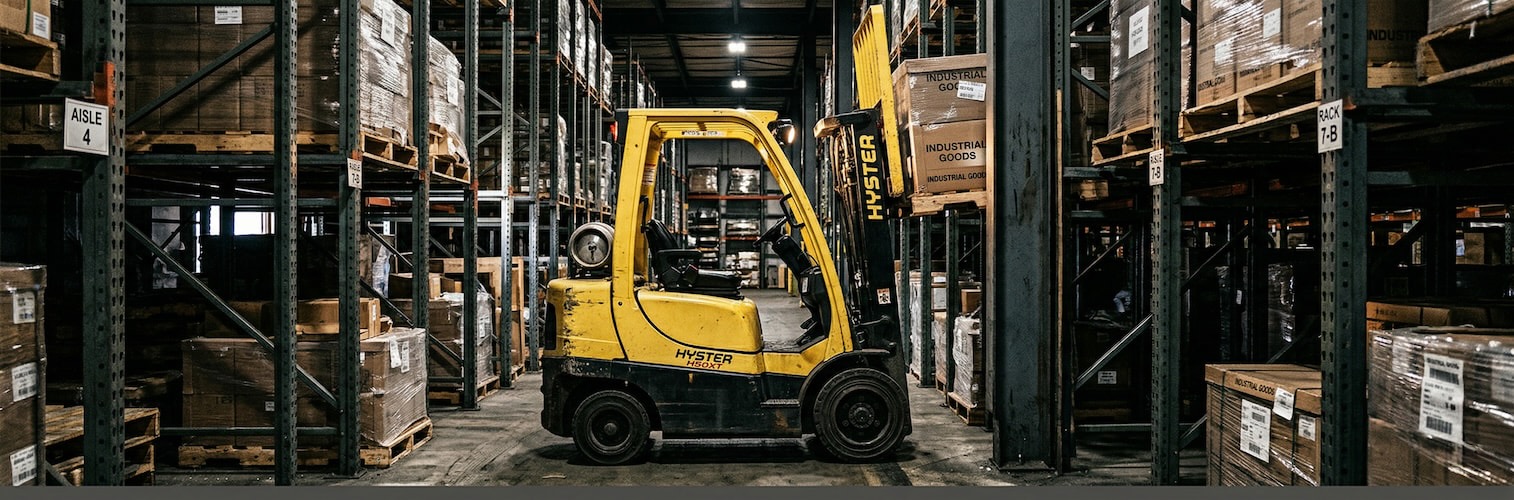
In selective racking, the forklift never enters the structure. It deposits and retrieves loads from the aisle, with full visibility and ample room to maneuver. The risk of structural impact is low.
In drive-in racking, the forklift operates inside the rack structure. Impacts to columns, base plates, and rails are frequent, especially in high-traffic warehouses or across rotating shifts where operator skill levels vary. These cumulative impacts can compromise structural integrity if they are not detected and addressed promptly.
This introduces two concrete costs: more frequent maintenance than selective racks, and an additional upfront investment in safety accessories (column protectors, pallet stops, heavy-duty rub rails). While these costs should not necessarily kill the project, they must be factored into your Total Cost of Ownership (TCO), not just the manufacturing and installation price of the steel.
Seismic Factors in Rack Design Across the US
Industrial racks in the US must be engineered taking into account the seismic risk (Seismic Design Category) of the project's specific zip code. This variable affects both systems, but with different implications.
Selective racks, being open structures with aisles between modules, are generally better at distributing lateral loads during a seismic event. Drive-in racks concentrate significantly more load and mass within their lanes, which requires far more rigorous structural engineering. High-density racks installed in high-seismic zones (like the West Coast) without proper calculations might perform fine under normal conditions but fail catastrophically during a moderate earthquake.
When quoting industrial racking in the US, ensuring the design complies with RMI (Rack Manufacturers Institute) standards and local IBC (International Building Code) seismic requirements is not optional. This applies to all storage systems, but it is especially critical for drive-in racks due to the immense load density they pack per square foot.
The True Cost Per Pallet Position
Comparing the price per module between the two systems leads to flawed conclusions. What matters is the cost per pallet position, factoring in the total warehouse square footage each system occupies.
Drive-in racks have a higher installation cost per module than selective racks due to their structural complexity and required accessories. However, by storing more pallets in the same available footprint, the cost per position can drop significantly once the project scales to enough volume.
For that equation to favor drive-in, you need: high storage density (a minimum of 6 pallets deep per lane), a low number of active SKUs in that zone, and consistent rack occupancy. If any of these conditions fluctuate, the cost per position tends to equalize or even favor selective racking.
When Drive-In Fails (Even If Space is Tight)
There are scenarios where a lack of available space points to drive-in as the obvious solution, but the system ends up being counterproductive.
-
If the operation requires frequent access to varied load positions, the maneuvering time inside the lanes kills any density gains. Inventory access becomes sluggish, and picking errors rise.
-
If products have expiration dates and the warehouse cannot accommodate a drive-through layout, the mandatory LIFO of drive-in creates an inventory rotation nightmare that no operational tweak can fully solve.
-
If inbound/outbound load spikes are concentrated and turnover is high but irregular, the restricted access creates massive bottlenecks throughout the shipping chain.
In these cases, well-configured selective racks, dynamic flow racks, or a hybrid combination of systems solve the space problem with far less operational friction.
Dynamic Racking as the Middle-Ground Alternative
When selective racks waste too much space on aisles and drive-in racks restrict access too heavily, dynamic storage systems offer a middle ground worth evaluating.
-
Push-back racks allow for multi-deep accumulation storage without the forklift ever entering the structure. They operate on LIFO and offer higher density than selective racks, with a much lower risk of structural damage than drive-in.
-
Pallet flow racks (Gravity flow) work on FIFO and provide high density with automatic product rotation via an inclined roller bed, requiring no operator intervention to advance the load. These are high-density systems specifically for when rotation demands First-In, First-Out.
-
Pallet Shuttle systems automate the movement of pallets inside the lanes and can operate in either FIFO or LIFO depending on the project's configuration. It is the natural evolution of drive-in when load volume and movement frequency justify an investment in automation.
Hybrid Configurations: How to Divide Your Warehouse Zones
Combining different racking systems within the same facility is the most common solution for a varied product mix. Layout design should define storage zones based on load type and required access frequency.
The drive-in rack zone is best suited for high-volume, low-turnover SKUs and homogenous products where storage density is the absolute priority. A classic example: raw materials or packaging supplies consumed in full batches.
The selective rack zone is ideal for high-velocity SKUs, date-sensitive products, and items moving in partial quantities. This is the zone that provides speed and access flexibility to the warehouse.
A standard benchmark in industrial warehousing is to allocate between 20% and 35% of the floor space to high-density racks and the remainder to selective racking, adjusted according to your actual inventory profile. It is not a rigid rule, but it serves as an excellent starting point for project sizing.
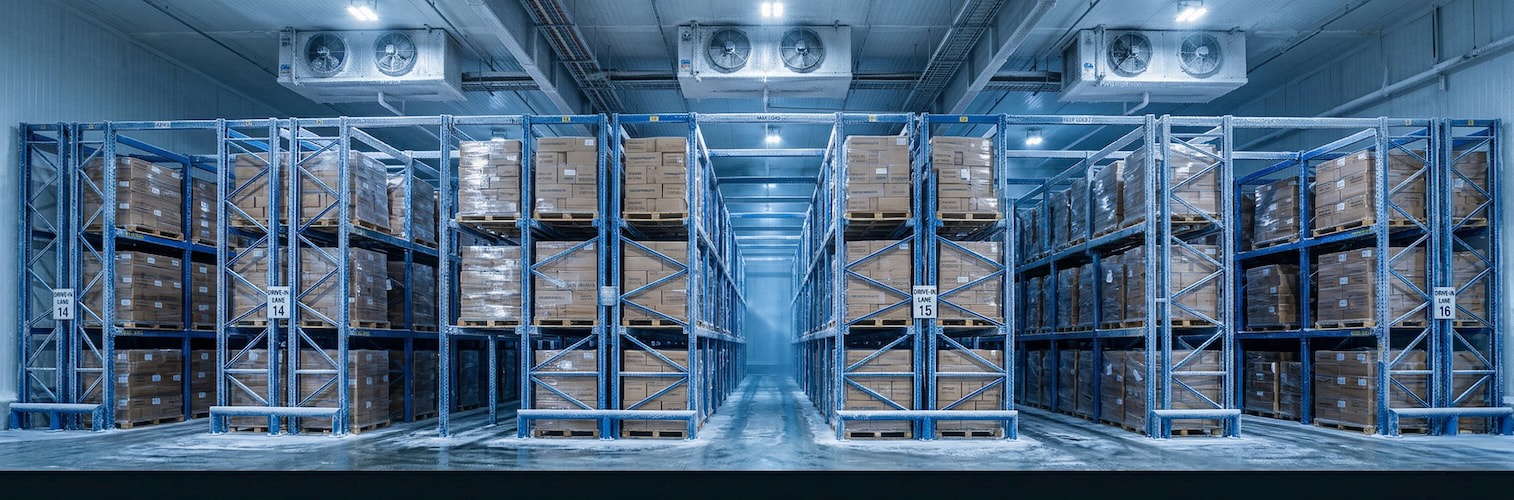
Cold Storage: The True Advantage of Drive-In Racks
In temperature-controlled facilities, every cubic foot of refrigerated space carries a direct energy cost. Shrinking the total volume that needs cooling directly impacts the facility's monthly operating expenses.
Drive-in racks eliminate the aisles that, in selective racking setups, consume space inside the freezer without storing any payload. That non-revenue-generating space disappears with high-density racks, minimizing the total footprint to be climate-controlled and slashing the energy consumption of the refrigeration system.
For cold storage facilities handling few SKUs, low turnover, and products without expiration constraints, drive-in racks provide an ROI that goes far beyond the initial cost of the steel.
Comparison Between Selective Racking and Drive-In Racking
| Criteria | Selective Racking | Drive-In Racking |
|---|---|---|
| Access type | Direct to Each Position | Front position only per lane |
| Compatible rotation | High turnover and low turnover | Low turnover |
| Inventory Management | FIFO or LIFO | LIFO (drive-in) / FIFO (drive-through) |
| SKU by zone | No practical limit | Optimal for fewer than 10 items |
| Storage density | Medium | High (min. 3 pallets deep) |
| Risk of damage to the racks | Low | Medium-high |
| Load Access Speed | High | Medium-high |
| Installation Cost | Lower | Higher |
| Cost per stored pallet (high volume) | Higher | Lower |
| Compatibility with perishable products | Yes | Only drive-through |
| Cold Storage | Possible | Recommended |
| Required Seismic Analysis | Standard | Reinforced in high-risk areas |
Frequently Asked Questions
How many pallets deep does a drive-in lane need to be to be cost-effective?
The break-even point typically starts at 3 pallets deep per lane. With fewer positions, the cost difference compared to selective racks is marginal, making it hard to justify the additional investment for a drive-in structure.
Do drive-in racks require specialized forklifts?
Standard drive-in racks can operate with standard counterbalance forklifts. However, the internal lane dimensions must be engineered with appropriate clearances for your specific equipment. In projects with tighter, more compact lanes, reach trucks are often required. Defining your material handling equipment before designing the racks prevents costly incompatibilities.
Is it possible to have double-deep selective racks?
Yes. Double-deep racking is a variation of selective racks that stores two pallets deep per position, increasing density without fully committing to the compact drive-in model. They require lift trucks equipped with deep-reach forks and reduce direct access to the rear position, but they serve as an excellent intermediate solution for warehouses needing more density without entirely sacrificing selectivity.
How do seismic zones affect rack design in the US?
All industrial racks in the US require structural engineering that accounts for the local seismic design category dictated by the IBC. High-density systems like drive-in racks concentrate massive loads per square foot, demanding rigorous design attention. Requesting PE-stamped (Professional Engineer) structural calculations that comply with RMI standards is absolutely mandatory for any storage project in the United States.
Which system is best when a single SKU's volume exceeds drive-in capacity?
The Pallet Shuttle is the natural next step. It automates load movement within the lanes, maximizes storage density without expanding the warehouse footprint, and can be configured for either FIFO or LIFO operations.
Let Us Evaluate Your Operation at No Cost
At RackUSA, we analyze your warehouse layout, your SKU mix, and your inventory velocity to recommend the storage system that perfectly aligns with your operation. With decades of experience manufacturing and installing industrial racking in the US, we have the expertise to back it up. Request a quote today and let's talk.