Why Speed and Accuracy Matter in Warehousing
In today’s competitive supply chain, speed and accuracy are non-negotiable. Customers expect next-day or even same-day delivery, and a single picking mistake can mean returns, delays, and lost trust. Warehouses are under constant pressure to move products faster without sacrificing accuracy.
This is where
Carton Flow Racking becomes a game-changer. By streamlining picking operations, reducing walking time, and guaranteeing first-in, first-out (FIFO) inventory flow, it transforms how warehouses handle small to medium-sized items.
In this guide, we’ll explore:
- How carton flow racking works
- Its key benefits for efficiency and safety
- Common applications across industries
- How to choose the right system for your needs
- Real-world success stories and insights
How Carton Flow Racking Works
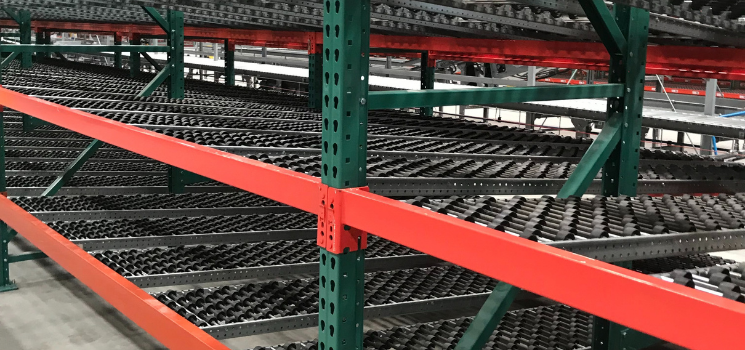
Carton flow systems are built with
inclined roller or wheel tracks that allow cartons, totes, or boxes to move smoothly from the loading side to the picking side using gravity.
- Load from the back (restocking aisle) → products roll forward.
- Pick from the front (picking aisle) → always the oldest product first (FIFO).
Pick from the front (picking aisle) → always the oldest product first (FIFO).
Key Benefits of Carton Flow Systems
1. Increased Picking Speed
Operators spend less time walking and searching for products. With items always positioned at the front, pickers can complete orders up to
40% faster compared to standard shelving.
2. Better Space Utilization
By maximizing vertical space, carton flow racks allow more SKUs per square foot. This is especially beneficial for warehouses in high-rent zones or those looking to delay costly facility expansions.
3. Improved Inventory Rotation
FIFO is built-in, reducing the risk of expired or obsolete stock. In industries like
food & beverage or
healthcare, this feature is not just efficient — it’s regulatory compliance.
4. Ergonomics and Worker Safety
Products are presented at waist level, minimizing bending, stretching, or climbing. This improves worker comfort and helps reduce repetitive strain injuries, cutting down on workplace accidents and downtime.
Carton Flow vs. Other Picking Systems
Compared to static shelving, carton flow racking provides up to 30% faster picking rates. Unlike push-back or pallet flow systems that handle larger loads, carton flow focuses on small, lightweight items, making it perfect for piece-picking operations.
📌 For further insights, check out
Modern Materials Handling’s overview of picking systems
Common Applications
Carton flow racking is widely adopted across industries:
- E-commerce fulfillment centers: Handling small, fast-moving products with high order volume.
- Food and beverage warehouses: Strict FIFO requirements for perishable goods.
- Pharmaceutical distribution: Where accuracy and traceability are essential.
- Automotive parts: Small components organized for just-in-time assembly.
- Retail distribution hubs: Managing high SKU variety with limited storage space.
Choosing the Right Carton Flow System for Your Warehouse
When selecting a carton flow solution, consider the following:
- Product size and weight – Determines the type of track (rollers vs. wheels).
- Order volume and SKU variety – High-volume operations may need reinforced lanes.
- Integration with existing pallet racking – Most systems can be retrofitted with minimal downtime.
- Budget vs. ROI – While initial investment is higher than static shelving, the labor savings and space optimization typically deliver ROI within 12–18 months.
👉 For technical guidance, the
Material Handling Institute (MHI) offers excellent resources on racking system design.
Real-World Example: Boosting Efficiency by 40%
A mid-sized electronics distributor in Texas implemented carton flow lanes into its selective racking system. Within three months:
- Order picking speed increased by 40%
- Order errors dropped by 25%
- Labor costs were reduced by reassigning staff to value-added tasks
This case demonstrates how carton flow racking is not just a storage upgrade, but a full workflow optimization.
Final Thoughts
Carton flow racking is more than just a storage solution — it’s a productivity tool. By optimizing space, improving inventory rotation, and enhancing ergonomics, it helps warehouses operate leaner and smarter.
Whether you’re running an e-commerce fulfillment center or managing strict FIFO requirements in food distribution, carton flow systems provide a scalable, long-term solution.
👉 At
RackUSA, we design and implement
custom storage solutions like carton flow systems to help businesses achieve maximum efficiency.
Frequently Asked Questions (FAQs)
Can carton flow racks be added to existing selective racking?
Yes, most systems are designed for easy retrofit with minimal disruption.
How much weight can each lane support?
Standard lanes hold between
50–75 lbs per level, but heavy-duty tracks can handle more.
Are carton flow systems only for small products?
No. With the right track and pitch, they can handle a wide variety of carton sizes.
How long does the installation take?
Most projects are completed within
a few days or weeks, depending on warehouse size.
What is the typical ROI?
Most warehouses see a full return on investment in 12 to 18 months through labor savings and improved efficiency.

 Racking
 Selective: Roll-Formed
 Selective: Structural
 Cantilever
 Dynamic: Carton-Flow
 Dynamic: Pallet-Flow
 Dynamic: Push-Back
 Pallet Shuttles (CS)
 Mezzanine | Pick Modules (CS)
 Rack Supported Buildings (CS)
 Gravity Conveyor (CS)
 Drive-In | Drive-Thru (CS)
 Shelving
 Shelving: Boltless Tab Rack
 Services