Racking
 Selective: Roll-Formed
 Selective: Structural
 Cantilever
 Dynamic: Carton-Flow
 Dynamic: Pallet-Flow
 Dynamic: Push-Back
 Pallet Shuttles (CS)
 Mezzanine | Pick Modules (CS)
 Rack Supported Buildings (CS)
 Gravity Conveyor (CS)
 Drive-In | Drive-Thru (CS)
 Shelving
 Shelving: Boltless Tab Rack
 Services
The Physical Conditions Required by Regulations for the Storage Area
EPA regulations under RCRA (specifically within Title 40 CFR Part 262) establish the minimum conditions that hazardous waste accumulation areas must meet. The area should be separated from production zones, administrative offices, and the storage of finished products or raw materials. Floors must be impermeable and crack-free, featuring a secondary containment system to prevent spilled liquid wastes from reaching drains or the soil. Walls should be constructed of non-flammable materials, and adequate ventilation must be in place to prevent the accumulation of dangerous vapors.
Aisle space must be sufficient to allow the unobstructed movement of personnel, forklifts, and emergency response teams. Signage must clearly indicate the hazardous waste area. Additionally, every container must be properly labeled with the words "Hazardous Waste," an indication of its specific hazards (using EPA/DOT hazard labels or GHS pictograms), and the exact accumulation start date. Fire extinguishers and spill control kits must be located within the area and be accessible without any obstructions. There can be no direct drain connections that would allow liquid waste to flow outside the protected zone.
Packaging is also a critical part of waste management. Each container must be compatible with the substance it holds, kept closed (except when actively adding or removing waste), and in good condition. A deteriorating container is a common source of leaks, which can be prevented through the systematic weekly inspections required by the EPA. This point is often overlooked, but under RCRA's "cradle-to-grave" liability, the environmental and financial responsibility for a spill falls entirely on the generator.
These are the baseline requirements for any temporary accumulation area. What the regulations do not explicitly specify is exactly how the storage systems should be organized within that physical space. That decision makes the difference between an area that simply passes an inspection and one that operates with genuine safety.
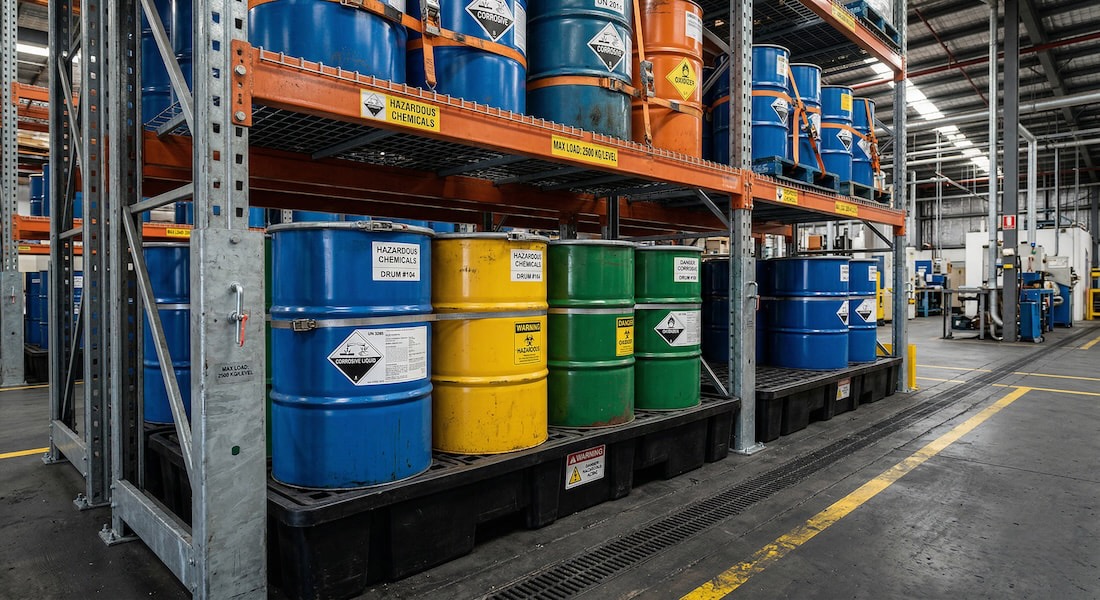
Why the Rack System is a Safety Decision, Not Just a Storage One
The rack dictates how the operator accesses each storage position. It defines how long they remain exposed during every hazardous waste handling maneuver. It defines how quickly they can exit the area if an incident occurs. In the context of hazardous materials storage, these variables determine the actual safety level of the entire space.
High-density systems like drive-in racks, which might be an efficient space-saving solution in a conventional warehouse, introduce serious problems when dealing with hazardous waste. The operator must drive the forklift inside the system to deposit or retrieve materials. If there is an active leak or an unstable container, the operator is inside the structure. Evacuation is slower. Visibility regarding the condition of waste stored in internal positions is severely limited. The storage space saved simply does not compensate for that level of exposure.
Selective racking is the most appropriate foundational system for hazardous waste management. It allows direct, individual access to each position without the need to move other materials. If a drum develops a leak, the operator can remove it immediately. They can perform the required inspections directly from the aisle. They can identify a problem before it escalates. In practice, that is the difference between a contained incident and one with a real environmental and financial impact.
For facilities that continuously generate the same type of waste, a dynamic FIFO (First-In, First-Out) pallet flow rack complements selective racking well. Waste advances by gravity from the loading zone to the extraction zone, strictly respecting the order of entry. This makes it easier to comply with RCRA's 90- or 180-day accumulation limits without relying exclusively on manual logs: the physical structure itself guarantees that the oldest materials leave first. In areas handling chemicals or substances whose risk profile changes over time, this automatic inventory control significantly reduces safety risks.
The Accessories That Turn a Standard Rack into a Safe Hazardous Waste System
Choosing the right rack is the first step. The accessories determine whether that system responds well to the real-world conditions of hazardous materials and waste storage.
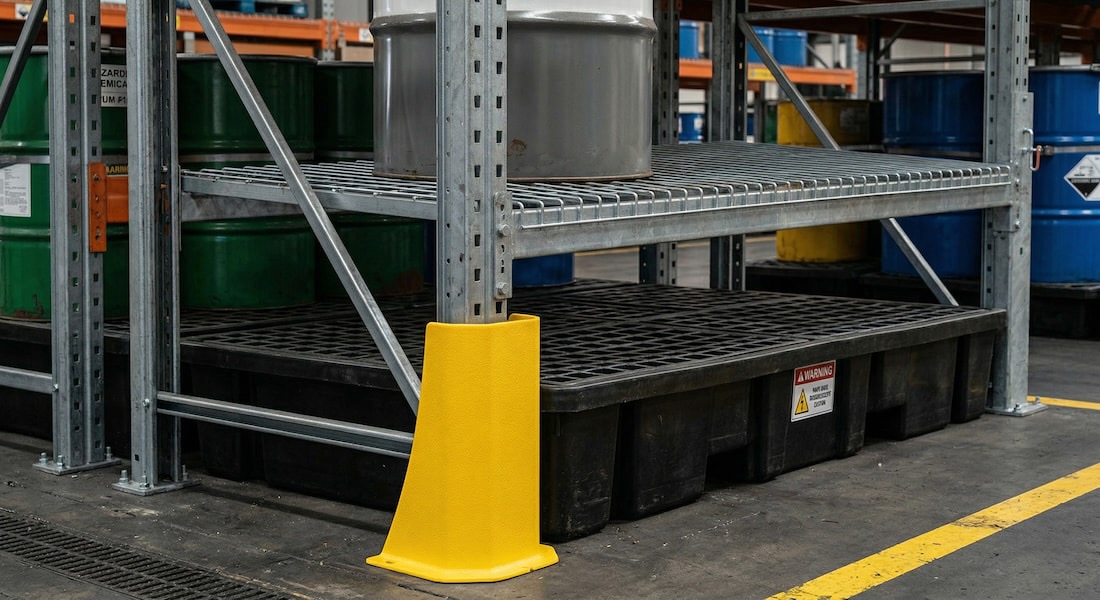
Wire decking, the metal grid placed as a support surface on each level, is the most underestimated component in hazardous waste management. Unlike solid shelving, wire decking does not trap spilled liquids: it directs them downwards toward the containment sump or spill tray on the floor. This allows for leak detection directly from the aisle, without having to climb to the affected level, enabling operators to act before the spilled volume exceeds containment capacity. In terms of operational safety, wire decking acts as an early warning mechanism for spills.
Solid Surface Decking at the base of the rack form the secondary containment system. Their capacity must be calculated based on EPA regulations, providing enough margin for a worst-case scenario. An undersized tray that overflows during a hazardous waste spill eliminates the system's entire advantage and can cause contamination in adjacent areas, which multiplies both the environmental impact and the generator's liability.
Column protectors are a component often treated as optional. In areas with forklift traffic, an impact against a column can destabilize containers holding corrosive, ignitable, or highly hazardous substances. Protectors absorb the impact and maintain the structural integrity of the storage system. The cost of installing them is marginal compared to the cost of managing the consequences of fires or spills resulting from a rack collapse.
Pallet stops, which prevent a palletized container from being pushed past its designated position, complete the system. They are low in cost but highly relevant in an environment where any uncontrolled movement of hazardous goods can have severe consequences for safety and human health.
How to Design the Internal Layout for Proper Hazard Segregation
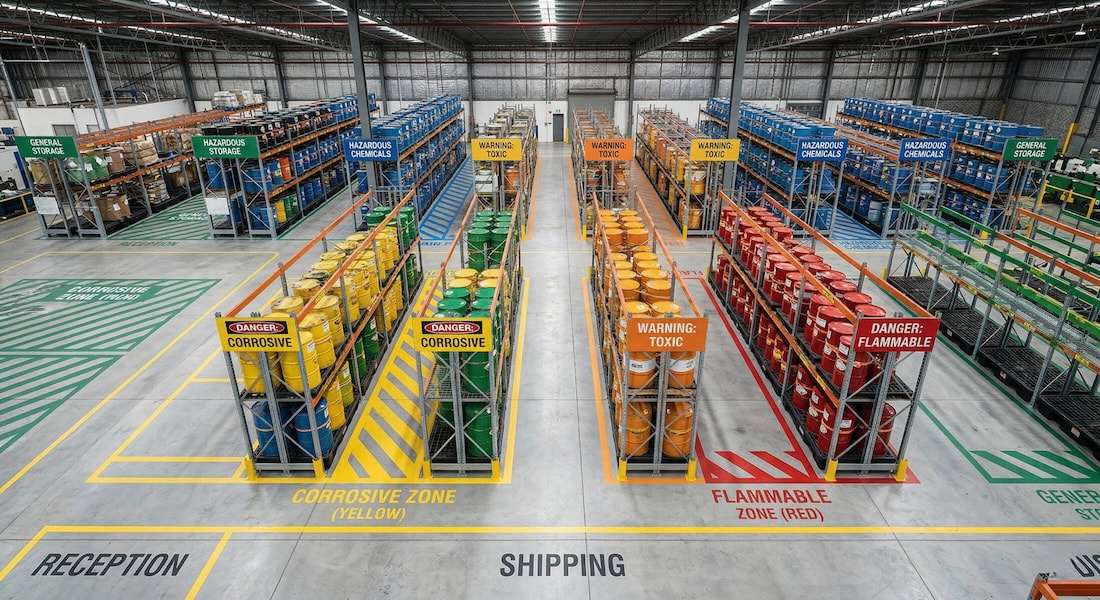
Regulations demand the strict segregation of hazardous wastes with incompatible characteristics. The layout must translate this requirement into concrete physical zones, not just rely on wall signage.
Each EPA hazard class must have its own dedicated rack module, with actual physical distance between modules containing incompatible wastes. For example, ignitable materials and oxidizers cannot be stored in adjacent modules: a leak in one could act as the catalyst for dangerous reactions in the other. Both OSHA industrial safety standards and EPA environmental regulations require this, and operational logic dictates it as well. Physical separation via aisles between modules is the only mechanism that guarantees this independence when an incident occurs.
Aisle width is a decision many companies make based on available space and the number of storage positions they need. The logic should be the reverse: first, define the width necessary to maneuver safely and evacuate during an emergency, and then size the capacity accordingly. The EPA explicitly requires "adequate aisle space" to allow the unobstructed movement of personnel and emergency equipment. In practice, a minimum width of 8 to 10 feet allows a forklift to operate and a person to move alongside it safely. Anything less introduces risks that compromise both personnel safety and the environmental management of the space.
Modules holding the highest risk materials, primarily ignitable and reactive wastes, should be positioned away from the main entrance but with clear, unobstructed evacuation routes. Wastes with a relatively lower risk can be located closer to the access point. Furthermore, racks designated for corrosive hazardous wastes must feature an anti-corrosion coating on columns and beams: dangerous acidic vapors progressively degrade standard steel, and a compromised column often shows no visible signs of failure until it is too late.
Common Mistakes in Hazardous Waste Management
There are recurring patterns when designing or auditing these types of spaces. Some compromise safety right from the start. Using high-density systems because they "optimize space," without considering the implications for evacuation and safe operation with these materials. Not installing column protectors because the forklift team "is careful." Placing solid shelves on racks because they are cheaper, without thinking about how hazardous waste spills will be detected in time. Accumulating materials without date tracking until the 90- or 180-day limit has already expired. Designing aisles to the absolute minimum to squeeze in more storage positions, leaving emergency routes that only exist on the floor plan.
Each of these mistakes has a cost. Sometimes it is a hefty EPA fine. Sometimes it is uncontrolled emissions that generate legal liability for contamination. Sometimes it is a fire or an accident that could have been prevented with better design decisions. In all cases, the cost of fixing it later far exceeds the cost of designing it right the first time.
The Difference Between a Space That Simply Complies and One That Truly Works
A hazardous waste accumulation area that complies with the EPA covers the legal minimum. One that is also internally well-designed protects human health, facilitates the traceability required by regulations, and reduces the probability that a minor hazardous waste incident escalates into a problem with a real impact on the facility, the environment, and the business's operational continuity.
Designing that space requires understanding the hazardous wastes generated, their frequency, their EPA/DOT incompatibilities, and the physical conditions of the site. It is not a decision that can be solved by simply picking a rack from a catalog. At RackUSA, we apply engineering principles to design storage systems that respond to the specific conditions of each operation. If you need to structure or redesign your temporary hazardous waste accumulation area, we can help you define the right solution.