Racking
 Selective: Roll-Formed
 Selective: Structural
 Cantilever
 Dynamic: Carton-Flow
 Dynamic: Pallet-Flow
 Dynamic: Push-Back
 Pallet Shuttles (CS)
 Mezzanine | Pick Modules (CS)
 Rack Supported Buildings (CS)
 Gravity Conveyor (CS)
 Drive-In | Drive-Thru (CS)
 Shelving
 Shelving: Boltless Tab Rack
 Services
What is nearshoring?
It is a strategy whereby logistics companies relocate their production processes and logistics services to nearby countries. It is an area of opportunity due to geographical proximity, reducing costs, improving logistics efficiency, and minimizing risks associated with distance, such as time and cultural differences. Countries such as Mexico and Costa Rica have become attractive destinations for companies seeking to optimize their supply chain.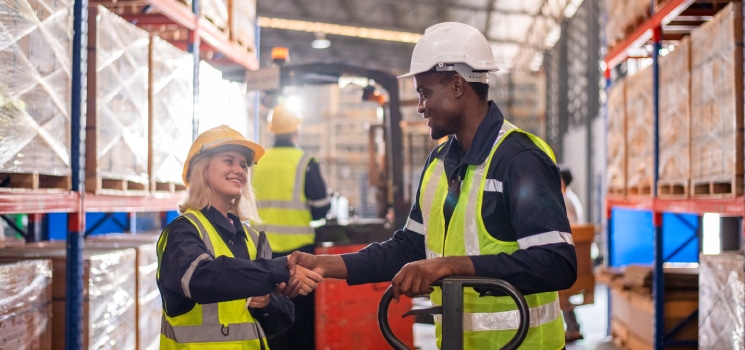
Differences between nearshoring and offshoring
| Criteria | Nearshoring | Offshoring |
| Labor costs | Moderate: they may be lower than in the country of origin, but not as low as in distant regions. | Son más bajos, ya que las organizaciones buscan países con costos laborales reducidos. |
| Time zones | Similar or with little difference, it facilitates communication and coordination in real time. | Time differences that may affect management and communication with the parent company. |
| Customs regulations | More accessible, as there are usually favorable trade agreements and regulations between neighboring countries. | There may be more restrictions and higher costs due to complex regulations and trade barriers. |
| Foreign companies | They establish operations in nearby countries with economic stability and favorable trade agreements. | They move their production to more distant countries, often with less regulation and lower operating costs. |
| Geographical proximity | High: operations are located in nearby countries, minimizing delivery times and logistics costs. | Low: factories or logistics distribution centers are located in distant countries, increasing transport times. |
| International business | Benefiting from regional trade agreements that reduce import and export costs. | You may face higher tariffs and transportation costs due to distance and trade policies. |
Strategies for implementing nearshoring in logistics
Selection of local suppliers
Identifying and collaborating with local suppliers is crucial, because this allows organizations to adapt very easily and reduce the costs associated with international trade. It facilitates compliance with customs regulations and improves efficiency in logistics operations in warehousing.Transportation and storage optimization
Geographical proximity reduces transportation times and costs. Implementing innovative storage solutions, such as metal racking, optimizes space utilization and streamlines product loading and unloading. Furthermore, taking advantage of modern industrial parks and warehouses is essential to maximizing efficiency.Integration of advanced technology
The use of technologies such as big data, artificial intelligence, and automation allows companies to analyze data in real time, improving decision-making. This is relevant in the automotive industry and in the production of electric vehicles, where agilityAdvantages of nearshoring in the supply chain
- Reduces logistics costs. Lower transportation, storage, and insurance expenses.
- Improves delivery times. Products reach the market faster, which is vital in e-commerce.
- Flexibility in operations. Ability to adjust production according to demand without long delays.
- Strengthens relationships with local suppliers. Promotes collaboration with partners in the region.
- Minimizes risks. Less exposure to global disruptions such as natural disasters or pandemics.

Challenges and innovations in logistics in the face of nearshoring
Despite its positive aspects, there are certain challenges that companies must face. Infrastructure in some nearby countries may require improvements, and competition for skilled labor may intensify. However, these barriers can be overcome by investing in technology and developing innovative logistics solutions.Training of logistics personnel
To overcome logistical challenges, it is vital to invest in staff training. This includes training in new technologies, efficient practices, and safety in materials handling, thus ensuring optimal operational efficiency.The role of industrial racks in warehouse optimization
Storage systems, such as custom industrial racks, play a vital role in the efficiency of logistics operations. Maximizing space and facilitating cargo handling improves productivity and reduces operating costs. With the rise of nearshoring and reshoring, companies need to optimize their facilities to handle higher production volumes. RackUSA's advanced systems contribute to a more resilient supply chain that is adaptable to the demands of global supply.How can RackUSA help with the transition to nearshoring?
At RackUSA, we provide storage solutions tailored to the specific needs of the logistics sector. We offer a wide range of products, from metal shelving and gondola racking to drive-in racks, pallet shuttles, and mezzanines, among others. These systems are designed to facilitate access to goods, reduce picking times, and improve warehouse safety.In an increasingly competitive market, nearshoring is an effective strategy for improving efficiency and reducing costs. If you are looking to optimize your supply chain, RackUSA is here to support you with customized, high-quality solutions.