A rack damaged by a forklift impact is more than just a cosmetic issue. A bent column compromises the load-bearing capacity of the entire row, forces pallets to be unloaded, halts operations, and can lead to collapse if not addressed in time. Types of rack protectors are designed to prevent these costs, and in high-traffic warehouses, they are the investment that pays for itself the fastest.
A rack damaged by a forklift impact is more than just an aesthetic issue. A bent column compromises the load-bearing capacity of the entire row, forces pallets to be unloaded, halts operations, and can lead to collapse if not addressed promptly. Protectors are designed to prevent these costs, and in warehouses with heavy traffic, they are the investment that pays for itself the fastest.
Why a rack needs protectors
Rack columns and frames are designed to withstand vertical loads, not side impacts. A 3 mph impact with a loaded forklift can generate forces that dent the sheet metal or misalign the frame enough to reduce its rated load capacity. Over time, repeated impacts in high-traffic areas accumulate: what started as a cosmetic mark ends up becoming a structural failure point.
The problem is concentrated in predictable areas: row ends, narrow aisles, intersections, loading and unloading areas, and the first 18 in. of each upright. That’s where protectors come in. Their function is to absorb, distribute, or deflect the energy of the impact before it reaches the structure, and they are part of any serious warehouse safety program.
Types of rack protectors
Each type covers a different risk zone. Mixing them according to the warehouse layout is usually more cost-effective than relying on a single model.
Column protector or post protector
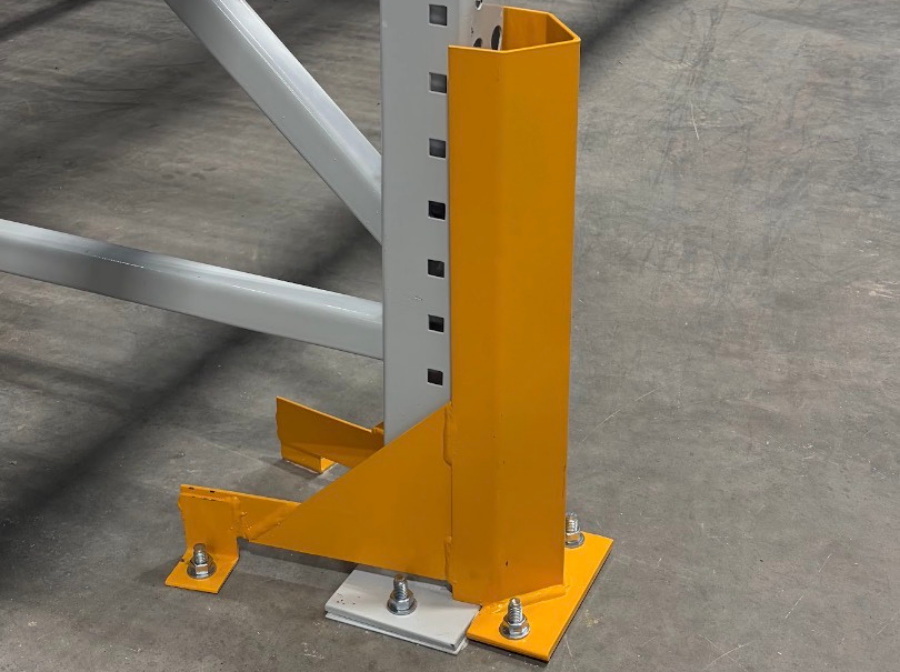
The most common and cost-effective option. It is a device that is placed around the lower section of the vertical post, typically 18 to 22 in. from the ground, which is where forklift forks and the base of the forklift strike the post. Some are bolted to the column, while others are anchored to the floor and surround the post without touching it, allowing the protector to absorb the impact without transferring it to the structure.
If the warehouse has standard forklift traffic, this protector covers most of the impact risk under normal operating conditions.
Battery or End-of-Row Protector
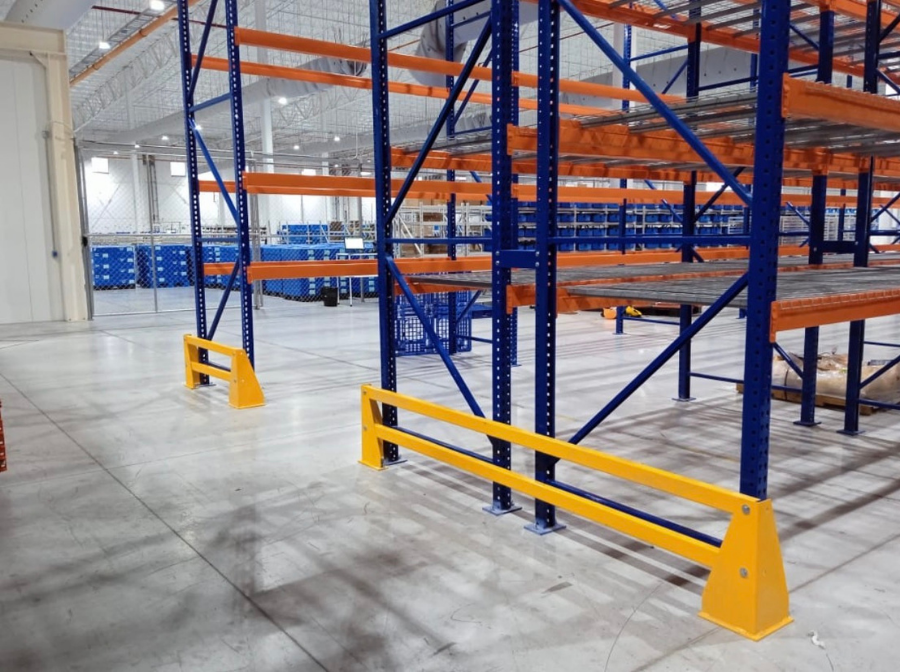
It is installed at the end of each row, where the rack ends and the aisle begins. This is the most exposed area of the system because any vehicle taking a poorly calculated turn will strike there first. It is typically a more robust barrier than the post protector, anchored to the floor, capable of withstanding direct impacts without shifting.
Corner Protector
Covers the points where two rows intersect or where the rack changes direction. It is smaller than a battery protector but equally useful when aisles are narrow and the forklift’s turning radius leaves no room for error.
Perimeter barriers and guardrails
For mixed-traffic zones, where personnel on foot circulate alongside forklifts. The barrier does not protect the column directly; it protects people and inventory located beyond the rack. They are common in industrial pedestrian aisles, manual picking areas, and office zones within the warehouse.
Safety panels and fall-arrest netting
They serve a different function but are part of the same system. They do not absorb impacts, but they prevent goods falling from a higher level from reaching the aisle or personnel. They are recommended in warehouses with pedestrian traffic beneath the racks or when small products are stored without lateral containment.
Materials: Structural Steel vs. High-Density Polyethylene
The two dominant materials address the problem in different ways.
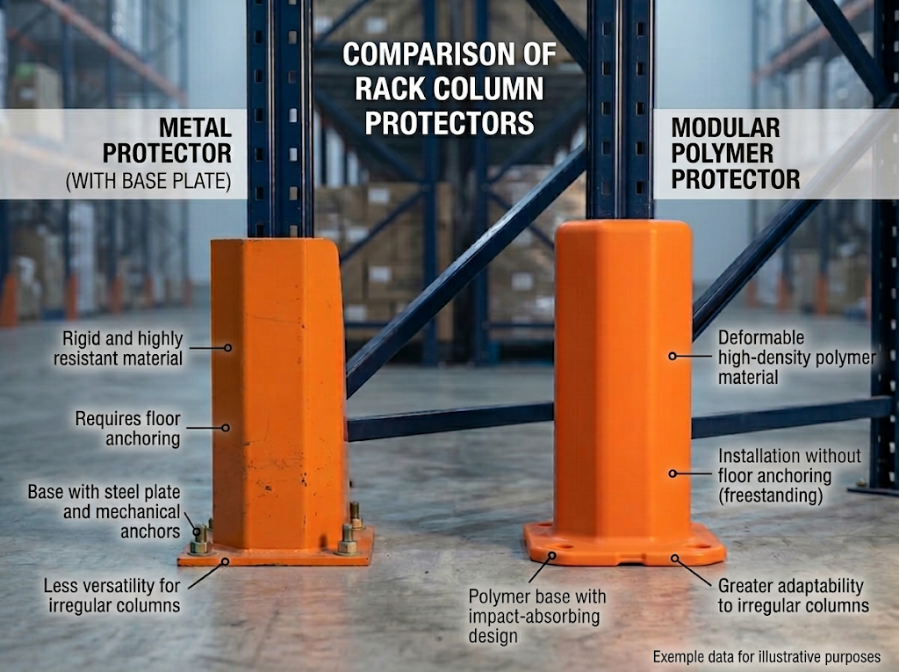
Steel absorbs impact through the controlled deformation of the guard itself. It is the choice for heavy traffic, large forklifts, and operations where an occasional impact is severe. When damaged, the guard is replaced, but the rack remains intact.
High-density polyethylene, also known as HDPE, works elastically: it deforms upon impact and returns to its original shape. It does not require replacement after minor impacts and reduces noise in the warehouse. It works best in areas with medium traffic or when impacts are frequent but low-energy. It also withstands moisture and chemicals better, making it common in cold storage and the food industry.
In practice, a large operation ends up combining the two: steel in critical areas and HDPE in secondary aisles.
How They Reduce Accidents and Operating Costs
The safety argument is the most obvious: fewer direct impacts on the structure mean less risk of collapse, fewer downtime incidents, and fewer injuries to staff. But the financial calculation is usually what seals the deal.
Replacing a damaged rack upright costs between three and eight times as much as the protector that would have prevented the damage. Added to that are costs that are rarely accounted for: the time to relocate the merchandise from the affected row, the interruption of the picking flow, the internal report, and, in serious cases, the structural inspection of the rest of the system. A single pallet drop due to partial collapse can equal the cost of protecting an entire aisle. Risks in warehouses with heavy forklift traffic are concentrated precisely in these areas and rarely give warning before they occur.
Protectors also extend the rack’s service life. A well-protected system can withstand over a decade of use without deformation, even in 24/7 operation. Without protection, deterioration begins to show in less than three years.
How to Choose the Right Protective Guard for Your Operation
Three questions guide the decision.
What type of forklift operates in each area? A conventional counterbalanced forklift impacts differently than a reach truck or a trilateral forklift. The protective guard must be sized for the weight and typical speed of the equipment operating in that area.
What is the traffic frequency in each aisle? Main aisles and the ends of rows account for most impacts. Starting there provides the best return on investment before covering the rest of the warehouse.
Are there pedestrians near the rack? If the answer is yes, protectors alone are not enough: pedestrian barriers and safety panels must also be installed. Structural protection and personal safety are separate issues that should be addressed in parallel.
Installation and Compatibility
Most protectors are anchored to the floor using chemical anchors or expansion bolts, allowing them to be replaced without touching the rack. This is important for two reasons: the protector can be replaced when damaged without affecting the structure, and it can be repositioned if the warehouse layout changes.
Protectors manufactured by RackUSA are compatible with selective, dynamic, push-back, drive-in racks, and structures from most brands on the market. It is not necessary to have racks from the same brand to install them, which makes it easy to reinforce an existing installation without having to replace the entire system. The complete line of industrial rack accessories also includes metal grids, crossbars, safety panels, and pallet stops that are compatible with one another.
Frequently Asked Questions
How many protectors does a warehouse need?
As a minimum guideline, one column protector for each post exposed to forklift traffic and one battery protector at each end of the row. For large operations, it’s worth mapping out critical areas beforehand before requesting a quote, because the correct distribution depends on the layout, the type of equipment, and the traffic flow.
Do the protectors replace rack inspections?
No. The protectors reduce damage, but periodic inspections are still mandatory to detect structural fatigue, loose fasteners, or columns with prior deformation. One does not replace the other.
Can they be installed on a rack that is already damaged?
Yes, but first you must assess whether the affected column retains its nominal load capacity. If it does not, the component is replaced and then the protector is installed. Placing a protector on an already compromised rack hides the problem without solving it.
Related Products
Three product lines that work in tandem with the protectors to complete a secure storage system.
Accessories for Industrial Racks
Protectors are one of seven accessory lines designed to extend the service life of a storage system. Metal grids, crossbars, safety panels, and pallet stops cover the remaining vulnerable points of the rack. RackUSA manufactures all product lines with broad system compatibility, allowing you to reinforce an existing installation without replacing all the equipment.
→ View the complete line of accessories
Selective Racking
This is the most commonly used system in warehouses with forklift traffic, and therefore where protectors make the biggest difference. If you’re evaluating a new rack, it’s worth planning for protection from the system’s design phase—not after the first impact.
→ Learn about selective racking
Installation and inspection services
Before installing protectors on an existing rack, a technical inspection identifies columns with pre-existing damage that should be replaced first. The RackUSA team evaluates the installation, identifies critical points, and recommends what to protect, what to reinforce, and what to replace.
→ Request an evaluation
Get a quote for the protection your warehouse needs
Every warehouse has its own set of critical areas. Our technical team will walk through your facility with you, identify the highest-risk zones, and put together a proposal that includes the right type of protective equipment, materials, and quantities for your operation. No cost, no obligation.
→ REQUEST A QUOTE 
 Racking
 Selective: Roll-Formed
 Selective: Structural
 Cantilever
 Dynamic: Carton-Flow
 Dynamic: Pallet-Flow
 Dynamic: Push-Back
 Pallet Shuttles (CS)
 Mezzanine | Pick Modules (CS)
 Rack Supported Buildings (CS)
 Gravity Conveyor (CS)
 Drive-In | Drive-Thru (CS)
 Shelving
 Shelving: Boltless Tab Rack
 Services