Racking
 Selective: Roll-Formed
 Selective: Structural
 Cantilever
 Dynamic: Carton-Flow
 Dynamic: Pallet-Flow
 Dynamic: Push-Back
 Pallet Shuttles (CS)
 Mezzanine | Pick Modules (CS)
 Rack Supported Buildings (CS)
 Gravity Conveyor (CS)
 Drive-In | Drive-Thru (CS)
 Shelving
 Shelving: Boltless Tab Rack
 Services
Order fulfillment is one of the most cost-intensive operations within the supply chain. Depending on the level of automation and the number of SKUs (Stock Keeping Units) handled by the warehouse, it can account for 45% to 75% of total operating costs. This means that a real improvement in this process translates directly into healthier margins, faster delivery times, and higher customer satisfaction—not just internal productivity.
The most common issue is not that the team underperforms, but that the picking method established when volumes were lower can no longer support current operational demands. This article breaks down how the process works, outlines the primary picking methods available, guides you on selecting the right logistics strategy based on your operational profile, and explains which storage systems drive actual day-to-day performance.
What is Order Fulfillment (Picking)?
Order fulfillment encompasses the entire set of operations through which products requested by customers are selected, picked, and prepared to ensure they are shipped accurately and on schedule. The destination can be an end consumer, another company warehouse, or a production facility.
It is worth clarifying a distinction that is often overlooked: picking and order fulfillment are not the same thing, even though they are frequently used as synonyms. Strictly speaking, picking is the physical extraction of products from a larger load unit to assemble an order. Order fulfillment, on the other hand, is the complete, end-to-end process that includes picking but also encompasses waves planning, warehouse travel, order verification, and final packing prior to shipping. Recognizing this difference helps you pinpoint exactly where your biggest bottleneck lies.
Another critical concept to master is the difference between a load unit (unit load) and an order unit. The former represents how products arrive and are stored in the warehouse: pallets, totes, or master cartons. The latter is the smallest fraction a customer can purchase. A warehouse might receive inventory on pallets of 200 units but sell them in increments of 10. When this fractional breakdown is not properly addressed in industrial racking design or inventory slotting strategy, extraction times skyrocket without anyone linking it to the true root cause.
Key Stages of Order Fulfillment
The fulfillment process generally follows five distinct phases. Rather than just describing them, it is far more valuable to pinpoint where each one commonly breaks down.
1. Order Planning and Wave Management
This is where resources are allocated, orders are grouped, and pick paths are defined. The Failure Point: Without a system that aggregates orders by zone or SKU (order batching), each operator picks one single order at a time. This forces them to make multiple, redundant trips to the exact same locations throughout the day.
2. Travel and Routing
This involves moving through the warehouse aisles to reach the product locations. It is the most time-consuming phase in traditional man-to-goods (person-to-goods) operations. The Failure Point: A poorly designed layout or placing high-velocity items (Class A inventory) far from the shipping docks can double travel times without the operations team realizing it is a fundamental design flaw.
3. Product Extraction
The precise moment an operator retrieves items from the rack. Its efficiency depends heavily on your racking infrastructure, pick-level heights, and accessibility. The Failure Point: Using the wrong storage setup slows down extraction. A selective rack ensures direct, immediate access to any pallet position, while dynamic pallet flow or carton flow systems automatically feed inventory to the pick face using gravity, eliminating manual rehandling.
4. Order Verification and QC (Quality Control)
This step confirms that the picked items perfectly match the customer's order. The Failure Point: Undetected errors here lead to returns, which trigger reverse logistics—the single most expensive cost in the entire operation. Returns require a full logistical re-run: extra labor, return-to-stock inventory management, and a direct hit to customer trust.
5. Packing and Shipping
The final loop: sealing, weighing, labeling, and staging. The Failure Point: An undersized packing or staging area creates a massive bottleneck as order volumes peak, especially during peak seasons or high-demand periods.
Order Picking Methods
The methods are not interchangeable. Each one caters to a completely different operational profile, and choosing the wrong one has direct consequences on the warehouse's operational efficiency and its ability to scale the operation without increasing errors.
Discrete picking (Order-by-order) is the most basic modality: the operator fulfills a single, complete order before starting the next one. It works well for large orders with few SKUs where the travel time is justified. It does not scale when handling hundreds of small daily orders because it forces repetitive trips to the exact same locations.
Zone picking divides the warehouse into physical areas of responsibility. Each operator manages the products stored within their zone and picks only the items corresponding to that section of the order; these fractions are later consolidated. This method minimizes travel time but requires a post-picking consolidation phase and careful balancing between zones to avoid operational bottlenecks.
Batch picking groups multiple orders into a single picking route. All items needed for the batch are extracted at once and then sorted and assigned to their respective orders. This drastically reduces total travel time, but if the sorting zone is not well-organized, error rates increase, erasing the time saved on the warehouse floor.
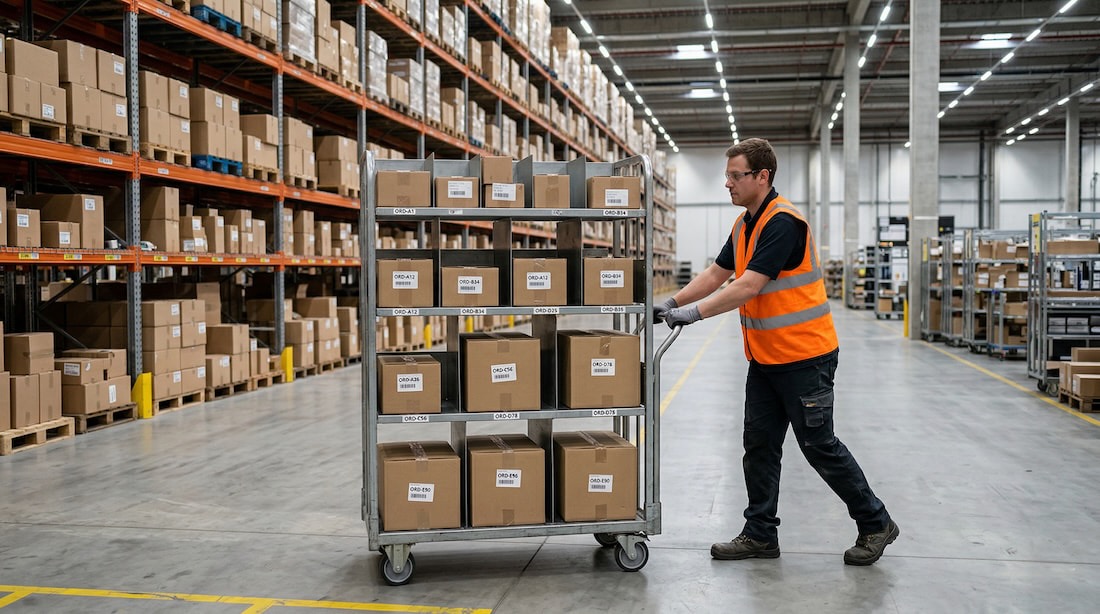
Pick-to-cart is a variation of batch picking that solves that specific sorting issue. The operator moves with a picking cart configured with individual totes or slots—one for each concurrent order. During the route, products are placed directly into the assigned slot for that order, eliminating the need for post-picking sorting. This is one of the most efficient methods for warehouses with a high volume of small-to-medium orders and does not require an upfront investment in automation to be implemented.
Goods-to-person (G2P) reverses the logic: the inventory moves to the operator at the fulfillment station via automated systems, conveyors, or AS/RS (Automated Storage and Retrieval Systems). Automated warehouses operating under this principle virtually eliminate all travel time. While the upfront capital investment is higher, for high-volume operations handling spikes from e-commerce, Black Friday, and social commerce, the return on investment (ROI) is realized rapidly.
Cross-docking is a special case: incoming merchandise is directed straight to the shipping docks with little to no intermediate storage. This requires precise synchronization between inbound and outbound flows, as well as real-time tracking of inventory in transit. Learn more about how cross-docking works in detail.
Which Storage System Best Empowers Your Picking Operation?
This is the most overlooked point in order fulfillment analysis, yet it is where you can achieve the highest efficiency gains without investing in expensive automation.
Selective racking is the backbone of most warehouses requiring direct access to all pallets. It allows immediate access to every position, which facilitates rapid product extraction. Combined with a pick-to-cart methodology and an optimized layout, it is a rock-solid solution for operations handling hundreds of daily orders across a wide variety of SKUs.
Pallet flow racks and carton flow systems utilize gravity to advance products to the front of the rack, ensuring they are always ready to be picked. Operators do not need to rearrange inventory or reach deep into the rack to access the correct item. They are ideal for high-density, high-rotation picking zones, and their FIFO (First-In, First-Out) logic makes them perfect for date-sensitive products. In warehouses with many fast-moving SKUs, these specialized industrial racks can reduce extraction times more than almost any other process adjustment.
An industrial mezzanine multiplies the warehouse's usable vertical square footage without expanding its footprint. In operations handling many low-volume products across a high number of SKUs, distributing storage locations across multiple vertical levels with dedicated picking zones on each floor significantly cuts down on horizontal travel time. Managing workflow between levels requires strategically placed forklifts, vertical lifts, or conveyors to prevent creating new operational bottlenecks.
One of the logistical best practices with the highest immediate impact on any storage setup is ABC inventory slotting: Class A items, which have the highest rotation, must be placed in the most accessible positions—at the operator's ideal picking height and close to the shipping area. Moving these high-velocity products from the back of the warehouse to the front zone can reduce travel times by up to 30% without changing your racking infrastructure or fulfillment methods. If you want to dive deeper into how to structure a warehouse by zones and inventory turnover, this article provides a step-by-step guide.

The Picking Cart: Variables That Matter
A poorly chosen cart limits even the best order fulfillment method. The technical variables are much more relevant than they are typically given credit for.
Load capacity defines how many concurrent orders an operator can transport in a single trip. A cart with four shelf levels and a 450 lb (200 kg) capacity allows an operator to work on four parallel orders; a basic two-level cart cuts that efficiency in half. The width of the cart must be compatible with aisle dimensions: a 28-inch (70 cm) cart in a 36-inch (90 cm) aisle creates friction that slows down internal logistics.
The configuration of the compartments matters just as much as the number of shelves. If products vary greatly in size, fixed uniform shelves lead to wasted space and the mixing of items between individual orders. Systems with adjustable dividers or separate totes for each order significantly reduce slotting and picking errors.
Ergonomics also count. An operator working in order fulfillment can walk between 6 and 12 miles (10 to 20 kilometers) per shift. A heavy-rolling cart, lacking adjustable handles, or equipped with casters that do not pivot well around corners, leads to cumulative fatigue. This translates directly into picking errors and injury risks—two consequences that no logistics strategy should accept as inevitable.
Technology to Support the Process
Warehouse Management Systems, known as WMS, centralize inventory data and coordinate order fulfillment tasks in real time. They automatically group orders by zone or SKU, optimize pick paths, and prioritize tasks based on operational criteria. Tools like Easy WMS are examples of this type of software, which connects inventory management with the physical operation of the warehouse, allowing for data-driven decisions rather than estimates. You can learn more about how technology is driving warehouse optimization in this article.
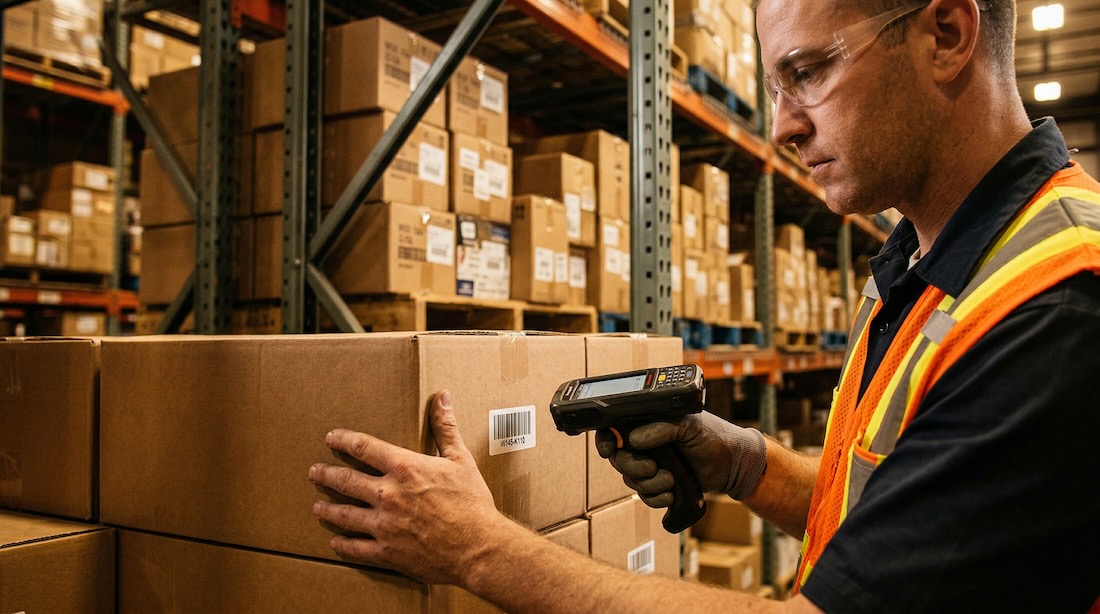
RF (Radio Frequency) technology, utilizing barcode scanners or wearable mobile computers, is one of the most widely adopted tools for verification during manual picking. It confirms in real time that the retrieved item perfectly matches the current order, delivering an immediate positive impact on order accuracy rates. Its deployment does not require fully automating the warehouse or incurring a massive upfront capital investment.
Safety During Order Fulfillment
Order fulfillment carries one of the highest accident rates within warehouse operations. The most frequent risks include collisions between carts and forklift traffic in aisles lacking clear separation, product falls due to improper extraction from higher racking levels, overloaded carts, and ergonomic issues from forced postures when picking from bottom rack levels.
Measures that mitigate these risks include: designating clear traffic lanes and directions in aisles to separate pedestrian traffic from forklifts, establishing and visibly posting weight limits for each cart, positioning the heaviest products at waist or chest level (the golden zone) to prevent bending down to the floor or reaching above the shoulders, and rotating personnel across high-intensity picking zones. Check out the primary warehouse risks and how to prevent them for further details.

Key Performance Indicators (KPIs) for Order Fulfillment
Managing fulfillment without measuring it is operating completely blind. The key performance indicators that provide real insights into how your picking logistics are performing are the following:
Order lines per hour directly measures operator productivity. A warehouse using traditional manual man-to-goodspicking typically handles between 60 and 100 lines per hour; a well-implemented pick-to-cart system can easily exceed 150 lines.
Picking accuracy rate is the percentage of orders fulfilled flawlessly without errors. Falling below 99.5% is an immediate red flag, signaling that your quality control verification process or location signage requires attention.
Order cycle time measures the total time elapsed from the moment an order is generated until it is completely ready for shipping. This is the most useful metric for identifying exactly which fulfillment stage is causing a bottleneck.
Cost per order (CPO) encompasses labor, error corrections, rehandling, and returns. This is the definitive financial figure that justifies or rules out any capital investment in upgrading industrial racking or switching picking methodologies. To understand how to calculate this in relation to complete shipments, the OTIF (On-Time, In-Full) metric offers a complementary perspective.
Return rate due to picking errors isolates quality issues from the rest of the fulfillment process. If this rate spikes, the root cause is almost always found in the verification phase or slotting identification, rather than operator travel speed.
When to Shift Methodologies
The picking method that works seamlessly for 50 orders a day can quickly become a massive bottleneck at 500 orders. The warning signs that your current order fulfillment system has been outgrown are clear: escalating cycle times despite maintaining the same headcount, error rates that climb alongside order volume, redundant trips to identical locations during the same shift, and overcrowded staging areas. Operations tackling demand spikes driven by e-commerce, last-mile logistics, or peak seasonal rotation are especially vulnerable to these issues.
Transitioning from discrete picking (order-by-order) to batch picking or a pick-to-cart system generally does not require purchasing new racking infrastructure or making an upfront investment in automation. Instead, it involves re-engineering the process, deploying proper picking carts, and auditing product slotting based on actual inventory turnover. When you start by diagnosing a specific logistical problem, selecting the right methodology becomes significantly easier.
Making the leap toward automated warehouses or goods-to-person systems is a much larger capital expenditure (CapEx) decision. It is justified when your order throughput is high enough, and inventory complexity or SKU variety can no longer be efficiently managed via manual methods. Before taking that step, a precise diagnostic of your current layout and processes usually reveals that there are still lower-cost, high-impact optimizations left to exploit.