
Pallet racking gets discussed constantly in warehouse planning conversations, but the version that actually moves the needle for most operations is selective pallet racking. It's not flashy. It won't win any density awards. But it shows up every single day in picking speed, safety, and how well your team can actually use the space you have.
This article breaks down why selective racking remains the industry default and what that means for your bottom line.
TL;DR
- 100% SKU accessibility: every pallet reachable without moving another
- Lowest installation and maintenance cost among major racking types
- Works with standard forklifts, no specialized equipment needed
- Best for medium-density storage where speed beats maximum cube usage
- Custom-fit selective racking from RackUSA, backed by 50+ years of manufacturing
What Is Selective Pallet Racking?
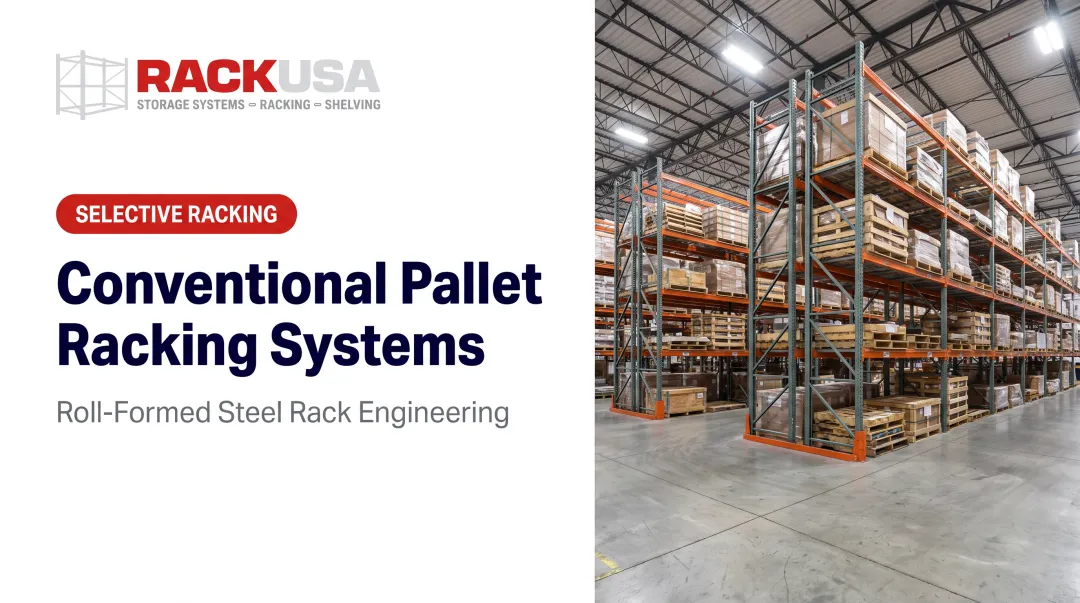
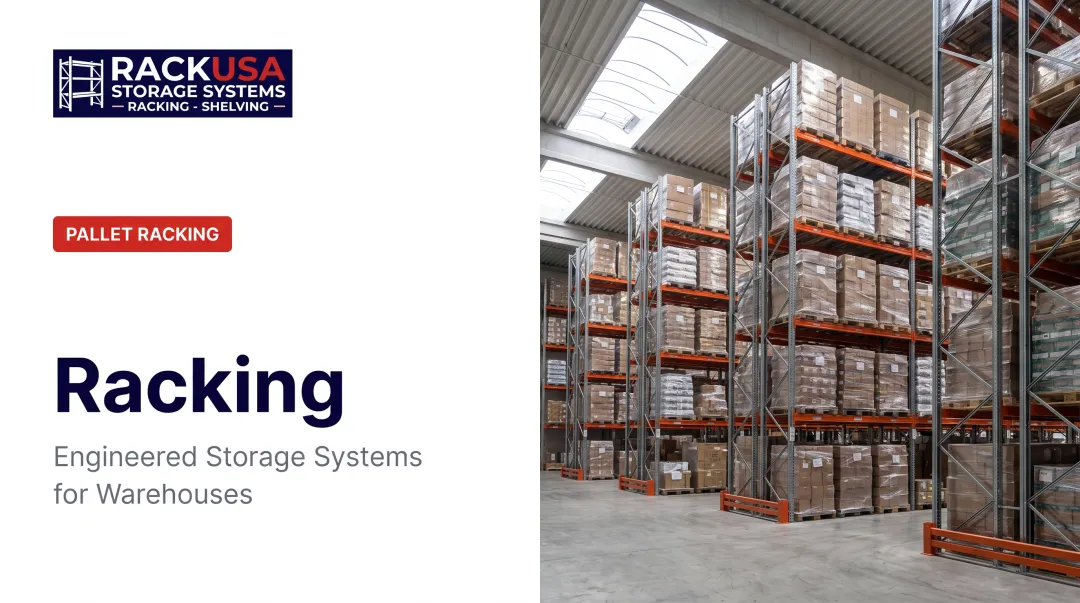
Selective pallet racking is a simple structure built from three parts:
- Vertical uprights that form the frame
- Horizontal beams that set each load level
- Open bays that give direct access to every pallet
You reach any pallet without digging through rows or shuffling other loads first.
You'll find it in retail distribution centers, e-commerce fulfillment hubs, manufacturing plants, and general warehousing. It is not the highest-density option on the market. Drive-in and push-back systems pack more pallets per square foot. For most businesses, selective racking still balances speed, flexibility, and cost better than denser systems.

Key Advantages of Selective Pallet Racking
These advantages map directly to warehouse KPIs: throughput, cost per pick, accuracy, and safety incidents. That's why selective racking has stayed the industry standard for decades.
Complete SKU Accessibility and Faster Picking
Every pallet position in a selective system stands independently accessible. No moving other loads to reach the one at the back.
This matters more than it sounds. A peer-reviewed literature review found that order picking can consume up to 55% of total warehouse operating expense. That's over half your labor budget tied to how fast people can find and grab product.
High-density systems like drive-in racking create a problem called honeycombing: empty storage locations that can't be used because they're blocked by other pallets ahead of them in the lane. Selective racking eliminates that entirely. Every slot is either full or genuinely available.
KPIs impacted:
- Order picking speed
- Labor cost per pick
- Inventory accuracy
- Order fulfillment time
This advantage matters most for facilities juggling high SKU variety, frequent replenishment cycles, or strict FIFO/LIFO rotation requirements, including e-commerce fulfillment centers where next-day shipping is standard.

Cost-Effective Installation and Adaptability
Selective racking's structure is straightforward: uprights and beams, no inclined rails, no nested carts, no motorized components. That simplicity translates directly into lower total cost of ownership.
Compare that to denser alternatives. Drive-in racking eliminates access aisles to pack in more pallets but requires back-to-front loading and sacrifices selectivity. Push-back and pallet-flow systems add mechanical components (rails, carts, roller lanes) that increase both upfront cost and long-term maintenance.
RackUSA's selective systems use beam-level positions adjustable at roughly 2-inch increments, so reconfiguring for a new pallet size or inventory profile doesn't mean tearing anything out.
A typical configuration (96" wide × 42" deep × 240" high with 4.5-inch beams) supports around 35,000 pounds overall, with capacity calculated per project based on actual load and warehouse height.
KPIs impacted:
- Capital expenditure
- Installation time
- Equipment costs
- Reconfiguration downtime
This matters most for growing businesses, seasonal inventory shifts, or any facility without the budget (or need) for automation.
Improved Safety and Organizational Control
Open-frame racking gives your team clear sightlines. Compare that to pallets stacked haphazardly on the floor, and the difference in visibility and organization is obvious.
Warehousing is not a low-risk industry. BLS reported a 2024 total-recordable incident rate of 4.8 cases per 100 full-time workers in warehousing and storage. Organized SKU zoning through proper racking reduces mislabeling, misplaced pallets, and forklift collision risk, all common contributors to that number.
OSHA's material handling standard, 29 CFR 1910.176, requires clear and maintained aisles, secure and stable storage, and housekeeping that prevents storage-area hazards. Selective racking's open layout supports all three by design.
KPIs impacted:
- Incident/injury rate
- Compliance audit pass rate
- Inventory shrinkage/damage rate
This advantage matters most in high-traffic, multi-shift warehouses or any facility preparing for a safety audit. RackUSA supports safer layouts through engineered load-capacity verification and turnkey installation as part of its project services.

Selective Pallet Racking vs. Other Racking Systems
Choosing a racking system means balancing accessibility against storage density. Your inventory profile—SKU mix, turnover rate, and pick frequency—determines the right fit.
| System | Access | Density | Best Fit |
|---|---|---|---|
| Selective | Direct access to every pallet | Lower (needs more aisle space) | Diverse SKUs, frequent turnover |
| Drive-In | Single entry, back-to-front (LIFO) | High (up to 2x selective capacity) | Large quantities, uniform product |
| Push-Back | Load/unload from one aisle (LIFO) | Medium-high (typically 2–6 pallets deep) | Consolidated lots, moderate turnover |
| Pallet-Flow | Gravity-fed lanes (FIFO) | High (20+ pallets per lane) | Perishables, FIFO-sensitive inventory |
Selective racking wins when SKU variety and picking speed matter more than maximum density—for example, mixed-SKU lanes with daily picks rather than deep reserves of one SKU.

What Happens When Racking Selection Is Ignored
Skipping proper racking design or grabbing whatever system is cheapest upfront tends to backfire. Common consequences:
- Wasted floor space from oversized aisles or mismatched beam heights
- Slower fulfillment and more picking errors from poor layout
- Higher collision risk as forklifts navigate awkward or cluttered paths
- Expensive reconfiguration when inventory needs shift and the system can't adapt
- Scaling headaches as growth outpaces a poorly planned original layout
None of these show up on day one. They compound quietly until someone finally asks why fulfillment times keep creeping up.
How to Get the Most Value from Selective Pallet Racking
Selective racking delivers its best ROI when a few things happen upfront:
- Match beam height and spacing to your actual pallets. Guessing at dimensions leads to wasted vertical space or overloaded levels.
- Inspect racks regularly. Damage caught early is a repair. Damage caught late is a safety incident.
- Work with an experienced provider for layout and engineering. Skip generic assembly jobs that skip proper design.
RackUSA's engineering process starts with a facility assessment: clear height, load requirements, forklift type, and growth plans. Custom engineering then factors in seismic design under RMI guidelines.
Standard selective systems typically run 1-3 tons per level, with final numbers calculated against actual pallet weights and building conditions. Installation is coordinated to minimize disruption, even in active warehouses already running full shifts.
Conclusion
Selective pallet racking earns its place as the industry default because it solves the problems warehouses face every day: accessing product fast, keeping costs manageable, and adapting as inventory changes. None of that is glamorous, but it's what keeps orders moving.
The advantages compound when the system is planned correctly from the start—correct beam heights, rated load capacity, and proper anchoring. Selective racking isn't a one-time purchase you install and forget. It's an operational asset that returns more value when you design and maintain it well.
Before you buy, match the layout to real load data and SKU velocity—not just the lowest quote per upright.
Frequently Asked Questions
What are the benefits of selective pallet racking?
The top three: full accessibility to every SKU, lower installation and equipment cost than high-density alternatives, and easy adaptability as pallet sizes or inventory profiles change.
Does pallet racking need to be bolted down?
Most jurisdictions and manufacturer guidelines require anchoring racks to the floor for stability. OSHA's 1910.176(b) requires stored material to remain secure against sliding or collapse, so anchoring specs should come from your rack's engineered design.
What is the primary advantage of a push-back racking system?
Push-back offers high-density LIFO storage, typically 2-6 pallets deep from one aisle. It trades accessibility for density—the opposite tradeoff selective racking makes.
How much does selective pallet racking cost compared to other systems?
Selective racking generally has the lowest installation and equipment cost among major racking types, thanks to its simple structure and compatibility with standard forklifts.
What is the maximum height for selective pallet racking?
Single units commonly range from 6 to 32 feet, though actual limits depend on ceiling height, load capacity, forklift reach, and local building codes.
How do I know if selective racking is right for my warehouse?
It fits best for businesses with diverse SKUs and frequent picking needs. A facility assessment is the most reliable way to confirm the right system for your operation.