
E-commerce sales hit $1,192.6 billion in 2024, up 8.1% from the year before, now making up 16.1% of all retail sales in the U.S., according to Census Bureau data. That growth doesn't disappear once a package ships. It lands somewhere first: a warehouse, a distribution center, a fulfillment hub. And every one of those facilities needs somewhere to put inventory before it moves.
Get racking wrong, though, and the problems stack up fast. Wasted floor space. Slower picking. Workers navigating cramped aisles around unstable loads. This guide breaks down what racking actually is, the main system types, how to choose between them, and what keeps a rack system safe for years, not just months.
Key Takeaways
- Racking uses vertical space to store more product without expanding your building footprint
- Selective racking maximizes access; drive-in and pallet flow trade access for density
- Match the system to SKU count, turnover rate, and facility layout
- Inspections and proper anchoring keep racks standing after forklift impacts
- Bundled engineering, installation, and support simplifies the full project
What Is Racking? (Meaning & Definition)
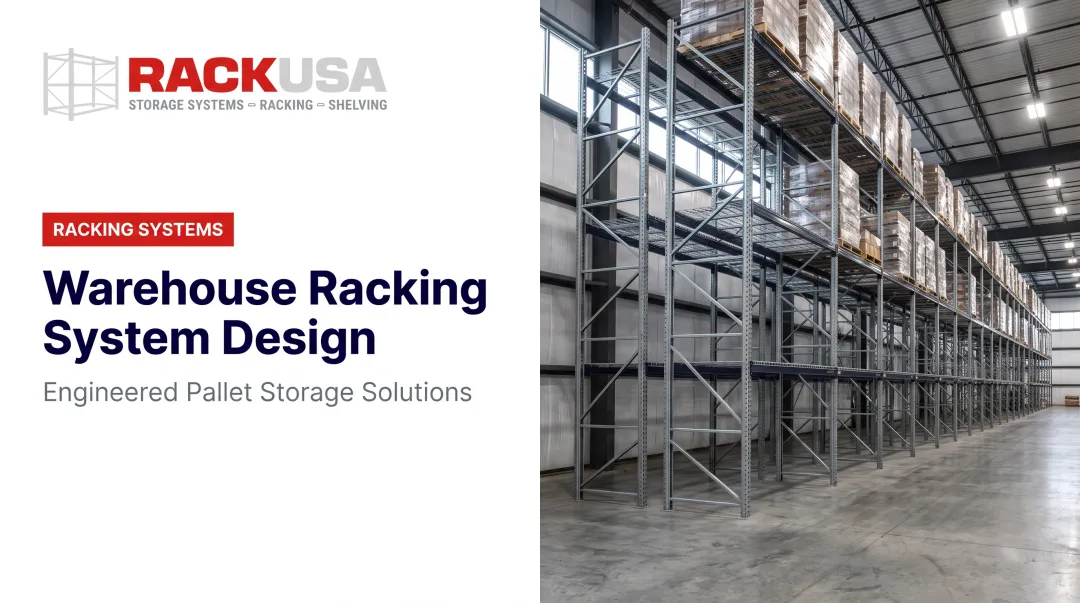
Racking is a structured storage system built from vertical upright frames and horizontal load beams, designed to stack palletized or heavy goods several levels high. Think of it as a skeleton for your inventory: steel columns and beams that turn empty air above your floor into usable storage.
Racking vs. Shelving: What's the Real Difference?
People use these terms interchangeably, but they're built for different jobs. The Rack Manufacturers Institute draws a clear line: rack is typically forklift-loaded and often carries pallet loads of 1,000 lb or more.
Shelving is usually hand-loaded. Boltless shelf units generally stay under that threshold, and bin shelving handles around 50 lb per square foot or less.
| Racking | Shelving | |
|---|---|---|
| Access | Forklift-loaded | Manually loaded |
| Typical load | Heavy palletized loads (often 1,000+ lb) | Lighter duty (bin shelving ~50 lb/sq ft or less) |
| Governing standard | ANSI MH16.1 | ANSI MH28.2 (boltless) or MH28.1 (bin) |
The Core Components of a Rack System
Every rack, regardless of type, relies on a few structural pieces:
- Upright frames – vertical columns that bear the load
- Load beams – horizontal supports connecting frames and holding pallets
- Decking – wire mesh or wood panels that support smaller loads or prevent pallets from shifting
- Bracing – diagonal supports that add lateral stability
- Footplates – base connectors that anchor the frame to the floor
How those pieces are built determines capacity and service life. RackUSA manufactures its systems from hot-rolled and heavy-gauge structural steel, with wire mesh decking rated up to 2,000 lb per shelf level when paired with bulk rack shelving.

Key Benefits of a Well-Designed Racking System
A racking system does more than hold pallets. Done right, it changes how a warehouse operates.
It Turns Vertical Space Into Usable Capacity
Warehouse space isn't cheap. U.S. industrial rent averaged $9.94 per square foot in Q1 2024, up 8.2% year-over-year, according to JLL data reported by Facilities Dive. Every square foot you use vertically is a square foot you don't have to lease or build.
High-density systems push this further. Push-back racking can boost storage capacity by up to 90% compared to traditional selective racks. Drive-in and drive-through configurations can double storage density by eliminating aisles altogether.
It Speeds Up Picking
Selectors spend roughly 55% of their time traveling between picks, not actually picking, according to NetSuite's warehouse efficiency research. Organized, well-labeled racking cuts that travel time. On the floor, that usually means:
- Fewer wrong turns between pick faces
- Fewer mispicks from unclear slotting
- Faster order fulfillment overall
It Supports Safety and Inventory Control
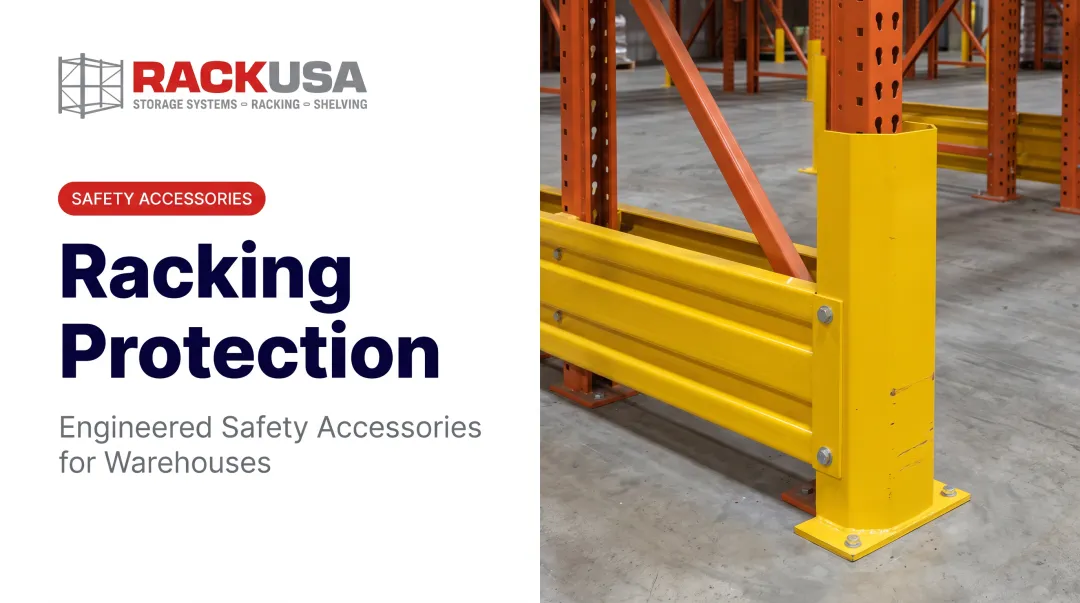
Properly anchored racking with correct load ratings protects people and product at the same time:
- Reduces the risk of tip-overs, collapses, and injuries
- Supports structured flow methods such as FIFO or LIFO
- Keeps stock from sitting unnoticed until it expires
Types of Racking Systems Explained
Not every warehouse needs the same rack. The right type depends on inventory turnover, SKU count, and how much floor space you're willing to trade for density.
Selective Pallet Racking
This is the most common racking type you'll see in distribution centers, and for good reason. Forklifts get direct access to every single pallet through open aisles.
- Best for: High-SKU inventories with frequent turnover
- Pros: Full accessibility, easy reconfiguration, works with almost any forklift
- Cons: Lower storage density than high-density alternatives, since aisles eat up floor space
Drive-In and Drive-Through Racking
Forklifts drive directly into the rack structure instead of accessing pallets from an aisle.
- Drive-in: Single entry point, LIFO retrieval (last pallet in, first out)
- Drive-through: Entry and exit at opposite ends, enabling FIFO retrieval
Both suit high-volume storage of uniform products, like cold storage warehouses stacking pallets of the same SKU. The trade-off? Lower pallet selectivity in exchange for up to 2× the density of selective racking.
Push-Back Racking
Pallets sit on inclined rails or nested carts. Load a new pallet, and it pushes the one behind it back. Retrieval works in reverse, LIFO style.
- Stores 2 to 6 pallets deep per lane
- No wide aisles required
- Ideal for bulk storage where product doesn't need strict rotation
Pallet Flow (Gravity Flow) Racking
Gravity does the work here. Pallets load at the high end of an inclined lane and roll slowly to the pick face on skate wheels or rollers, creating automatic FIFO rotation.
- Automatic FIFO—oldest stock reaches the pick face first
- Best for perishable or date-sensitive inventory
- High density with continuous lane replenishment
High-Density and Mobile/Pallet Shuttle Systems
Mobile racking sits on motorized bases that roll along floor tracks, opening one working aisle at a time while keeping direct pallet access everywhere else.
Pallet shuttle systems go further: an electric shuttle travels inside deep lanes, moving pallets while the operator stays at the lane entrance.
RackUSA's Matador pallet shuttle system is built for this. It's available in 2D (single-axis movement) and 4D (longitudinal and transverse movement) configurations, running semi-autonomously or fully autonomously. Features include:
- Self-charging electric shuttles
- Pallet measurement, weighing, and scanning before entry
- FIFO and LIFO inventory management
- Integration with WMS, WCS, and WES platforms
Specialty Racking: Cantilever, Mezzanines & Rack-Supported Structures
Some inventory doesn't fit standard pallet dimensions.
- Cantilever racking: Arms extend from columns to hold long, bulky items like pipes, lumber, or steel profiles, with no vertical uprights blocking the load
- Mezzanines and pick modules: Multi-level platforms that can nearly double usable operating space within an existing footprint
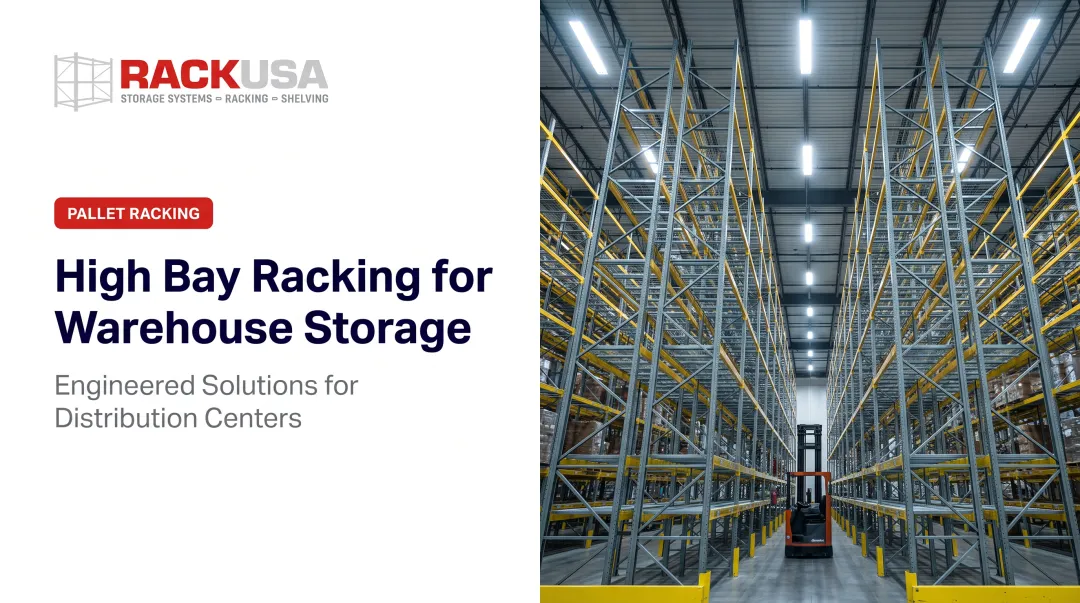
- Rack-supported buildings: The rack structure itself supports the roof and walls, common in high-bay facilities exceeding 30 feet

How to Choose the Right Racking System for Your Facility
Picking a rack system means matching four variables to your operation. Get one wrong, and the whole system underperforms.
Start With Your Inventory
- Pallet size and weight determine beam capacity requirements
- SKU count points toward selective (high SKU diversity) or high-density (fewer SKUs, more volume per SKU)
- Turnover rate dictates FIFO versus LIFO needs
Then Look at Your Facility
Physical constraints decide which configurations are even viable:
- Floor space and footprint limit overall layout options
- Clear height — a 40-foot facility supports configurations a 20-foot warehouse can't
- Column spacing affects bay layout and usable beam lengths
- Floor load capacity caps how much weight you can place per square foot
Factor In Operations
- Forklift type (reach truck, counterbalance, order picker) sets reach limits and minimum aisle needs
- Aisle width trades storage density against travel speed and access
- Throughput needs determine whether fast selective access matters more than maximum cube utilization
Budget and ROI
Pricing varies widely by system. Industry benchmarks put single-deep selective racking materials at $50 to $200 per pallet position, double-deep around $80 to $300, and gravity-flow systems between $150 and $450, according to Speed Rack West's pricing breakdown. These figures exclude installation and vary with steel pricing, seismic requirements, and customization.
High-density systems cost more upfront but reduce long-term leasing or expansion costs, since you're storing more product in the same footprint. RackUSA's pricing runs quote-based, scoped around your specific pallet type, aisle configuration, and project volume rather than a flat catalog price.
Don't Skip Engineering and Compliance
Seismic zone requirements changed meaningfully with ANSI MH16.1-2021, which introduced a direct analysis method for rack design, later adopted into IBC 2024. That means structural load analysis isn't a formality anymore in many regions.
Working with a manufacturer that bundles in-house engineering, facility layouts, seismic analysis, and PE-stamped drawings keeps compliance inside the same scope as the rack design. You avoid splitting structural sign-off across multiple vendors for one installation.

Racking Safety, Installation & Maintenance Best Practices
A rack system is only as safe as its installation and upkeep. Solid anchors, posted load limits, and routine checks prevent most avoidable rack failures.
Installation Basics
- Confirm level flooring before setup begins
- Use proper anchor bolts rated for your slab and seismic zone
- Follow manufacturer torque specifications exactly, not "close enough"
Ongoing Inspection
OSHA's 1910.176 standard requires stable storage and clear, maintained aisles. It does not explicitly mandate rack anchors or load plaques.
ANSI/RMI standards cover what OSHA leaves open. They require load capacity plaques of at least 50 square inches that list:
- Unit load
- Level load
- Total bay load limits
Inspection frequency isn't fixed by regulation. The Rack Manufacturers Institute notes that practice ranges from monthly to annual, scaled to traffic and load severity. Look for:
- Bent or dented uprights
- Loose or missing bolts
- Corrosion, especially in cold storage or high-humidity environments
Any impact from a forklift warrants an immediate inspection, regardless of your regular schedule.
Training and Upkeep
Train staff on habits that protect people and equipment:
- Proper load distribution across beams and bays
- Safe forklift navigation around rack structures
- Prompt reporting of damage after any contact
As inventory needs shift, plan periodic repair or reconfiguration rather than letting an outdated layout create bottlenecks.
Partnering with an Experienced Racking Manufacturer
Coordinating a rack project across separate design firms, installers, and maintenance vendors eats up time and creates gaps where accountability disappears. A single manufacturer handling design, engineering, installation, and ongoing support closes those gaps.
RackUSA has manufactured storage systems since 1972 from Gómez Palacio, Durango, Mexico. The company operates offices and warehouses across the U.S. and Mexico, with representation in Guatemala, El Salvador, and Costa Rica. That cross-border footprint gives companies with facilities on both sides of the border one point of contact instead of separate regional vendors.
Credentials that support facility decisions:
- MHI R-Mark certification under Certification No. 5190
- Compliance with ANSI MH16.1-2023 for cold-formed steel racking
- Seismic engineering built into designs based on location, load, and structural geometry
If you're weighing which system fits your facility, a direct facility assessment surfaces issues that generic guides can't. Request a consultation before committing to a configuration.
Frequently Asked Questions
What is racking?
Racking is a structured, multi-level storage system built from upright frames and horizontal beams. It's engineered to store palletized or heavy goods vertically in warehouses and distribution centers.
What are the different types of racking?
The main types are selective, drive-in/drive-through, push-back, pallet flow, and mobile and other high-density systems, such as pallet shuttles. The right choice depends on your inventory turnover, SKU count, and available floor space.
What is the difference between racking and shelving?
Shelving is designed for manually handled, lighter-weight items and is hand-loaded. Racking is engineered for heavier, forklift-loaded palletized goods, typically carrying loads of 1,000 lb or more.
How much weight can a pallet rack hold?
Load capacity depends on the specific design, materials, and engineering specifications of each system. Always check the posted load-rating plaque on your rack before loading, since capacity isn't universal.
How often should racking be inspected for safety?
There's no single fixed interval mandated by OSHA or RMI. Industry practice ranges from monthly to annual inspections, with immediate checks required after any forklift impact or visible damage.
Can racking systems be customized for specific industries?
Yes. Systems can be configured for dimensions, load ratings, and coatings used in cold storage, pharmaceuticals, manufacturing, and automotive parts handling.