
Introduction
Walk into almost any warehouse in North America and you'll find the same steel skeleton holding up the operation. Trade publications call single-deep, selective rack the most common type used in warehouses and distribution centers, and for good reason: it's simple, adaptable, and works with nearly any forklift already on the floor.
Familiarity breeds complacency, though. Many businesses default to conventional racking without exploring its full range of configurations, sizing options, or safety obligations. That gap shows up later as wasted floor space, mismatched beam capacities, or OSHA violations nobody caught during a walkthrough.
This guide breaks down what conventional pallet racking is, the components that make it work, where it beats other storage systems, and what compliance requires.
Whether you're specifying a first warehouse layout or auditing an existing one, you'll leave knowing when selective racking is the right fit—and when it isn't.
Key Takeaways
- Selective racking gives direct, single-pallet access to every SKU without moving other loads first.
- Lowest cost per pallet position of any racking type—often $80 to $120 for equipment alone.
- Teardrop-style beam connections allow tool-free height adjustments as inventory changes.
- OSHA enforces rack safety through general industry rules; ANSI MH16.1 fills the engineering gap.
- Hybrid layouts pairing selective racking with high-density systems often balance access and density best.
What Is a Conventional Pallet Racking System?
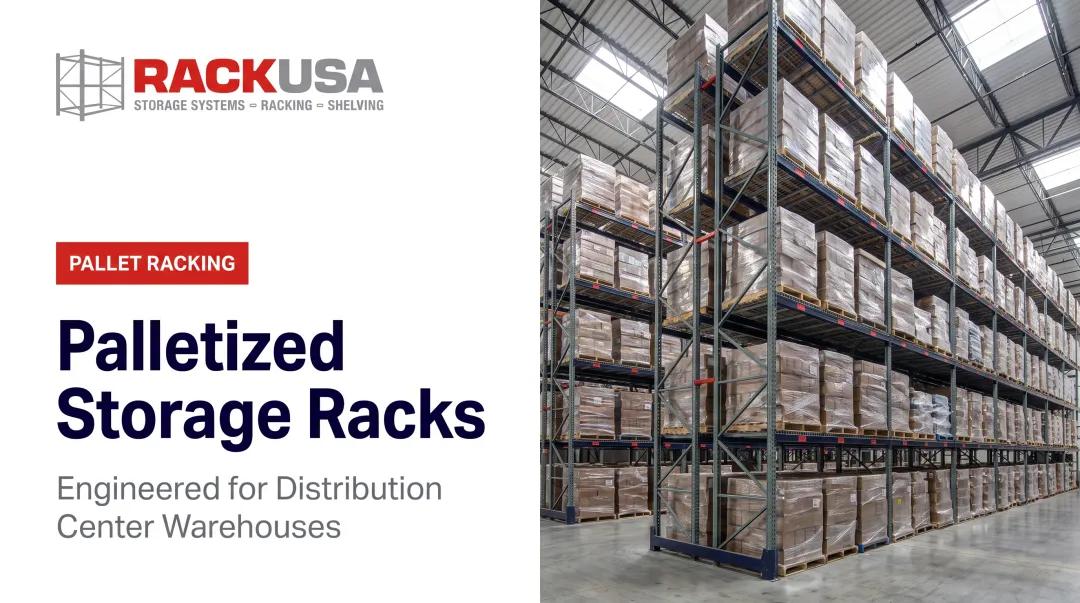
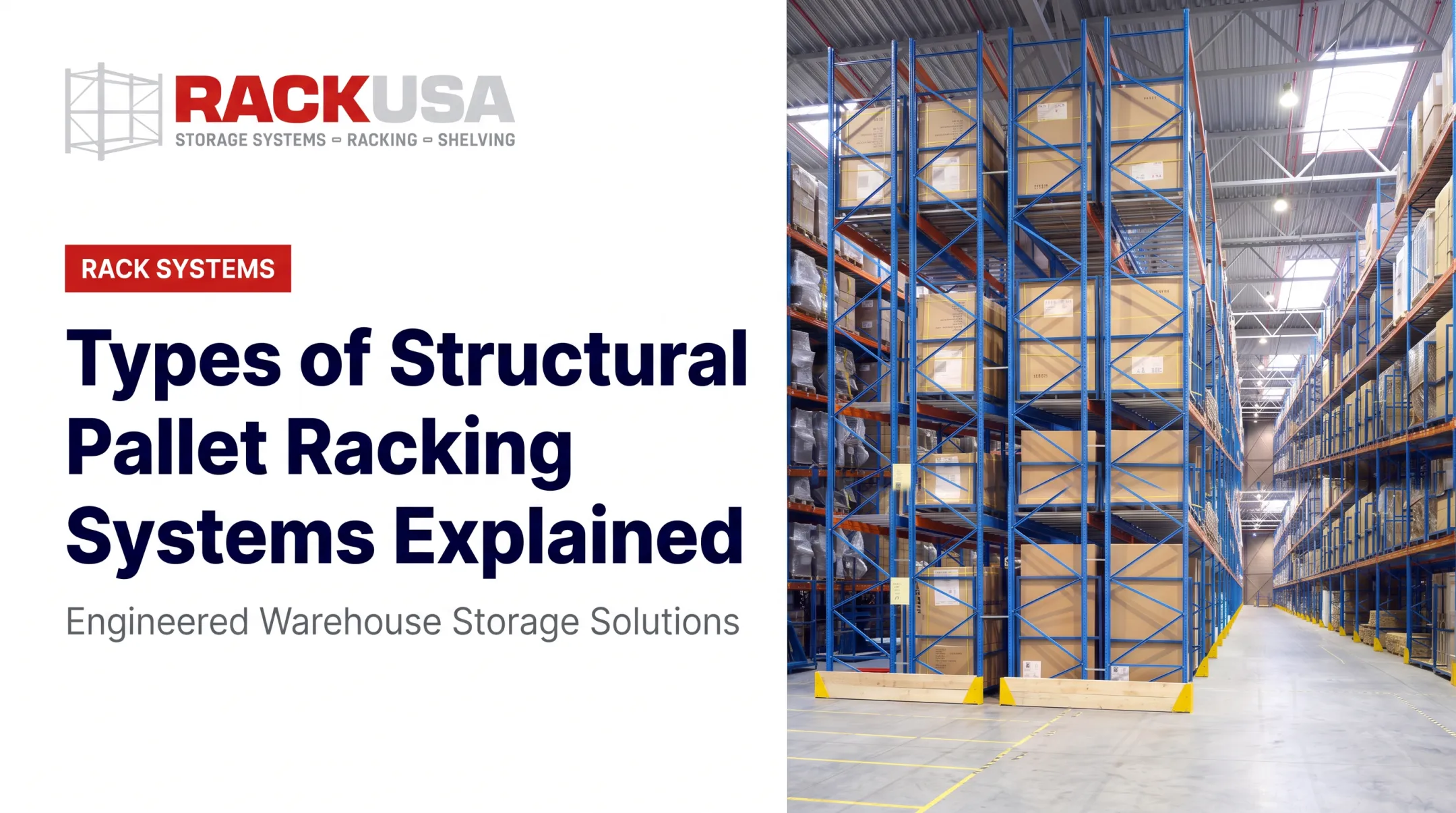
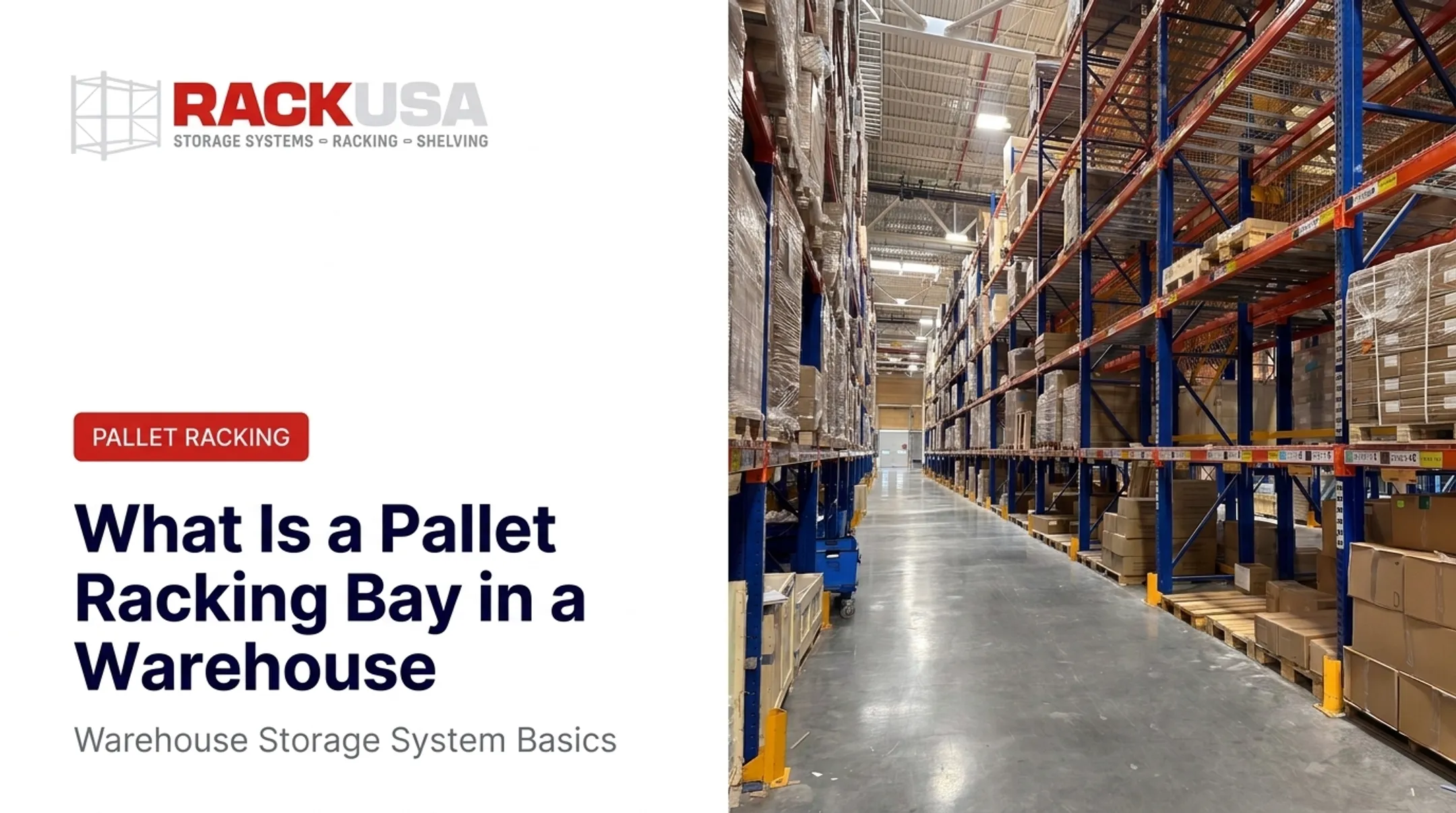
Conventional pallet racking, also called selective or adjustable pallet racking, consists of vertical steel upright frames connected by horizontal beams. Pallets sit directly on those beams, one level at a time, one pallet deep.
The defining feature is direct access. A forklift operator drives into the aisle and pulls any pallet from any bay without shifting other loads out of the way first.
That sets it apart from high-density systems like drive-in or pallet flow racking, which trade some immediate accessibility for packing more pallets into the same footprint.
Selective rack is also among the most flexible configurations available. It handles:
- Mixed pallet sizes and weights within the same row
- Frequent SKU changes without reconfiguring the entire structure
- Wide SKU mixes without forcing a full system redesign
That flexibility fits general warehousing, manufacturing staging areas, and retail backroom storage alike.
Why Businesses Default to Conventional Racking
Most new warehouse layouts start with selective racking, and it's rarely a bad instinct. The system is straightforward to install, costs less per pallet position than nearly every alternative, and works with any standard counterbalance, reach, or narrow-aisle forklift already on site. No specialty equipment required.
Calling it the "basic" option undersells it. For facilities managing dozens or hundreds of SKUs with moderate turnover, selective racking isn't a placeholder until something denser comes along. It's the long-term answer. Operations with high SKU diversity tend to outgrow high-density systems fast, while selective rack keeps scaling with them.
Core Components and How Conventional Racking Works
Every selective rack system breaks down into a handful of core parts:
- Upright frames – vertical steel posts joined by horizontal and diagonal bracing, forming the structural backbone
- Footplates (baseplates) – anchor the frame to the concrete floor
- Horizontal beams – step-style or box-style beams that span between frames and support pallets
- Wire decking or shelf panels – rest on the beams to support pallets or loose cartons

The Teardrop Connection
Most manufacturers, RackUSA included, use a teardrop-style connection. Beams end in hooks that clip into teardrop-shaped punched holes along the upright frame. No bolts, no tools—just lift, angle, and drop the beam into place.
That tool-free fit is why beam heights can be raised or lowered in minutes when pallet sizes or inventory needs change, without rebuilding the rest of the structure.
Safety Accessories Every Installation Needs
A bare frame-and-beam setup isn't a finished installation. Every conventional racking layout should also include:
- Corner guards and upright protectors to absorb forklift impacts
- Safety pins or locks that keep beams seated under load
- Stop beams or pallet stops to prevent loads from sliding off the back
- Wire mesh decking to stop cartons or pallets from falling through open beam bays
Certification and Structural Standards
Not all racking is manufactured to the same standard, and that gap doesn't show up until something fails. Racking certified under MHI's R-Mark program, which RackUSA holds, confirms that design, manufacturing, and installation practices meet ANSI MH16.1 requirements for load ratings and structural integrity.
RackUSA's Selective Roll-Formed Racking line, built from cold-rolled steel at its Gómez Palacio, Durango facility, ships in a standard boltless configuration or a single-piece welded frame for sites with heavier forklift traffic or seismic exposure.
Engineering accounts for the site’s seismic zone, total system load, and the geometry of uprights, beams, and connectors so resistance is designed into the structure from the start. Generic, uncertified rack can’t match that same load-rating accuracy.
Advantages of Conventional Pallet Racking
Lowest Cost Per Pallet Position
Selective rack wins on cost. New equipment typically runs $80 to $120 per pallet position, compared to $220 to $400 for push-back rack and $550 to $850 for pallet flow systems, according to a 2026 cost breakdown from integrator Hammerhead.
That pricing covers standard hardware only; installation, engineering, and permitting are quoted separately. The gap between selective and high-density systems still holds across most projects, thanks to simpler installation and no specialty equipment.
Full Access Without Sacrificing Density
Selective racking flexes to fit varied pallet weights and shapes in the same row. It can add density—double-deep bays or auxiliary picking shelves at lower levels—without giving up direct aisle reach to every pallet.
That access eliminates honeycombing: the wasted, half-filled slots that pile up in drive-in lanes where only the front pallet is reachable. FIFO and LIFO both work freely because nothing blocks a position. Pickers and forklift operators skip the shuffle of pulling pallets aside, so travel time drops, fulfillment speeds up, and stock audits disrupt less of the floor.

RackUSA's structural selective line supports those double-deep and lower-shelf setups in the same system category, so you gain depth or ground-level picking without switching rack types.
Selective racking excels when a facility has:
- A high SKU count with moderate turnover per SKU
- General warehousing or distribution needs
- Manufacturing staging areas requiring frequent pallet swaps
- Retail backroom storage with mixed inventory
Layouts Matched to the Facility
No two buildings share the same load, clearance, and throughput mix. Matching pallet weights, aisle widths, and forklift types to the real floor plan beats a generic spec-sheet layout on ROI.
RackUSA folds that work into the rack project—facility design, seismic and structural load analysis, and PE-stamped drawings bundled with the system—so the configuration fits the building instead of forcing the building to fit a standard kit.
Standard Sizes and Dimensions for Conventional Pallet Racking
Three measurements define every selective rack bay: upright height, upright depth, and beam length. Together they set how many pallets fit per bay and how many levels stack vertically.
Common size ranges include:
- Upright depth: 36 to 48 inches (42 inches fits standard 48-inch-deep pallets)
- Upright height: About 8 to 20+ feet, based on ceiling clearance, sprinklers, and HVAC setbacks
- Beam length: 96 to 144 inches, for one, two, or three pallets side by side per level
- Frame height steps: Often offered in 4-inch increments in vendor product guides
Beam capacity, rated in pounds per pair, is not a single fixed number. It shifts with beam gauge, profile height, and unsupported span between frames, so two racks with the same beam length can carry very different loads.
These ranges reflect common manufacturer offerings, not one mandated industry standard. Standard selective racking generally handles 2,200 to 6,600 lb per level, while structural heavy-duty racking is rated higher. RackUSA engineers each system to the project's actual pallet dimensions, load per level, and clear warehouse height rather than defaulting to a fixed size chart.
Conventional Racking vs. Other Storage Systems
Conventional Racking vs. Shelving
Pallet racking and shelving solve different problems:
- Pallet racking: Engineered for palletized loads handled by forklifts, cranes, or shuttle carts, with heavy-gauge steel frames built to carry thousands of pounds per level
- Shelving: Designed for hand-stacked, individually picked items—lighter loads, solid shelf decks, and no forklift access required
Trying to use one for the other's job usually fails fast.
Conventional Racking vs. High-Density Racking Types
Drive-in, push-back, pallet flow, and double-deep racking all trade some direct access for greater storage density.
| System | Access | Best for |
|---|---|---|
| Selective | Every pallet, anytime | High SKU count, mixed inventory |
| Double-deep | Two pallets deep | Two pallets per SKU, moderate density |
| Drive-in | Front pallet only | Single-SKU, high-volume, LIFO |
| Push-back | Last-in accessible first | Multi-pallet SKUs, LIFO density |
| Pallet flow | Load rear, pick front | High-volume FIFO |
Most real warehouses aren't purely one or the other. A common approach pairs selective racking for high-turnover SKUs with a high-density system for bulk, slow-moving stock. That mix delivers speed where it matters and density where it doesn't hurt picking.
RackUSA manufactures both ends of that spectrum: selective, double-deep, drive-in, push-back, and pallet flow. Designing a hybrid layout is more straightforward when you are not juggling multiple vendors' specs. Getting that split right is exactly where a layout consultation earns its keep.
Safety Standards, OSHA Compliance, and Ongoing Maintenance
OSHA doesn't publish a single dedicated "pallet racking standard." Rack safety instead falls under general industry provisions: 29 CFR 1910.176 covers material storage and aisle clearance, while 1910.22 addresses housekeeping and walking-working surfaces. OSHA also points to ANSI MH16.1, developed by RMI, as the national consensus standard for rack design and load-rating. That standard is referenced guidance, not an OSHA regulation in itself.
Staying compliant comes down to a handful of consistent habits:
- Post load capacity signage on every bay so operators know exactly what a level can hold
- Run regular rack inspections to catch bent beams, cracked welds, or loose connectors early
- Repair damaged components promptly rather than leaving a compromised bay in service
- Keep aisles clear at widths matching the forklifts operating in them

The Damage Nobody Notices Until It's a Problem
Forklift strikes are the leading cause of rack damage. Even a minor hit can affect a beam, an anchor, or a front column without an obvious sign at floor level.
That's why routine inspections matter more than a one-time check at install. Damage builds quietly, and no single interval fits every site—traffic volume, load frequency, and forklift activity all factor in.
Long-term compliance isn't a one-time purchase decision. RackUSA manufactures selective racking to RMI/ANSI MH16.1 standards and bundles engineering, installation, and technical support with system purchases, so facilities can keep storage aligned with OSHA-referenced practices over the rack's working life—not only on day one.
Frequently Asked Questions
What are the different types of pallet racking?
Beyond conventional/selective racking, common types include double-deep, drive-in/drive-thru, push-back, pallet flow, and cantilever racking. Most trade some direct access for higher density; cantilever is built for long or bulky loads.
What is the difference between pallet racking and shelving?
Pallet racking handles heavier, forklift-loaded palletized goods on a heavy-duty steel frame. Shelving is built for lighter, manually handled, individually picked inventory.
What size is standard pallet racking?
Upright depths commonly range from 36 to 48 inches, with heights from 8 to 20+ feet. Beam lengths typically run 96 to 144 inches, though exact sizing depends on pallet dimensions and facility clearance.
What is the OSHA standard for pallet racking?
OSHA enforces rack safety through general industry provisions like 1910.176 and 1910.22, referencing ANSI/RMI MH16.1 as the design consensus standard. There's no single OSHA regulation written specifically for pallet racking.
How much weight can conventional pallet racking hold?
Capacity depends on upright gauge and height plus beam length and profile; there's no universal number. Manufacturer-rated load capacities should always be posted on the rack and never exceeded.
Is conventional pallet racking the right choice for my warehouse?
Conventional racking is ideal for operations managing many SKUs that need frequent, direct access to every pallet. If storage density or automation needs are higher, consulting a provider like RackUSA for a layout assessment helps confirm the best fit.