
That labor adds up fast. Industry estimates suggest picking can account for as much as 55% of total warehouse operating costs, according to Georgia Institute of Technology data cited by DC Velocity. Choosing the right picking system directly affects how fast you ship and how much it costs you to do it.
This article breaks down the major picking system types, how to choose between them, and how your racking and storage layout either supports or sabotages your picking strategy.
TL;DR
- Picking systems control how items are located, retrieved, and staged—and that drives labor cost and speed
- Core types: discrete, batch, zone, wave, cluster, and automated picking
- Match the method to order volume, SKU variety, layout, and budget
- Storage design — racking, shelving, pick modules — directly shapes picking efficiency
- Most warehouses run a hybrid of strategies, not a single method
What Is a Warehouse Order Picking System?
A warehouse order picking system is the combination of methods, technology, and layout used to select and retrieve items for orders. It covers far more than workers pulling items off shelves by hand.
It covers two things working together:
- The strategy: how orders are grouped, sequenced, and routed
- The infrastructure: racking, carts, pick-to-light systems, robotics, and the physical layout that supports movement
It is an operational system tied directly to your storage design, not a standalone labor task. Change your racking configuration and you change what picking strategies are even possible.
Why Order Picking Systems Matter for Warehouse Efficiency
Picking errors, wasted travel time, and poor layout choices cost real money and frustrate customers.
Research shows travel time alone can eat up more than 50% of total order-picking time, according to a systematic literature review on picker routing. That's half your labor budget spent walking, not picking.
As SKU count and order volume grow, the problems compound:
- Congestion in high-traffic aisles slows everyone down
- Mis-picks increase when layouts aren't intuitive
- Customer dissatisfaction rises with slower, less accurate fulfillment
Where Storage Design Comes In
Well-engineered storage cuts travel distance and improves accessibility before you ever touch a picking strategy.
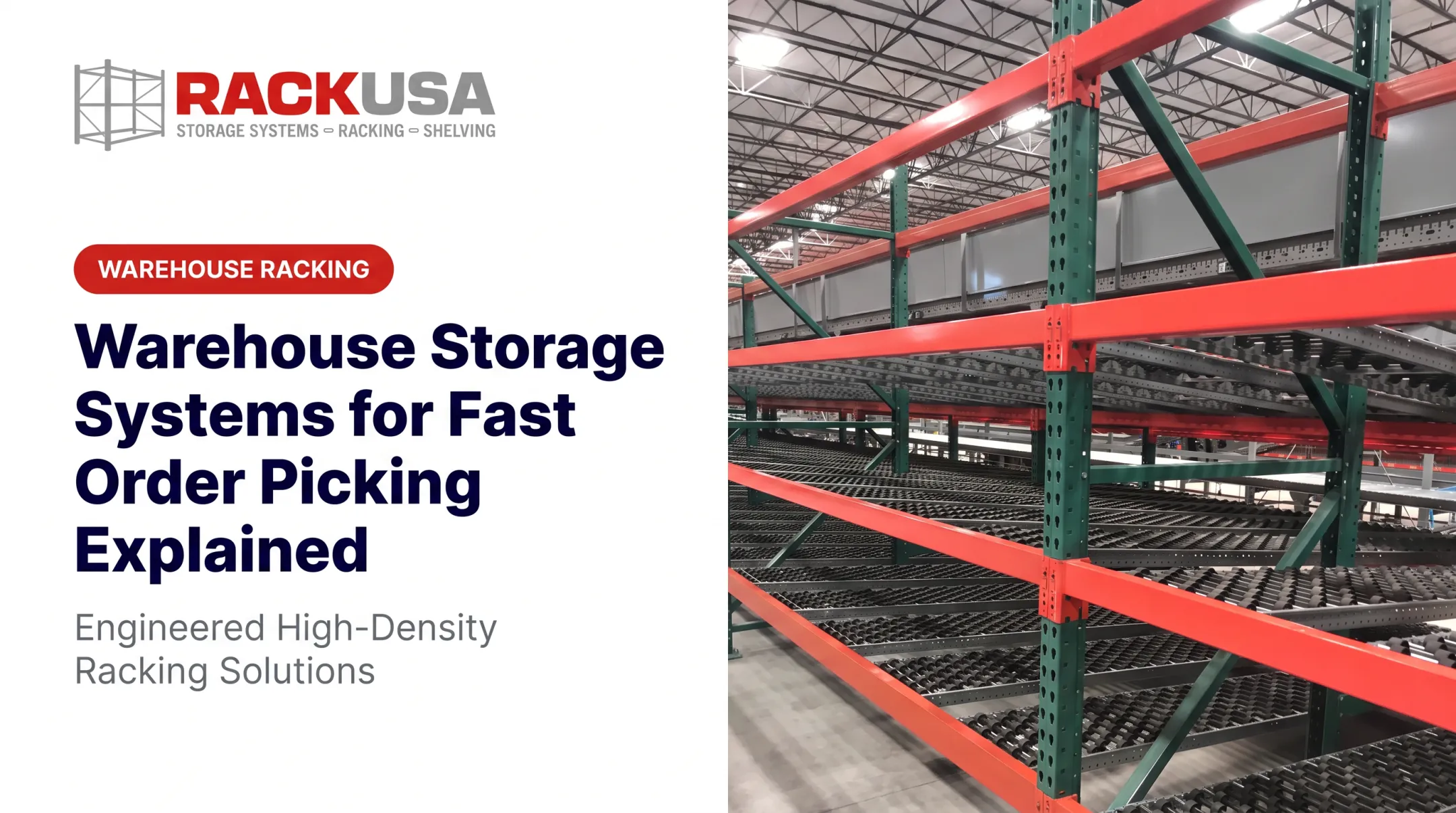
RackUSA's Carton-Flow racking, for example, uses gravity-fed lanes that keep cartons moving toward the pick face automatically. Products stay at the front of the rack, so pickers travel less to reach them and FIFO rotation stays intact.
When storage already shortens travel paths, every picking method you layer on top works faster and with fewer errors.
Types of Warehouse Order Picking Systems
Picking systems range from simple manual methods to fully automated technology. The right fit depends on your order profile and warehouse scale. Most operations end up blending several types into a hybrid approach.

Discrete (Single Order) Picking
One picker completes one order at a time, retrieving all items before moving to the next. The picker follows a single pick list and travels sequentially through storage locations.
It's the simplest, most linear method: no batching, no grouping.
- Best for: Small warehouses, low order volume, or high SKU diversity per order
- Strengths: High accuracy, minimal training required
- Trade-offs: High travel time; doesn't scale well as order volume climbs
Batch and Cluster Picking
Batch picking has one picker collecting items for multiple orders in a single pass using a consolidated list. Cluster picking does the same thing but uses separate bins per order on a multi-bin cart.
Both group orders with overlapping SKUs or locations to cut repeat trips.
- Best for: High-volume operations with overlapping SKUs, like e-commerce fulfillment
- Strengths: Reduced travel time, higher throughput per labor hour
- Trade-offs: Batch picking requires a sorting step afterward; cluster picking needs specialized carts; both need solid WMS coordination
RackUSA's Carton-Flow racking pairs naturally with this style of picking. Gravity-fed lanes keep individual cartons accessible at the pick face, which matters when pickers are grabbing multiple SKUs per trip instead of one order at a time.
Zone and Wave Picking
Zone picking assigns pickers to fixed warehouse areas; orders pass between zones as they're built. Wave picking schedules groups of orders for coordinated picking and shipping based on priority or deadlines.
One organizes picking around geography. The other organizes it around time.
- Best for: Large distribution centers with high SKU counts, multiple pick zones, and time-sensitive shipping
- Strengths: Less congestion, familiar zones for pickers, synchronized picking and shipping
- Trade-offs: Requires a strong WMS; order tracking gets more complex across zones and waves
Technology-Assisted and Automated Picking
This category covers pick-to-light, voice-directed picking, autonomous mobile robots (AMRs), robotic arms, and automated storage/retrieval systems (AS/RS). Instead of pickers walking to goods, many of these systems bring goods to the picker (known as goods-to-person picking).
Results can be significant. DHL Supply Chain deployed 100 Locus Robotics AMRs in health-care fulfillment and reported 50% fewer errors, 60% shorter order cycle time, and 90% less worker training time, per DC Velocity. That's one case, not a universal guarantee, but it shows the ceiling.

- Best for: High-volume operations, large facilities, businesses prioritizing long-term labor savings
- Strengths: High accuracy, strong throughput, scalability, less physical strain on workers
- Trade-offs: Higher upfront investment, integration complexity, and manual handling may still be needed for oversized or irregular items
How to Choose the Right Order Picking System
The right system depends on your order profile and facility constraints — not what's trending or what a competitor uses.
Key factors to weigh:
- Order volume and SKU variety — more overlap between orders favors batching; more diversity favors discrete picking
- Warehouse size and existing racking infrastructure — your layout may already dictate what's feasible
- Budget — plan for equipment, software, and training before you commit
- Accuracy requirements — match the system to your service-level commitments
- Growth projections — will this system still work at double your current volume?
- Labor versus automation — tight labor markets push more operations toward automation sooner
RackUSA's engineering team typically evaluates SKU count, rotation predictability, required storage density, and load weight when recommending infrastructure.
Carton-flow supports individual box picking with gravity rollers that present product at the front face. Selective racking gives direct access to every pallet and suits high SKU counts or unpredictable rotation.
Supporting Your Picking Strategy with the Right Storage Infrastructure
Picking efficiency depends as much on how storage is organized as on which picking method you choose. You can implement a perfect batch-picking strategy on paper, but if your racking forces pickers to zigzag across the warehouse, you've lost the advantage.
Solutions that reduce travel distance and improve accessibility include:
- Pallet-flow racks — gravity-driven FIFO for full pallets, ideal for high-turnover or date-sensitive inventory
- Pick modules — elevated work levels that integrate picking areas with conveyors and existing racking
- Mezzanines — can double or triple usable warehouse area without expanding the building footprint
- Carton-flow systems — keep individual cartons accessible at the pick face with minimal picker movement

Those systems only pay off when the layout matches the picking method you run every day. RackUSA starts with an on-site assessment of workflow, product rotation, and space constraints. The team then builds a layout, including pick modules and rack-supported structures, matched to the strategy you have already chosen.
Turnkey work typically covers design, installation, rack labeling, guard rails, and post-installation support.
What to Check Before Finalizing Your Picking System
Before you commit, check these common missteps:
- Don't jump to full automation. A simpler batch or zone system may already meet current needs. Automation solves specific bottlenecks; it is not a default upgrade.
- Account for the full cost curve. Maintenance, training, and software licensing add up over time, beyond the initial equipment purchase.
- Confirm your racking supports the method. Zone picking fails when the layout lacks clean zone boundaries.
- Base decisions on your own order profile. A competitor's SKU mix and volume may look nothing like yours.
Conclusion
Order picking is one of the biggest drivers of warehouse cost and customer satisfaction. Get it wrong, and everything downstream slows down. No single system fits every operation. Most facilities land on a hybrid approach matched to their volume, layout, and budget.
Pairing the right picking strategy with well-engineered storage, whether carton-flow racking, pick modules, or a full mezzanine build-out, delivers the biggest efficiency gains. Those two decisions were never really separate to begin with.
Frequently Asked Questions
What are the different order picking methods used in warehouses?
The main types are discrete, batch, cluster, zone, wave, and automated/technology-assisted picking. Most warehouses combine several methods rather than relying on just one.
What is the most effective warehouse picking system?
There's no single "best" system. Effectiveness depends on your order volume, SKU variety, and budget. Automation tends to pay off most at higher volumes.
How does racking layout affect order picking efficiency?
Poorly planned racking increases travel distance and creates congestion in high-traffic aisles. Systems like pallet-flow racking or pick modules improve accessibility and cut down unnecessary movement.
Can small warehouses benefit from automated picking systems?
Yes. Basic technology like pick-to-light or voice-directed picking can help smaller operations. Full automation (AS/RS, AMR fleets) is usually reserved for higher-volume facilities where the investment pays back faster.
How do I know when to upgrade from manual to automated picking?
Watch for rising order volume, climbing error rates, or persistent labor shortages. These signals usually mean it's time to evaluate automation.
What role does a WMS play in order picking?
A warehouse management system coordinates pick lists, routes, and task assignments across whatever strategy you're using (discrete, batch, zone, wave, or automated). It's the coordination layer that makes hybrid strategies actually work.