
Introduction
Picture a 15,000-square-foot stockroom where pallets stack three-high on the floor because every rack bay is already full. A forklift driver squeezes between two rows, clips a beam, and now you're waiting on a repair crew before the next truck arrives.
That scenario plays out daily in small warehouses and retail backrooms across the country.
Large distribution centers chase maximum storage density with narrow aisles and automated retrieval systems. Small warehouses face a different problem: less square footage, tighter budgets, and inventory mixes that shift constantly. What works in a 200,000-square-foot DC rarely fits a 20,000-square-foot facility.
This guide covers the racking types that actually make sense at a smaller scale, how to choose between them, standard sizing you'll encounter, layout strategies, and what installation and safety compliance really require.
Key Takeaways
- Selective pallet racking suits most small warehouses with varied SKUs and limited quantities of each
- Cantilever racks handle long or bulky items without eating up aisle space
- Vertical storage (taller uprights, mezzanines) usually beats horizontal expansion when floor space is fixed
- Anchor bolts and load plaques are required for safety compliance
- New, custom-sized racking often reduces long-term compatibility risk compared to mixed used lots
Best Types of Warehouse Racking Systems for Small Warehouses
Small warehouses need racking that balances accessibility, cost, and vertical use of space. Floor space is the limiting factor here, not total volume, so the tradeoffs differ from those in a sprawling fulfillment center.
Selective Pallet Racking
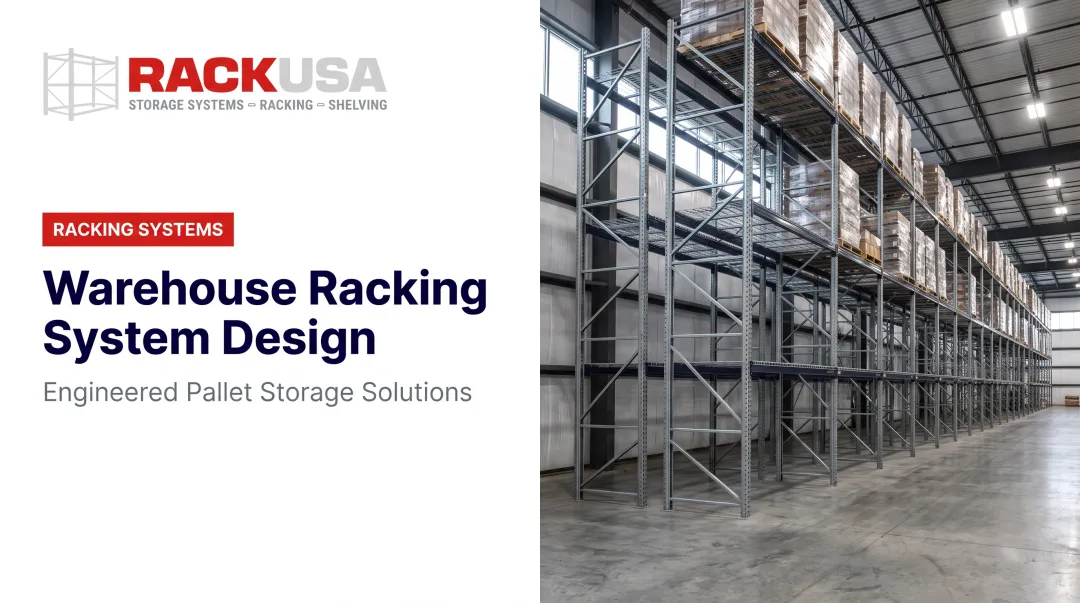
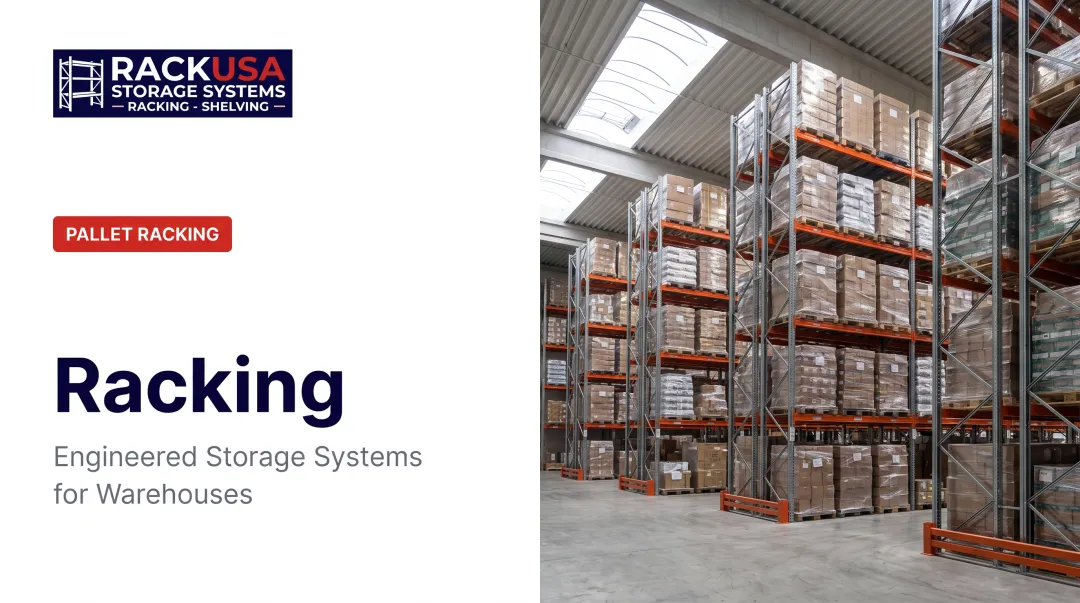
Selective rack is the default choice for most small operations, and for good reason. Every pallet position stays directly accessible, meaning no digging through rows to find what you need. It's also the easiest system to reconfigure as your inventory mix changes.
This matters most for businesses juggling many different SKUs in modest quantities, a common profile in small retail distribution or light manufacturing supply rooms. You're not moving pallet-loads of one product; you're managing dozens of smaller lots that need fast retrieval.
RackUSA's roll-formed selective racking uses a screwless beam-to-frame connection, which lets warehouses adjust shelf levels without special tools or major downtime. That flexibility counts for a lot when your product mix shifts seasonally.
Cantilever Racking
Lumber, pipe, tubing, furniture: anything long or awkwardly shaped doesn't fit neatly into a standard pallet bay. Cantilever racking solves that with open arms extending from a central column, so there's no upright blocking horizontal access.
Key advantages for tight spaces:
- No front columns to obstruct loading or forklift access
- Arms adjust to different lengths and load capacities on the same frame
- Available in single-sided (against a wall) or double-sided (aisle) configurations
RackUSA's cantilever systems handle capacities from roughly 1,100 pounds up to several tons per arm, depending on bracing and column configuration. That range covers everything from light trim stock to heavy structural steel.
Narrow-Aisle and Double-Deep Racking
Reducing aisle width or storing pallets two deep instead of one adds real density without expanding the building footprint. Double-deep racking, for instance, stores pallets two deep on single-sided rows or four deep on double-sided rows.
The catch: narrow-aisle layouts typically require reach trucks or specialized turret equipment instead of standard counterbalanced forklifts. That's an added equipment cost small operations need to weigh against the extra storage they'd gain.
Vertical Storage and Mezzanines
When your floor space is fixed, going up is often the most cost-effective way to add capacity. That might mean taller uprights, a rack-supported mezzanine, or a dedicated pick module.
RackUSA's mezzanine and pick-module systems are self-supporting steel platforms that add a full work level above the existing floor without civil engineering changes to the building itself. Depending on layout, they can double or even triple usable operational area.
They can also incorporate picking zones, offices, conveyors, and existing shelving underneath—useful when you need capacity without a larger footprint or a full building project.

How to Choose the Right Racking System for a Small Warehouse
The right system depends on a handful of concrete inputs, not gut feel. Get these wrong and you'll be redesigning within a year.
Ceiling height and vertical clearance. How tall can your uprights realistically go, and can the building support a mezzanine load? This determines whether vertical storage is even on the table.
SKU count and pallet characteristics. More distinct SKUs generally favor selective racking, since you need direct access to everything. High-volume, single-SKU operations lean toward denser systems like double-deep or flow racks.
Aisle width and forklift compatibility. This is where a lot of small warehouses get tripped up. Standard counterbalanced forklifts need wide turning aisles. Reach trucks can work in aisles as narrow as 7 feet, according to Toyota Material Handling, but that figure depends entirely on the truck model and load size, not a universal rule.
Before locking in a layout, check the actual aisle-width spec sheet for the equipment you plan to run.
Budget and growth planning. Choose a connector type and layout that allows for easy expansion later. A modular, screwless connection system, like RackUSA's roll-formed selective rack, lets you add bays or adjust beam heights as the business grows instead of a fixed configuration from day one.
Working with an experienced manufacturer on a custom layout that accounts for building columns, dock doors, and future expansion helps avoid a costly redesign down the road. RackUSA bundles facility layout and engineering with product projects, including structural load analysis and seismic review matched to your space and budget.
Standard Warehouse Racking Sizes and Dimensions
Most rack sizing starts with the pallet you're storing. The standard GMA pallet measures 48 by 40 inches, and that dimension drives everything else about frame depth, beam length, and spacing.
Common configurations you'll run into:
| Dimension | Typical range | Notes |
|---|---|---|
| Frame depth | 36"–48" | Roughly pallet depth minus 6 inches |
| Beam length | 8', 9', 10', 12' | Based on pallet width and spacing needs |
| Upright height | 6'–32' | Set by ceiling clearance and load; small warehouses often stay toward the lower end |
As a reference point, RackUSA's typical selective-rack configuration runs 96 inches wide by 42 inches deep by 240 inches tall (20 feet), using 4.5-inch beams. Storage levels adjust in 2-inch increments so you can match different pallet sizes. That's a common starting point, not a fixed standard—exact sizing is always project-dependent, and many small facilities run shorter uprights.
One clearance rule that isn't optional: fire code. Per OSHA's standard interpretation on sprinkler clearance, you need a minimum 18-inch vertical clearance between sprinkler heads and the top of stored material. That clearance is measured as a horizontal plane across the storage area. Some high-piled setups require more—confirm the rule with your local fire authority before you lock rack height.

Layout Tips to Maximize Space in a Small Warehouse
Before you order a single beam, measure your total square footage and map every obstacle: columns, dock doors, mezzanine supports, HVAC drops. Skipping this step is how warehouses end up with racks that don't quite fit.
A few practical priorities:
- Go vertical before you go horizontal. Taller uprights or a mezzanine almost always beat trying to squeeze in another row at floor level.
- Slot fast-moving SKUs near shipping and receiving. This cuts travel distance and speeds up picking, a principle Modern Materials Handling backs consistently in its slotting research.
- Avoid concentrating every fast mover in one aisle. Spreading high-velocity items across a couple of aisles reduces congestion during peak picking periods.
- Mix rack types by product need. Don't force one system to handle everything. Pair selective racking for general inventory with cantilever bays for long items in the same footprint.
This kind of hybrid layout, rather than a single rack type stretched to cover every product, is usually what makes a small warehouse function well day to day.
Installation, Safety, and Compliance Considerations
Does warehouse racking have to be bolted down? Yes, in almost every case. The Rack Manufacturers Institute states that every column (aisle, rear, and interior) should be bolted to the floor with a proper baseplate, and anchors must match the engineered design, according to RMI's guidance on rack anchoring.
Unanchored racking is a common and serious safety violation, particularly in seismic zones where lateral forces can tip an unbolted frame.
Beyond anchoring, three things matter most:
- Load capacity placards must be posted and visible, listing the maximum load per level and per bay
- Routine inspections catch bent frames, damaged connectors, or missing hardware before they become failures
- Rated capacity limits must never be exceeded; overloading is one of the most common causes of rack collapse, even in smaller facilities
RackUSA builds seismic factors directly into its rack engineering, calculating for the warehouse's seismic zone, total system load, and upright/beam/connector geometry under RMI guidelines. Its products carry ANSI MH16.1-2023 compliance and MHI R-Mark Certification (#5190).
With turnkey product installations, RackUSA can bundle structural load analysis, PE-stamped drawings, and anchor inspections—the documentation you'll want on file if an inspector ever asks.
New vs. Used Racking for a Small Warehouse
Used racking can cost less upfront than new. Sellers often advertise steep discounts, but real savings depend on condition, connector compatibility, and the local market.
Used racking still needs careful inspection for bent frames, cracked welds, and verified load ratings before it goes near inventory.
Mixing components from different manufacturers is a particular risk. Rack systems are engineered for specific connector types and load paths. Mismatched parts can cut the rated capacity in ways that only show up under load or during an inspection.
New racking, by contrast, comes with:
- Warranty coverage on structural components
- Custom sizing matched to your layout
- Documented load ratings you can hand to an inspector without guesswork
For a small warehouse planning to grow—or one that needs racking built around a specific column layout and dock configuration—new manufactured racking from an established provider like RackUSA reduces long-term compatibility and safety risk versus a mixed used lot.

Whichever route you take, get a written load capacity and condition assessment before you load a single pallet.
Frequently Asked Questions
Does warehouse racking have to be bolted down?
Yes. Anchor bolts are required by rack manufacturers and building/safety codes to prevent tipping or shifting, particularly in seismic areas or high-traffic zones. Unanchored racking is a frequently cited safety violation.
What are the standard sizes for warehouse racking?
Common frame depths run 36–48 inches, beam lengths span 8–12 feet, and upright heights typically range from 6 to 32 feet. Exact sizing always depends on pallet dimensions and available ceiling clearance.
What are racks in a warehouse called?
Common terms include pallet racking, selective rack, cantilever rack, and industrial shelving. "Racking" broadly refers to any structural steel system built to store palletized or shelved goods.
What is the best pallet racking for a small warehouse?
Selective pallet racking generally works best for small warehouses with diverse SKUs, since it gives direct access to every position. Cantilever racks or mezzanines fit more specific space or product constraints.
How much weight can small warehouse racking hold?
Capacity varies by beam and upright rating. Standard roll-formed selective racking often handles 2,000–6,000 lbs per level, while heavier structural racking exceeds that. Always verify capacity through the posted placard or engineering documentation, not assumptions.
Can I install warehouse racking myself?
Basic selective racking is sometimes self-installed, but professional installation is strongly recommended to ensure proper anchoring, code compliance, and safety, especially for taller units or specialized systems like cantilever or mezzanines.