
Choosing wrong is expensive. The decision affects storage capacity, forklift investment, labor costs, and how easily you can adjust as your business changes. Get it wrong, and you're stuck retrofitting a warehouse mid-lease.
This guide breaks down what each system is, where the real cost and capacity differences lie, and how to figure out which one fits your operation.
TL;DR
- Selective racking gives direct pallet access with standard forklifts at lower cost — best for high SKU variety
- VNA racking maximizes density in the same footprint with turret trucks, at higher capital cost
- Aisle width is the core split: about 10-12 ft selective vs. 5-6 ft or less for VNA
- The right choice depends on SKU count, ceiling height, budget, and throughput needs
- Get a professional layout and structural review before you commit to either system
Selective vs VNA Racking: Quick Comparison
| Factor | Selective Racking | VNA Racking |
|---|---|---|
| Cost | Lower upfront investment; standard forklifts | Higher initial investment due to guided turret trucks and wire/rail guidance systems |
| Storage density | Lower density; standard aisle per rack row | Significantly higher pallet positions per square foot |
| Equipment | Counterbalance or reach trucks | Turret trucks or order pickers, often wire- or rail-guided |
| Accessibility | Full FIFO access to every pallet, anytime | Direct FIFO access to every pallet; aisle-to-aisle moves are less flexible |
| Layout flexibility | Easy to reconfigure beam levels and bay layouts | Fixed aisle guidance makes reconfiguration more complex and costly |
| Aisle width | About 12 ft for conventional counterbalance trucks | Under 6 ft; some guided trucks as narrow as 54 in |
| OSHA's guidance puts conventional counterbalanced-truck aisles at roughly 12 feet, though actual needs shift with the truck and load. VNA aisles can run under 6 feet, and some guided models work in aisles as narrow as 54 inches, per Frazier Industrial's VNA breakdown. |

These figures are planning benchmarks, not universal rules. Final aisle width always comes from the truck manufacturer's spec sheet plus a layout study.
What is Selective Pallet Racking?
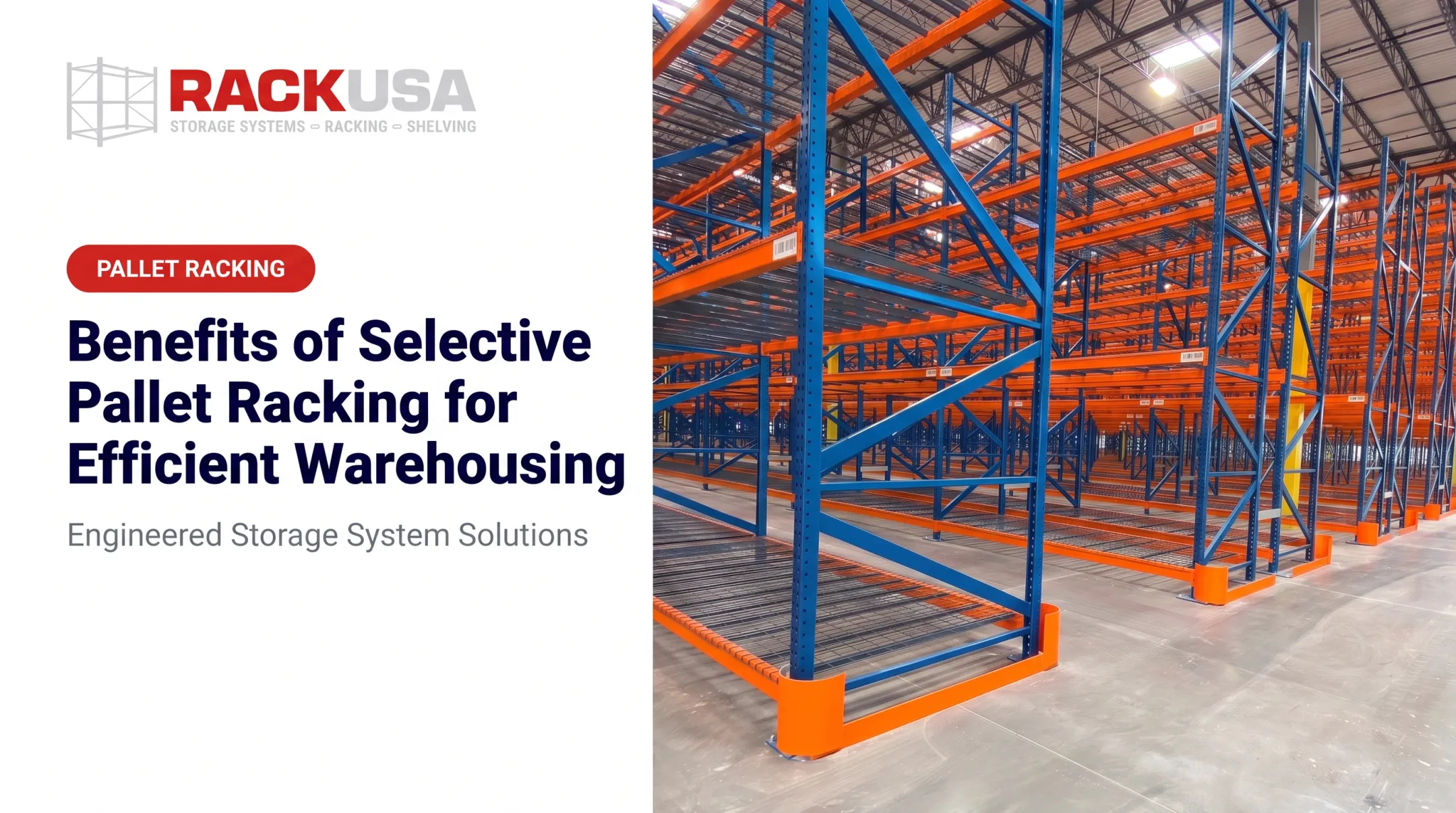
Selective pallet racking is the industry standard. Single-deep beams let you drive up and access any pallet directly, without moving anything else out of the way.
Core benefits:
- Reconfigures beam levels and bay layouts easily as inventory changes
- Works with standard counterbalance or reach forklifts, no specialty equipment required
- Supports high SKU variety with true FIFO rotation
- Costs less upfront than nearly any other rack type
At RackUSA, standard selective roll-formed racking generally supports 1 to 3 tons per level. Final capacity always depends on actual pallet weights, warehouse clear height, and forklift type.
A typical configuration (96-inch wide, 42-inch deep, 240-inch tall bay with 4.5-inch beams) can handle up to roughly 35,000 lb overall and 6,800 lb per level, depending on materials.
Single-Deep vs. Double-Deep Configurations
- Single-deep: direct access to every pallet, ideal for high-turnover SKUs
- Double-deep: stores pallets two positions deep per row, boosting density but requiring deep-reach forklifts and sacrificing some selectivity

Use Cases of Selective Racking
Selective racking fits operations with frequent inbound/outbound movement and diverse product lines:
- General warehousing and third-party logistics
- Food and beverage distribution (frequent rotation, date sensitivity)
- Retail backroom storage
- Spare parts and MRO storage
That spread across general warehousing, 3PL, food distribution, and retail is why selective racking remains the default system documented throughout manufacturer and RMI literature.
What is Very Narrow Aisle (VNA) Racking?
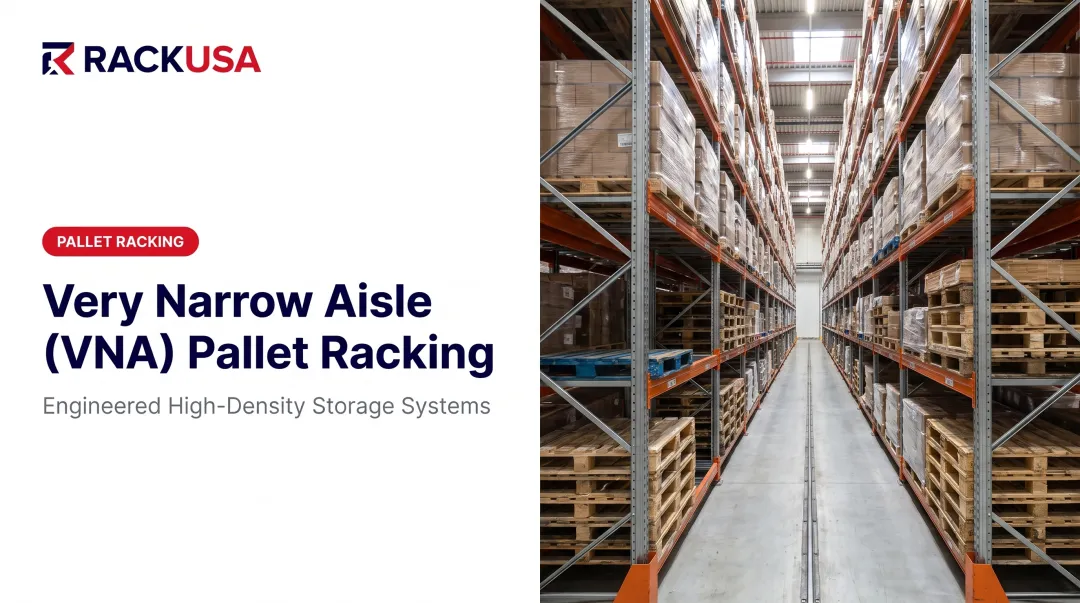
VNA racking is a layout strategy, not a different rack structure. Aisles narrow to roughly 5–6 feet (sometimes less), and specialized guided trucks replace standard forklifts so operators can work that tight space safely.
Core benefits:
- Maximizes cubic storage use without expanding the building footprint
- Adds pallet positions per square foot by shrinking aisle space and often building higher
- Preserves individual pallet selectivity, unlike drive-in systems
Wire-Guided vs. Rail-Guided Systems
- Wire guidance: A floor-embedded wire guides the truck’s sensor and steers automatically. Some systems brake if the signal drops, per Raymond Corporation's guidance documentation.
- Rail guidance: Floor- and ceiling-mounted tracks keep the truck aligned in the aisle.

Truck configurations also vary:
- Man-up turret trucks: Raise the operator with the forks for picking and putaway at height
- Man-down trucks: Keep the operator at floor level while the mast rotates to place pallets
Use Cases of VNA Racking
VNA works best where:
- Ceiling clearance is high enough to justify building vertically
- Pallet sizes are stable and predictable
- Inventory flow doesn't require constant reconfiguration
Common industries include large distribution centers, cold storage, and 3PL operations chasing maximum cube utilization.
In one documented case, Sovena USA—a bottler and distributor in Rome, New York—redesigned a 185,000-square-foot facility with VNA racking and VNA lift trucks and doubled its storage locations in the same footprint, according to Modern Materials Handling's 2013 report.
That project also used push-back and pallet-flow, so the result is not pure VNA-only. It still shows the scale of density gains possible when aisles shrink and the building goes vertical.

Selective vs VNA: Which Is Better for Your Warehouse?
There's no universal winner. Weigh these factors:
- SKU diversity: High variety favors selective racking's flexibility
- Ceiling height: VNA only pays off if you can build vertically
- Budget: Selective racking needs far less capital for trucks and guidance systems
- Throughput speed: Selective racking allows faster truck movement between aisles
- Future flexibility: Selective racking reconfigures easily; VNA's fixed guidance makes changes costly
Choose selective racking if: you prioritize flexibility, lower cost, and broad SKU access with frequent inventory changes.
Choose VNA racking if: maximizing storage density in a fixed footprint outweighs the cost of specialized trucks and guidance infrastructure.
Aisle width decisions aren't just a floor-space question. They're tied to seismic design, structural load calculations, and rack geometry.
RackUSA's engineering approach factors in the warehouse's seismic zone, total system load, and upright/beam/connector geometry before finalizing a layout. A facility assessment matters more than picking a system off a spec sheet.
Real World Example: Choosing the Right System
Picture a mid-size distributor running out of pallet positions in a leased warehouse. The lease has three years left. Moving isn't an option, but storage costs are climbing every quarter as inventory grows.
The operational challenge: fixed floor space, rising storage costs, no room to expand outward.
The evaluation:
- Standard selective racking couldn't add meaningful capacity without more square footage
- Converting a section to VNA meant investing in turret trucks and guidance infrastructure, a real capital outlay
- The facility had 32-foot clear ceiling height, mostly untapped
The operator ran the numbers. VNA-style narrow-aisle conversions have driven documented capacity gains of up to double the storage locations in comparable footprints, as seen in the Sovena case above.
Combined with stable, predictable SKUs (bottled products, consistent pallet sizes), the vertical space made VNA the stronger long-term play.

The takeaway: the decision hinged on ceiling height and SKU stability, not just floor space. A warehouse with low clearance or highly variable inventory would have landed on a different answer.
If you're facing a similar squeeze, request an engineered facility layout and racking design consultation before committing capital. RackUSA's team responds to layout requests in under four business hours with an initial proposal based on your space, load requirements, and forklift setup.
Conclusion
Neither system is universally "better." Selective racking wins on flexibility and cost. VNA wins on density. The right fit depends on your ceiling height, SKU behavior, and budget — not which system sounds more advanced.
Get the choice right, and you reduce long-term storage costs, speed up picking, and avoid a costly retrofit two years down the road. RackUSA bundles engineering and installation with the rack system so what you install matches how your warehouse actually operates.
Frequently Asked Questions
What type of forklift is best for narrow aisles?
Reach trucks work for moderately narrow aisles, around 10-11 feet. Very narrow aisle systems require turret trucks or wire/rail-guided VNA trucks built specifically for aisles under 6 feet.
What are the OSHA regulations for pallet racking?
OSHA requires clear, marked aisles with sufficient safe clearance, plus load-limit signage and regular inspection of racking and powered industrial trucks. It doesn't mandate a specific aisle-width number; that comes from your truck and load specifications.
What is narrow aisle reach?
Reach trucks use extending forks to place or retrieve pallets inside the rack. They work in aisles around 10-11 feet, narrower than the 12+ feet standard counterbalance trucks need.
Can I convert selective racking into a VNA system?
Yes, but it requires new guided trucks, floor guidance installation, and often rack disassembly and reconfiguration. Treat it as a full project: start with a facility layout review rather than a simple upgrade.
How much more storage capacity does VNA racking provide compared to selective racking?
VNA typically yields far more pallet positions in the same footprint; some documented projects have doubled capacity. Exact gains depend on ceiling height, pallet size, and rack geometry, so a facility-specific layout study is essential.
Is VNA racking worth the investment for a small warehouse?
VNA pays off best in facilities with high ceiling clearance and stable, high-volume SKUs. Smaller operations or those with variable inventory usually find selective racking more cost-effective.