
The choice affects more than aesthetics. It shapes load capacity, forklift-impact resistance, upfront cost, lead time, and how much you'll spend on repairs five years from now. The stakes are only growing — the US 3PL market hit $323.4 billion in 2025, up 5.0% year over year, with value-added warehousing and distribution accounting for $72.7 billion of that total. More throughput means more forklift traffic, and more forklift traffic means rack damage adds up fast if you picked the wrong system.
This guide breaks down both systems so you can match the right one to your operation.
TL;DR
- Structural racking uses hot-rolled, bolted steel built for maximum strength and impact resistance
- Roll-form racking uses cold-rolled, clip-together steel built for speed and easy reconfiguration
- Higher upfront cost for structural usually pays off through longer life in high-impact environments
- Choose based on load weight, forklift traffic, SKU turnover, and operating environment
- Many facilities mix both systems by zone — RackUSA engineers and manufactures both
Structural vs. Roll Form: Quick Comparison
| Factor | Structural | Roll Form |
|---|---|---|
| Composition | Hot-rolled steel channels, bolted connections | Cold-rolled steel, teardrop-punched, clip-in beams |
| Load capacity | Higher: RMI cites 8,000-12,000 lbs per level as a structural-leaning threshold | Lower to moderate; best for lighter, hand-loaded inventory |
| Impact resistance | Withstands forklift contact with minimal damage | More prone to denting in high-traffic zones |
| Installation | Bolted assembly, longer lead time, harder to reconfigure | Boltless, tool-free, quick to reconfigure |
| Cost | Higher upfront due to material and labor | Lower upfront, faster to ship and assemble |
Note on pricing: Industry authorities do not publish a standard structural cost premium. Structural racking is typically quoted project-by-project based on load, height, and steel gauge. Get a specific quote rather than relying on a blanket percentage.
What is Structural Pallet Racking?
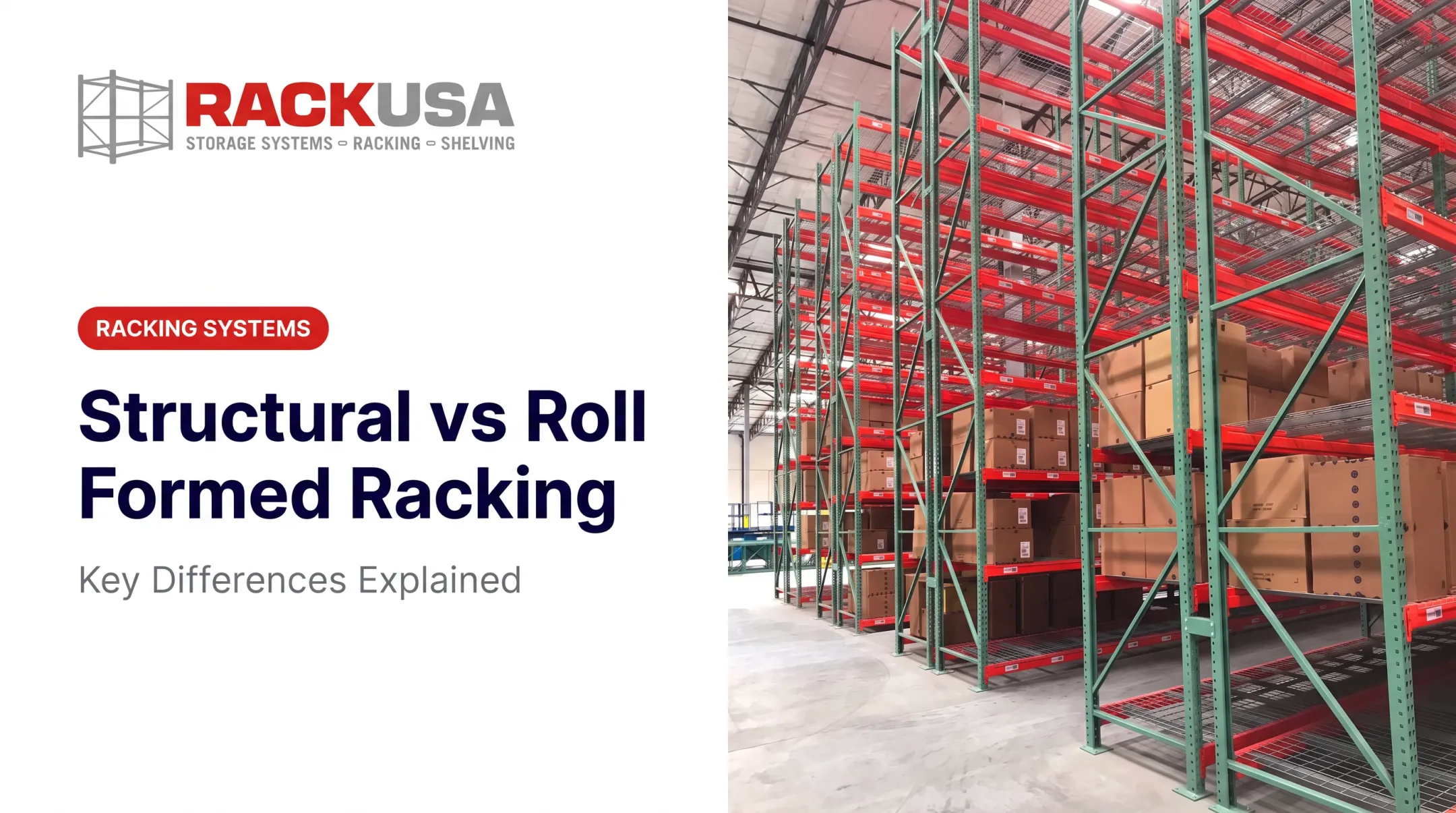
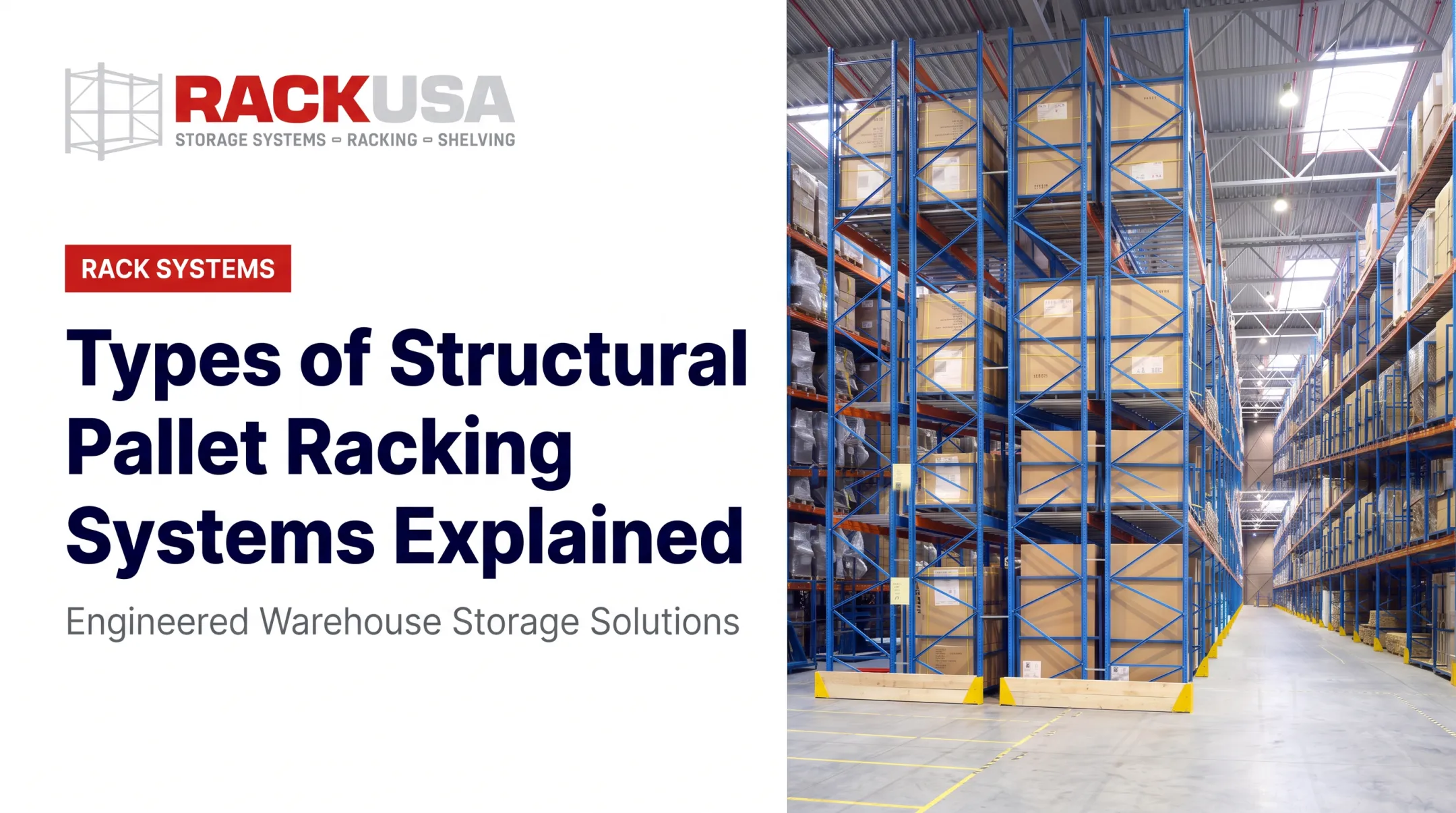
Structural racking is built from heavy-gauge, hot-rolled steel, bolted together for rigidity. RMI notes that bolted connections (instead of clips) give structural rack its impact resistance and longer service life, at the cost of more labor during installation.
That rigidity translates into fewer damage events, less unplanned downtime, and the ability to store heavier SKUs without a later system upgrade. RackUSA manufactures structural racking in selective and drive-in/drive-through configurations, the latter offering up to 2x the storage density of selective racking by eliminating aisle space between bays.
Common structural configurations:
- Selective racking with heavy-gauge steel profiles for direct pallet access
- Drive-in racking for LIFO (last-in, first-out) storage
- Drive-through racking for FIFO (first-in, first-out) flow

Use Cases of Structural Racking
Choose structural racking when forklift impact risk is high or pallet loads push capacity limits.
- Cold storage: Confined aisles, slick floors, and cold temps drive forklift abuse; Food Logistics recommends hot-rolled structural steel, bracing, and heavy-duty foot protectors.
- High-impact forklift zones: RMI notes most damage occurs below the first beam level, where one hit can sharply cut load capacity.
- Heavy manufacturing and outdoor/washdown: Corrosive or damp sites favor galvanized structural frames over roll-form teardrop connectors, whose holes tend to clog if galvanized.
What is Roll Form (Roll-Formed) Pallet Racking?
Roll form racking uses cold-rolled, lighter-gauge steel with teardrop or keyhole punches along the upright. Beams clip directly into the slots — no bolts, no tools. RMI describes this as producing flexible, quicker-to-install, cost-efficient systems best suited to lighter products at moderate heights.
That speed matters when inventory changes often. Need to raise a beam level or add a bay? Roll form lets you do it in minutes, not hours.
RackUSA's Selective Roll-Formed Racking is custom-engineered by load per level, clear height, and forklift type, with seismic factors built into the structural calculations, not an afterthought bolted on later.
Use Cases of Roll Form Racking
- E-commerce and fulfillment: direct pallet access and boltless flexibility for high-volume, mixed-order picking
- Seasonal inventory: reconfigure bay heights in minutes as product mix shifts through the year
- Light-to-medium loads: standard selective roll-form typically handles 1–3 tons (about 2,000–6,000 lb) per level

Roll form isn't the right call everywhere, but for fast-moving, lighter-load operations, it's hard to beat on cost and speed.
Structural vs. Roll Form: What's Better for Your Warehouse?
Five factors should drive your decision:
- Pallet weight: heavier loads push you toward structural
- Forklift traffic and operator experience: high-traffic aisles or newer operators raise rack-impact risk
- SKU change frequency: frequent reconfiguration favors roll form's boltless design
- Environment: cold storage, washdown, or outdoor exposure favors structural
- Budget and lead time: roll form ships and installs faster and cheaper
Choose structural if:
- You're running drive-in systems or storing loads over 3 tons per level
- You operate in cold storage or another high-impact environment
- Downtime from rack damage is costing you more than the upfront premium
Choose roll form if:
- Your loads fall in the 1–3 tons per level range
- You need to reconfigure bays regularly
- Speed to install matters more than maximum durability
Many facilities land somewhere in between, running structural frames in receiving and reserve storage while using roll form in picking zones. RackUSA's engineering team evaluates load per level, clear height, aisle layout, and seismic zone requirements to recommend the right mix for each facility.
Real-World Example: Choosing the Right Racking System
Consider a mid-sized distribution facility running a single roll-form system across its entire warehouse. The reserve storage area, however, sees constant forklift traffic from high-turnover pallet drops: three shifts a day, seasonal volume spikes, and a mix of experienced and newer operators.
Over time, the facility notices a pattern: bent uprights, dented beams, and rising repair frequency concentrated entirely in that one zone. A safety walkthrough flags several damaged frames below the first beam level, exactly where RMI notes impact damage most often occurs and does the most structural harm.

The practical fix is zone-based, not a full rip-out: switch the high-impact reserve area to structural racking and keep roll form in the picking area, where reconfiguration speed matters more than raw impact resistance.
The result: fewer emergency repairs, less unplanned downtime, and a rack system matched to how each zone is actually used — not a one-size-fits-all install from day one.
If your facility has a similar high-impact zone, a rack assessment from RackUSA's engineering team can pinpoint where structural upgrades would pay off fastest.
Conclusion
The right racking system depends on your specific loads, traffic patterns, and reconfiguration needs.
Structural racking wins where impact resistance and heavy loads matter most:
- Cold storage
- Drive-in systems
- High-traffic reserve zones
Roll form wins where speed, cost, and flexibility drive the operation:
- Fulfillment centers
- Picking areas with changing SKU mixes
Getting this decision right connects directly to real outcomes: fewer OSHA-flagged hazards, less unplanned downtime, and a racking budget that doesn't get eaten up by repeat repairs. Whether you need a single system or a hybrid layout, matching the rack to the job upfront is cheaper than fixing the mismatch later.
Frequently Asked Questions
What are the OSHA guidelines for warehouse racking?
OSHA's 1910.176(b) requires stored materials to be stable and secure against sliding or collapse, while 1910.22(d) requires regular inspection and correction of hazards. When specifying a new system, RackUSA can help design racking that meets these requirements.
Can structural and roll form racking be combined in one warehouse?
Yes. Hybrid layouts are common: structural frames in high-impact or heavy-load zones, roll form in picking or lighter-load areas. RackUSA engineers can design a zone-by-zone layout matched to each area's load and traffic profile.
How long does structural racking last compared to roll form?
Service life depends on design, material quality, usage, environment, and inspection habits, according to RMI. Structural racking is generally more durable and impact-resistant; roll form is lighter and more prone to damage under heavy traffic.
Is roll form racking safe for heavy pallets?
Roll form is built for lighter-to-moderate loads, typically 1–3 tons per level. For heavier pallets or loads above that range, structural racking is the safer choice.
How much more expensive is structural racking than roll form?
Pricing depends on steel gauge, load requirements, and project scope, so there is no single industry-wide premium. Structural costs more upfront, but fewer repairs and less downtime can offset that over time.
Which racking type is best for cold storage warehouses?
Structural racking is generally recommended for cold storage due to its resistance to forklift impact damage and suitability for damp, high-humidity conditions. Industry sources recommend hot-rolled steel uprights and beams with bracing for these environments.