
The fix usually isn't hiring more people. It's rethinking how storage is laid out. Rack type, aisle width, and slotting logic determine travel time, pick accuracy, and throughput long before a picker ever touches an order.
This guide breaks down the storage systems built for speed, the picking methods that pair with them, and how to choose (and maintain) the right setup for your operation.
Key Takeaways
- Storage system choice — racking, shelving, or flow racks — is the foundation of fast picking, not an afterthought
- Pick speed depends on product accessibility and SKU organization, not just headcount
- Pairing the right rack with a picking method (zone, batch, wave) maximizes throughput
- Routine safety audits and rack maintenance protect speed and worker safety simultaneously
What Is Fast Order Picking and Why Storage System Design Matters
Order picking is the process of retrieving items from storage to fulfill a customer or production order. It's also the most labor-intensive task in most warehouses, which is why small inefficiencies compound fast.
Poor layout is usually the culprit. Long travel distances, mismatched slotting, and cluttered pick faces slow every single order.
The Georgia Tech order-picking tutorial documents up to a 44% reduction in average batch tour length when travel is properly managed through batching and layout. Redesigning the walk path matters as much as the picker's speed.
Velocity-Based Slotting Cuts Travel Time
ABC/velocity slotting puts your top movers closest to the pick face:
- A-items (typically the top 10-20% of SKUs) generate 70-80% of picks and belong at ergonomic height, near pack stations
- B-items go in accessible secondary locations
- C-items can sit further out or higher up
Modern Materials Handling reports that effective slotting delivers 8-15% improvements in picking and replenishment labor, with one customer citing $500,000 in annual savings. That's a case example, not a guarantee, but it shows the scale of what's possible.
Pair slotting with the right storage design and a WMS, and travel drops further. Carton-flow racks and pick modules keep high-velocity SKUs at the pick face, while the WMS routes pickers along the shortest path instead of a fixed sequence.

Best Warehouse Storage Systems for Fast Picking
Not every rack type is built for speed. Some prioritize density; others prioritize access. Here's how the main options stack up:
| System | How It Works | Best For |
|---|---|---|
| Selective pallet racking | Direct access to every pallet | High-SKU operations needing frequent access |
| Carton/pallet flow | Gravity-fed FIFO, product auto-presents at pick face | High-frequency picking, rotation-sensitive goods |
| Push-back/drive-in | High-density, forklift-loaded | Slow-moving, bulk, or uniform SKUs |
| Multi-tier shelving/mezzanines | Maximizes vertical cube space | Small parts, reachable at every level |
| Pick modules | Combines racking, shelving, conveyors | Engineered for high-throughput fulfillment |
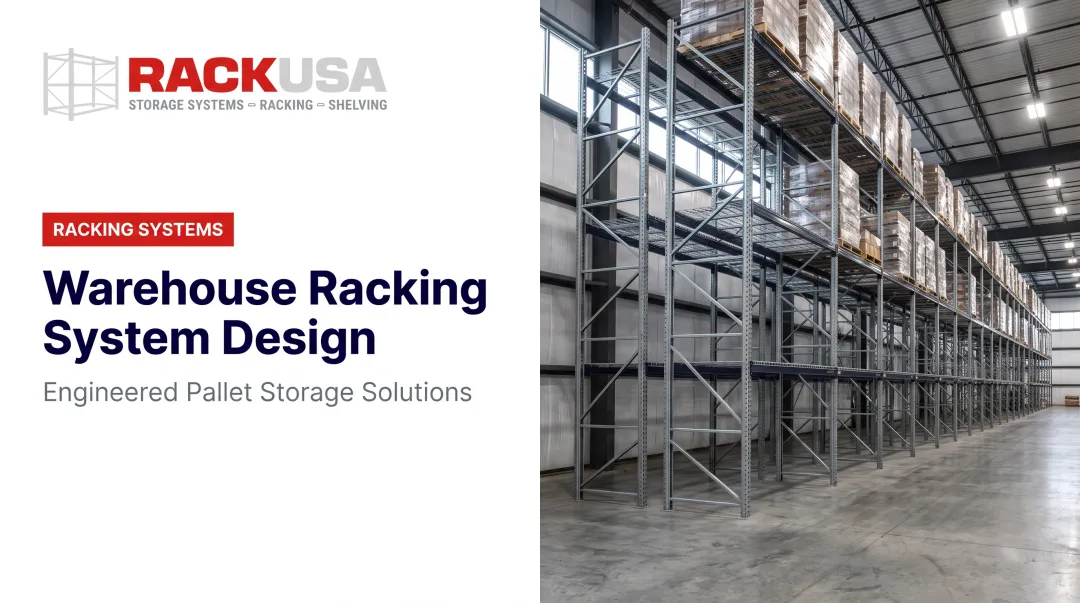
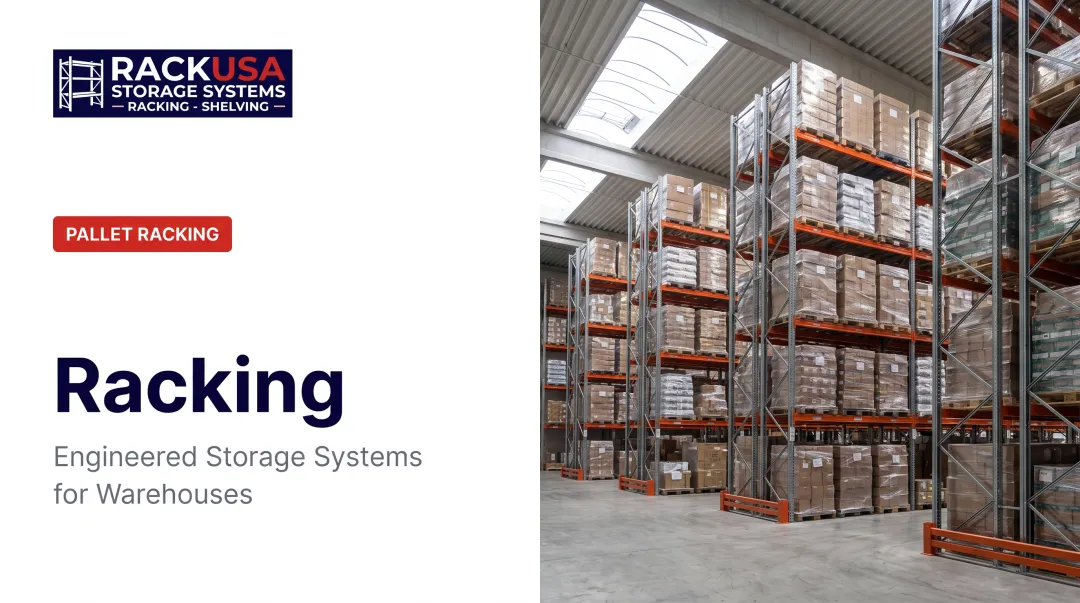
Selective pallet racking remains the most common choice because it gives direct access to every position — no digging through pallets to reach what you need. It costs more floor space than dense storage, but for operations juggling dozens or hundreds of SKUs, that trade-off pays off in speed.
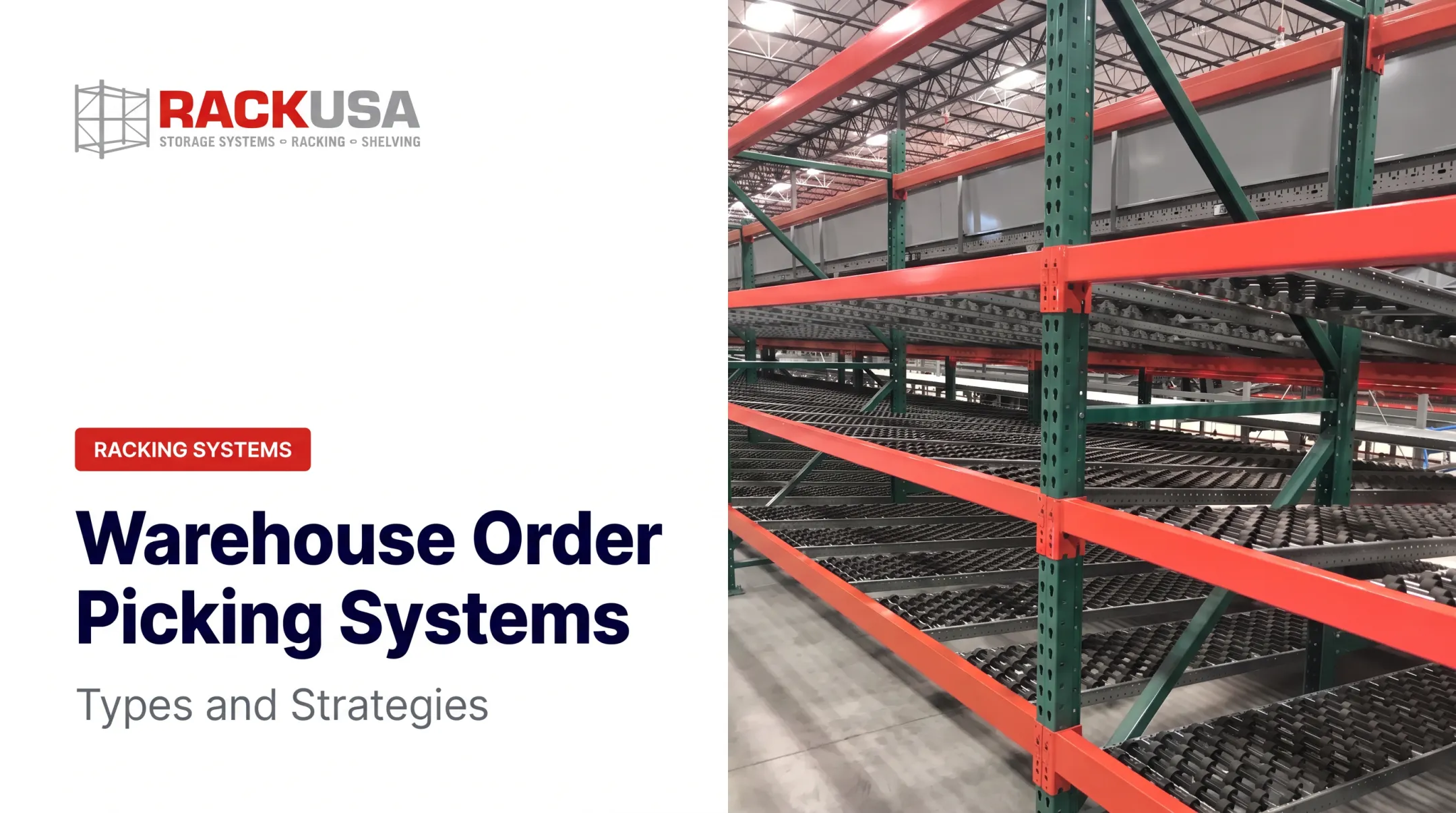
Carton and pallet flow racks use gravity to feed product toward the pick face automatically. As a picker removes a carton, the next one rolls forward. This keeps travel low and enforces FIFO rotation, which matters for perishables or dated inventory.
Push-back and drive-in racking maximize density but sacrifice access. They're ideal for slower SKUs or bulk storage — not for items you're picking dozens of times a day.
Mezzanines and pick modules address a different constraint: floor space. When the footprint is maxed out, elevated pick levels keep travel short without a building expansion. RackUSA mezzanines and pick modules add working levels that can integrate picking zones, conveyors, and guardrails in one engineered structure—often multiplying usable area while keeping pick faces reachable.

When density and speed both matter, automated shuttles outperform deep lane racking that still depends on forklifts inside the structure.
Matador pallet shuttle systems use electric carts to move pallets through storage lanes so forklifts never enter the rack. RackUSA builds them in 2D (single-axis) and 4D (longitudinal and transverse) configurations. Compared with standard drive-in racking, Matador typically offers:
- FIFO and LIFO support in the same platform family
- Real-time pallet tracking
- WMS integration for higher-throughput, controlled replenishment

Order Picking Methods That Pair With Your Storage System
The rack gets product within reach. The picking method determines how efficiently your team actually moves through it.
Discrete (Single Order) Picking
One picker retrieves one order, start to finish. It's the simplest method to manage and works well for small operations or low SKU counts. Repeated trips for small orders still waste time.
Batch and Zone Picking
Batch picking groups multiple orders into a single pass. Instead of walking the same aisle five times for five separate orders, a picker collects items for all five at once, then sorts them at the end. This directly reduces the repeat travel that drives up labor cost.
Zone picking assigns pickers to fixed storage zones. Orders move through each zone and get consolidated at the end. This cuts congestion since pickers aren't crossing paths across the whole warehouse.
Wave and Goods-to-Person Picking
Wave picking releases orders in coordinated batches tied to shipping schedules. That timing helps when product must be ready as trucks load, and it often layers batch or zone logic on top.
Goods-to-person systems bring inventory to a stationary picker, cutting travel time to nearly zero. It shifts labor-intensive work into a capital investment, so it makes the most sense at higher volumes where the payback is clear.
Matching Method to System
- Flow racks pair naturally with batch picking — constant product presentation supports fast, repeated grabs
- Pick modules pair well with zone picking, with each level or section as its own zone
- Pallet shuttle systems support goods-to-person-style workflows at scale

How to Choose and Optimize Your Storage System for Picking Speed
Before comparing rack types, evaluate three things:
- Order volume and SKU count — More SKUs typically favor selective racking; consolidated, predictable lots favor high-density storage
- Product characteristics — Weight, rotation requirements (FIFO vs. LIFO), and load stability all narrow your options
- Facility constraints — Clear height, aisle width, and growth plans determine whether static racking or dynamic/flow solutions make more sense
RackUSA's project evaluations typically weigh SKU count, rotation predictability, required density, and load weight together. A single generic threshold rarely fits a real operation.
High-volume, consistent SKUs might justify a pallet shuttle. Scattered, unpredictable SKUs usually don't.
Apply 5S to Keep It Organized
Once the rack is in place, discipline keeps it fast. The 5S method:
- Sort — remove items that don't belong in the pick zone
- Set in order — arrange remaining items logically
- Shine — keep pick faces clean and clear
- Standardize — make the clean, organized state routine
- Sustain — audit regularly to maintain it
Skipping 5S is one of the fastest ways to erode the speed gains a new rack system delivers.
Safety, Maintenance, and Long-Term Reliability of Picking Storage Systems
High-frequency picking areas see more forklift traffic, more collisions, and faster rack wear than slow-moving storage zones. That makes routine inspection non-negotiable, not optional. OSHA's 29 CFR 1910.176 requires safe clearances, clear and marked aisles, and stable, secure storage in general-industry warehouses. For elevated pick modules, 29 CFR 1910.29 sets specific requirements: top rails at 42 inches (±3 inches) and guardrails capable of resisting 200 pounds of force. These are compliance minimums, not optional guidelines. RMI guidance on inspection frequency isn't one-size-fits-all. It recommends:
- Monthly inspections for high-damage-potential areas
- Quarterly for medium-risk zones
- At least annually everywhere else
- Immediate inspection after any collision or seismic event RackUSA builds seismic factors directly into its structural engineering, following RMI guidelines, and its selective roll-formed systems carry MHI R-Mark certification. Safety hardware is engineered and installed with the project rather than sold as a standalone audit service:
- Custom rack design and load-capacity labeling
- Guard rails and end-of-rack protectors
- Load capacity plaques that show safe weight limits Those plaques are a documented safeguard against overloading, one of the most common causes of rack failure in high-traffic picking zones.
Frequently Asked Questions
What is the 5S rule in warehousing?
5S stands for Sort, Set in order, Shine, Standardize, and Sustain. It's a discipline for keeping pick locations organized, which directly reduces travel time and picking errors.
What is the most effective warehouse picking system?
It depends on order volume and SKU mix, but goods-to-person and zone picking paired with flow racking are typically fastest for high-volume operations. Lower-volume operations often do fine with discrete or batch picking on selective racking.
What are the three order picking systems?
The three broad categories are manual (person-to-goods), automated (goods-to-person), and voice-directed picking. Voice-directed still involves a human picker, guided by spoken prompts instead of paper lists.
What is the difference between pallet flow racking and selective racking for picking?
Selective racking gives direct access to every pallet position but uses more floor space. Pallet flow uses gravity-fed lanes for automatic FIFO rotation, which speeds up picking for high-turnover or dated inventory.
How do I know if I need automated storage instead of traditional racking?
Key indicators include high and consistent order volume, rising labor costs, and limited floor space for expansion. If manual picking can't keep pace with demand, automated or semi-automated systems like pallet shuttles become worth the investment.
How often should picking racks be inspected for safety?
Inspection frequency should be risk-based per RMI guidance — monthly for high-traffic, high-damage-potential areas, quarterly for medium-risk zones, and at least annually elsewhere. Always inspect immediately after a collision.