
That growth creates a problem many facility managers underestimate: standard ambient racking wasn't built for sub-zero conditions. Cold and freezer environments change how steel behaves, how moisture interacts with equipment, and how workers move through aisles.
Racking decisions in these environments directly affect throughput, worker safety, and cost per pallet stored. This guide breaks down the top pallet rack systems for cold storage, the engineering behind them, and how to pick the right one for your facility.
TL;DR
- Cold storage racking must withstand steel's ductile-brittle transition near 0°F, condensation, and corrosion
- Top systems: Selective, Drive-In, Pallet Flow, Push-Back, and Pallet Shuttle serve different density needs
- Structural steel outperforms roll-formed in high-traffic freezer aisles due to impact resistance
- Hot-dip galvanized finishes and ANSI MH16.1/RMI compliance are non-negotiable for safety and longevity
- RackUSA engineers cold storage racking systems tailored to your facility's specific cold chain needs
Overview of Pallet Racking in the Cold Storage Industry
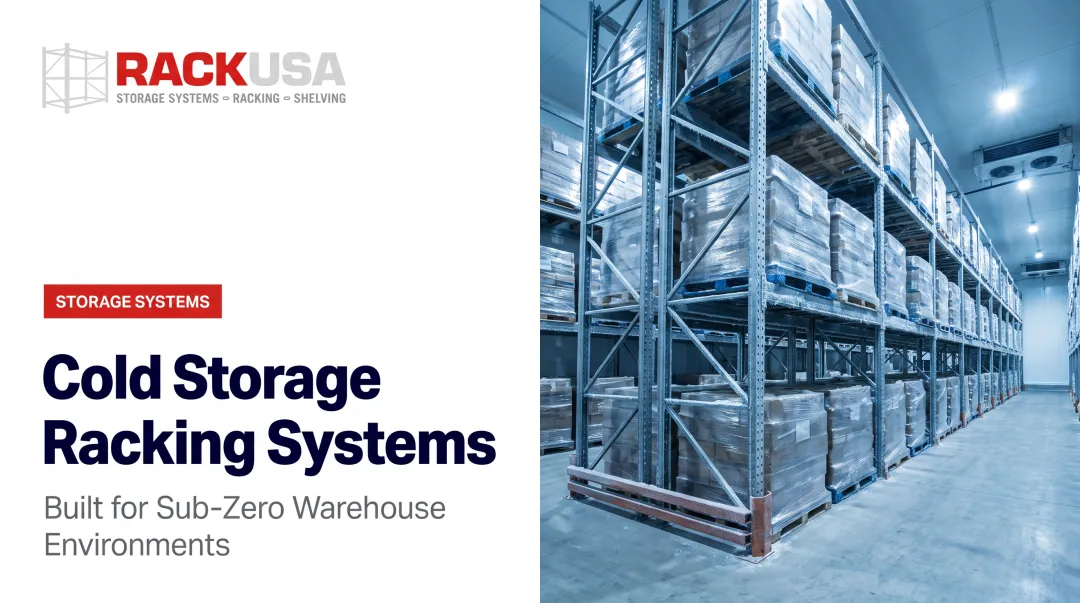
Cold storage pallet racking refers to engineered storage structures designed specifically to function in refrigerated, frozen, and ultra-low temperature environments while still maximizing cube space and pallet throughput. These aren't ambient racks with a coat of paint added.
The demand for this kind of equipment is climbing fast. Beyond the GCCA capacity figures above, cold chain warehousing has become one of the fastest-growing segments in industrial real estate. Grocery delivery, meal kits, and biopharma storage needs are driving this growth, demand that didn't exist at this scale a decade ago.
This surge in demand raises the stakes for equipment selection, because not all racking performs equally in these conditions. A rack rated for a dry, 70°F distribution center can fail differently in a -10°F freezer, where steel toughness drops and forklift operators wear bulky gear that reduces maneuvering precision.
The sections below rank the top systems using four criteria:
- Storage density per square foot
- Selectivity and pallet access frequency
- Material and finish resistance to temperature extremes
- Compatibility with automation and labor-reduction goals
Top Pallet Rack Systems for Cold Storage Facilities
Choosing the right system means balancing how much product you need to store against how often you need to touch each pallet. Here's how the five leading options stack up.
Selective Pallet Rack
Selective rack is the most common configuration in any warehouse, cold or ambient. It gives forklift operators direct, single-deep access to every pallet position, no maneuvering around other loads required.
In cold storage, selective rack works best as the baseline system for multi-SKU coolers and distribution centers where inventory turns quickly and product variety is high. Its tradeoff is space efficiency, since single-deep storage uses more floor area per pallet than deep-lane alternatives.
| Factor | Details |
|---|---|
| Storage Density | Low to moderate (single pallet deep) |
| Selectivity | High: 100% direct access to every pallet |
| Ideal Use Case | Multi-SKU coolers/DCs with frequent turnover |
Drive-In / Drive-Through Rack
Drive-in racking lets forklifts enter the rack structure itself to load and retrieve pallets, eliminating the aisle space that selective rack requires. Drive-through configurations add a second entry point, allowing pallets to load on one side and unload on the other, supporting FIFO (first-in-first-out) rotation.
Drive-in rack can accommodate up to 75% more pallets than selective rack in cooler and freezer applications, making it a frequent pick where floor space is limited and product volume is high.
| Factor | Details |
|---|---|
| Storage Density | High: significantly more pallets per square foot than selective |
| Selectivity | Low: typically one SKU per lane |
| Ideal Use Case | Freezer warehouses with high-volume, low-SKU-count product |
Pallet Flow Rack
Pallet flow rack uses a gravity-fed system of rollers or wheeled tracks. Pallets load at the rear of the lane and glide forward as front pallets are removed, guaranteeing first-in-first-out rotation without operator effort.
This automatic FIFO behavior makes pallet flow a natural fit for date-coded frozen or chilled goods, where rotation errors mean spoiled inventory or compliance headaches. Pharmaceutical cold storage often relies on this system for the same reason.
| Factor | Details |
|---|---|
| Storage Density | High: commonly 2 to 12+ pallets deep |
| Selectivity | Moderate: access by lane, not by pallet |
| Ideal Use Case | Date-sensitive perishable or pharmaceutical cold storage |
Push-Back Rack
Push-back racking operates on a cart-and-rail system where each new pallet pushes the previous one back along an inclined lane. It's last-in-first-out (LIFO), loaded and unloaded from a single aisle, with multiple lanes accommodating different SKUs side by side.
Push-back systems can deliver up to 90% more storage than selective racking in the same footprint, typically storing pallets 2 to 5 positions deep. That combination of density and multi-SKU flexibility makes it popular in food-oriented cold storage operations.
| Factor | Details |
|---|---|
| Storage Density | High: 2 to 6 pallets deep per lane |
| Selectivity | Moderate: multiple pick faces across lanes |
| Ideal Use Case | Cold storage needing both density and SKU variety |
Pallet Shuttle System
Pallet shuttle systems use semi-automated or fully automated carts that move pallets within deep storage lanes. Forklifts only load and unload at the aisle entry point instead of driving into the rack itself. That design keeps workers out of the coldest zones for longer stretches, which matters when aisle temperatures sit well below freezing.
RackUSA's Matador pallet shuttle system is built around this exact idea: reduce forklift travel into freezer lanes, cut labor exposure to extreme cold, and boost throughput per square foot. It's offered as part of RackUSA's custom storage solutions lineup, engineered on a project-by-project basis to match a facility's temperature zone, lane depth, and automation goals.
| Factor | Details |
|---|---|
| Storage Density | Highest of the group: deep-lane storage with minimal aisle space |
| Automation Level | Semi-automated to fully automated, integrable with AS/RS |
| Ideal Use Case | High-volume freezer/cooler operations seeking labor reduction and throughput gains |

Critical Engineering & Material Considerations for Cold Storage Racking
Picking the right rack type is only half the equation. Material choices determine whether that rack survives years of freezer traffic or fails prematurely.
The Ductile-Brittle Transition
RMI identifies roughly 0°F as the point where carbon steel can begin a ductile-to-brittle transition, becoming more prone to sudden fracture under impact rather than bending or deforming gradually. Load capacity itself doesn't change at this threshold, but impact resistance does.
This is why structural steel rack, built from hot-rolled channels with bolted connections, is generally recommended over lighter roll-formed rack in high-traffic freezer aisles where forklift contact is routine. RackUSA manufactures both lines in-house at its Gómez Palacio facility. Structural rack is rated for 1 to 3 tons per level and built specifically to hold up under repeated impact in cold, damp conditions.
Corrosion Protection and Finishes
Condensation and freeze-thaw cycling accelerate corrosion in ways ambient warehouses never encounter. Effective cold storage rack typically uses:
- Hot-dip galvanized coatings for long-term corrosion resistance in humid freezer environments
- Cold-rated epoxy-polyester powder coatings engineered to remain flexible instead of cracking at low temperatures
- Food-grade finishes where facilities need alignment with FDA or USDA sanitation expectations
RackUSA evaluates coating selection on a project-specific basis rather than applying a single default finish, since a -10°F blast freezer and a 34°F produce cooler have different corrosion and condensation profiles.
Automation, Hygiene, and Compliance Requirements
Facilities adding pallet shuttles or AS/RS integration need tighter manufacturing tolerances on guide rails, reinforced bases for mobile components, and anchoring systems compatible with cold slabs and vapor barriers. Skipping this step is a common source of shuttle misalignment down the line.
Beyond automation compatibility, rack design also affects hygiene and airflow. Open rack profiles support airflow and drainage, reducing condensation pooling, while smooth surfaces support washdown protocols in facilities under GFSI or FDA oversight.
Taller racks with tighter aisle spacing also reduce the volume of air that needs to stay cooled, lowering energy costs over time. ANSI MH16.1 remains the governing structural standard for the rack types covered in this article, though its scope excludes drive-in, drive-through, and cantilever configurations specifically.

How We Chose the Best Cold Storage Racking Systems
The most common mistake buyers make is assuming a rack rated for ambient warehouse conditions will perform the same way in a freezer. It won't. Confined aisles, forklift traffic in tight lanes, and sub-zero impact sensitivity change the risk profile entirely.
This list weighed four factors:
- Compliance with RMI/MHI guidelines and ANSI MH16.1 where applicable
- Material and finish suitability for the specific temperature zone in question
- Density-versus-selectivity fit based on SKU count and turnover rate
- Automation compatibility for facilities planning shuttle or AS/RS integration
Each factor ties back to two outcomes that matter most in cold storage: worker safety and cost per pallet stored.
Conclusion
The "best" cold storage rack system depends on your facility's throughput, SKU diversity, and automation roadmap. A high-density push-back system that works beautifully for a single-SKU freezer could be the wrong call for a multi-SKU cooler needing frequent access.
Before finalizing a system, evaluate scalability, total cost of ownership, and long-term maintenance needs, not just the upfront price per position.
That kind of long-term thinking is easier with a manufacturer who manages the whole project directly. RackUSA has manufactured storage systems since 1972, offering structural and roll-formed racking, dynamic pallet flow, push-back, and Matador shuttle systems engineered for cold chain conditions. With offices spanning the U.S. and Mexico, the team handles engineering through installation as one connected process rather than passing the project between separate vendors.
Frequently Asked Questions
What are OSHA requirements for warehouse racking?
OSHA doesn't issue a rack-specific standard, but 29 CFR 1910.176 requires safe aisle clearances and stable, secure storage. RMI/ANSI MH16.1 is the referenced engineering standard most facilities use for compliance.
What is the best pallet rack system for a freezer warehouse?
Drive-in, push-back, and pallet shuttle systems are typically preferred for freezers due to higher density and less worker exposure to cold. The right choice still depends on SKU count and turnover rate.
Should cold storage racking use structural or roll-formed steel?
Structural steel is recommended for high-traffic, forklift-accessed freezer and cooler zones because of its superior impact resistance. Roll-formed suits hand-pick areas with minimal vehicle contact risk.
How much does drive-in or push-back racking increase storage density in cold storage?
Drive-in racking can hold up to 75% more pallets than selective rack, while push-back can add up to 90% more storage in the same footprint. Actual gains depend on lane depth and layout.
What temperature causes steel racking to become brittle?
RMI identifies roughly 0°F as the point of ductile-brittle transition, where steel becomes more sensitive to impact damage. Load capacity itself isn't affected, but fracture risk under sudden impact increases.
Can pallet racking systems be integrated into a rack-supported cold storage building?
Yes. Rack-supported structures use the racking itself as the building's frame, eliminating separate columns, increasing usable density, and reducing construction time and cost for coolers and freezers.