
Introduction
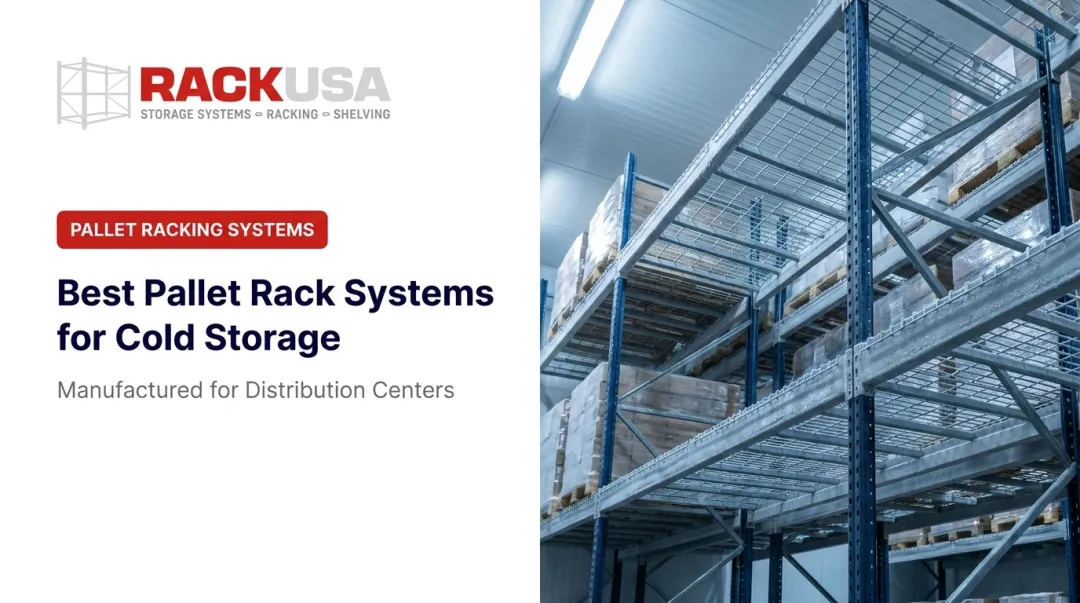
Coolers, freezers, and blast-chill rooms punish racking in ways a dry warehouse never will. Forklifts navigate tight aisles on slick floors, steel contracts in sub-zero air, and condensation attacks every unprotected surface. Many facility managers assume standard pallet rack holds up fine at 34°F or -10°F. It doesn't—not for long, and not without costly failures.
The stakes are real money. Cold storage space can cost up to three times more per square foot to build and operate than a standard dry warehouse, according to Steel King Industries. That makes every square foot of rack a critical ROI decision, not an afterthought.
This guide covers rack types, materials, selection criteria, safety compliance, and cost factors—so you can specify a system built for your temperature, traffic, and throughput.
Key Takeaways
- Near 0°F, steel’s ductile-brittle transition raises impact damage risk without changing load capacity.
- Match steel to traffic: structural for forklift cold rooms, roll-formed for hand-picking.
- Drive-in, pallet flow, push-back, and shuttle systems pack more product into costly cold space.
- Rack-supported buildings and OSHA-aligned safety programs protect inventory and crews.
Why Cold Storage Facilities Need Specialized Racking Systems
Steel behaves differently once temperatures drop. This is the single biggest reason generic racking fails in freezers.
The Ductile-Brittle Transition
Below roughly 0°F, steel becomes more sensitive to impact—the ductile-brittle transition. RMI's guidance on cold storage automation confirms freezer warehouses can reach as low as -22°F, where thermal contraction and material brittleness become real engineering concerns. Moisture and freeze-thaw cycles accelerate corrosion on top of that.
Here's the part that trips people up: this doesn't reduce how much weight a rack can hold. A beam rated for 4,000 lbs at room temperature still holds 4,000 lbs at -10°F. What changes is how that beam responds to a forklift impact. Cold, brittle steel is more likely to crack on contact rather than bend and absorb the blow, the way it would at 70°F.
Structural Steel vs. Roll-Formed Steel
Your traffic pattern should drive this decision:
- Structural steel (hot-rolled, heavy-gauge) suits vehicle-accessed coolers and freezers, where forklifts operate constantly in tight aisles. It absorbs impact better and holds up over years of intensive use.
- Roll-formed steel works well for hand-picking operations with no forklift traffic. It's lighter, less expensive, and easier to reconfigure as SKU counts or layouts change.
RackUSA builds both lines from cold storage-rated components. Its roll-formed selective rack uses a boltless beam-to-frame connection, so crews can change beam heights without tools as inventory profiles shift. Where forklift impact risk is high, heavy-gauge structural rack is the safer long-term choice despite the higher upfront cost.

Corrosion Protection
Condensation, washdown cycles, and freeze-thaw exposure all attack unprotected steel. Coatings matter as much as gauge thickness:
- Hot-dip galvanizing — maximum corrosion resistance in wet or washdown-heavy environments
- Powder coating — cost-effective protection in standard refrigerated conditions
- Stainless components — best fit for the most demanding, high-humidity zones
RackUSA evaluates coating and accessory needs project by project, since a 34°F cooler with occasional washdown has very different requirements than a -20°F blast freezer running around the clock.
Every standard pallet racking type—selective, drive-in, pallet flow, and beyond—can be built in either structural or roll-formed steel. System type and material grade are separate decisions.
Types of Cold Storage Racking Systems
No single rack type fits every cold room. The right choice depends on throughput, selectivity, product homogeneity, and available footprint, and most facilities end up combining two or three types under one roof.
Selective Pallet Racking
Selective rack gives a lift truck direct access to every pallet position. That's the main appeal: total flexibility for facilities juggling high SKU variety or unpredictable inventory rotation.
- Lowest cost per pallet position of any rack type
- Fastest to install and easiest to reconfigure later
- Ideal for reserve inventory or fast-moving cold-room stock
The tradeoff is density. Every pallet needs its own aisle access, so selective rack uses more floor space per pallet than high-density alternatives, and floor space in a freezer is expensive real estate.
Drive-In and Drive-Through Racking
Drive-in rack eliminates picking aisles entirely. Lift trucks drive directly into the rack structure to load and unload, stacking pallets several deep on continuous rail-supported lanes.
Steel King reports drive-in configurations can hold up to 75% more pallets than selective racking in the same footprint, a meaningful gain when every square foot carries a premium refrigeration cost. Drive-through rack, which allows entry and exit from both ends, works well for high-volume FIFO handling of homogeneous, long-shelf-life product.
Pallet Flow and Push-Back Racking
Both systems trade some selectivity for real density gains:
- Pallet flow: Gravity-fed rollers move pallets from load face to pick face for true FIFO, suited to frozen and chilled goods with strict date control
- Push-back: Stores pallets 2–6 deep on inclined rails (each new load pushes the row back); runs LIFO for product without tight rotation rules
Both cut labor and aisle count significantly compared to selective rack, which matters when every minute an employee spends in a -10°F aisle counts against productivity.
Carton Flow Racking
For case-pick and piece-pick operations, carton flow lets individual cartons glide on rollers from a rear replenishment zone to a front pick face. Workers never reach deep into a lane, and replenishment happens independently of picking, so the two tasks never collide. In cold aisles, that translates directly to less time spent exposed to low temperatures per order picked.
Pallet Shuttle and Mobile Racking Systems
Semi-automated shuttle carts move pallets deep into storage lanes while the forklift operator stays at the rack face, cutting the time equipment and people spend inside refrigerated aisles.
RackUSA's Matador pallet shuttle system is one turnkey option built for this environment:
- Runs in 2D (single-axis) or 4D (multi-directional) configurations
- Self-charges around the clock
- Supports both FIFO and LIFO rotation
Operators can manage perishables without giving up throughput. Because it keeps forklifts out of the rack lanes, it also cuts door openings and helps hold temperature steady, reducing a real freezer cost.
Mobile racking on sliding bases is another option worth a look. One documented case, a fruit storage facility profiled by Modern Materials Handling, gained 75% to 80% more practical capacity over 20 years by replacing static aisles with movable ones, while keeping direct SKU access and improving airflow. It's a strong middle ground for facilities that need density but can't give up selectivity entirely.

How to Choose the Right Cold Storage Racking System
Start with the facility-specific factors that actually drive rack selection:
- Inventory volume and SKU variety: high SKU counts favor selective rack; homogeneous bulk product favors drive-in or pallet flow
- Seasonality: facilities with sharp seasonal peaks need flexible or expandable configurations
- Throughput needs: fast pallet turnover points toward flow rack or shuttle systems, not static drive-in
- Ceiling height: taller clear spans open the door to rack-supported buildings and denser vertical storage
- Floor drainage and condensation management: washdown-heavy facilities need coatings and base plates rated for constant moisture
Balancing Selectivity and Density
Every rack decision is a tradeoff between how many pallets you can access at once and how many you can fit in the space. Most well-run cold storage facilities don't pick just one system.
They put selective rack near shipping doors for fast movers and use drive-in or pallet flow for reserve stock deeper in the freezer. That mix gives you access and density where each matters most.
Engineering Considerations
Cold storage builds carry engineering demands that dry warehouses don't. Seismic zone, total system load, slab thickness, and soil conditions under the slab all shape a safe rack design, especially on tall or heavily loaded systems.
RackUSA builds that analysis into turnkey project delivery, with PE-stamped drawings and permitting assistance bundled into the project. Structural and seismic compliance get confirmed before installation day.
Budgeting for the Long Term
Weigh upfront cost against what you'll spend over the system's life:
- Higher-density systems, such as shuttle or drive-in, cost more to install but cut long-term labor and energy costs
- Roll-formed rack costs less upfront but may need earlier replacement in high-impact zones
- Factor maintenance, coating touch-ups, and reconfiguration costs into any comparison, not just the purchase price
Rack-Supported Cold Storage Structures
In a rack-supported building, the racking system itself becomes the structural frame. The rack holds up the roof and exterior walls instead of a separate building shell wrapped around rack installed later.
Why this matters for cold storage specifically:
- Builds structure and racking in one sequence, with no separate civil-engineering phase before rack installation
- Cuts material and labor costs by eliminating a standalone structural shell
- Maximizes usable density with clear-span interiors, which matters more when every refrigerated square foot costs extra to build and cool
Rack-supported buildings can reach heights well beyond what's practical with freestanding rack inside a pre-built shell. That vertical capacity unlocks storage density a standard building envelope cannot match.
RackUSA's turnkey capabilities cover rack-supported buildings and mezzanines, so clients handle structure and storage design under one provider, from engineering through installation. One provider removes a common friction point: coordinating a building contractor and a separate rack installer on timing, tolerances, and structural loads.
Safety, Maintenance & OSHA Compliance for Cold Storage Racking
Cold environments raise the stakes on standard rack safety rules. Reduced dexterity in gloves, slippery floors, and dimmer lighting all make existing hazards worse.
Baseline OSHA requirements apply to any pallet rack, cold or not:
- Load capacity plaques identifying safe weight per level and per bay
- Secure anchoring to the slab
- Clear, marked aisles with sufficient clearance for equipment
- Storage secured against sliding or collapse
OSHA's general housekeeping standard also requires floors kept clear of ice, snow, and spills—especially in freezers, where condensation and frost build up fast.
Rack Safety Audits
Regular inspections matter more in freezers because of the ductile-brittle transition covered earlier. Impact damage a rack might tolerate at room temperature can crack a cold, brittle upright. Build an inspection schedule that includes:
- Full-system inspections at least annually
- Monthly checks on high-traffic zones like end-of-aisle rack and pass-through areas
- Prompt repair or replacement of any bent, cracked, or visibly damaged component
RackUSA engineers cold storage racking for structural performance in freezer conditions and bundles technical support and repair guidance with system projects so installations stay OSHA-aligned over the life of the rack.
Frequently Asked Questions
What are the types of racking systems?
The main categories are selective, drive-in/drive-through, pallet flow, push-back, carton flow, and automated pallet shuttle or mobile systems. The right choice depends on your facility's throughput, SKU variety, and available footprint.
What are the OSHA rules and requirements for pallet racking?
OSHA requires load capacity signage, secure anchoring, clear and marked aisles, and stable storage secured against collapse. Check OSHA's 1910.176 and 1910.22 standards for full specifics.
How much does a 5,000 MT cold storage project cost?
Costs vary widely based on rack type, automation level, structural and seismic requirements, and region. Request a customized quote for figures tied to your site and load requirements.
What is the best racking system for a freezer or cooler?
Drive-in and pallet shuttle systems are popular for maximizing density in freezers, while selective racking suits facilities needing broad, direct access to many different SKUs.
What steel is best for cold storage racking?
Structural steel is preferred where forklifts operate—it handles impact better when steel is cold and more brittle. Roll-formed steel works well for manual, hand-picking environments without vehicle traffic.
How long does it take to install a cold storage racking system?
Timelines depend on system complexity, pallet position count, and site accessibility. Rack-supported structures often shorten the overall schedule since building and racking go up together.