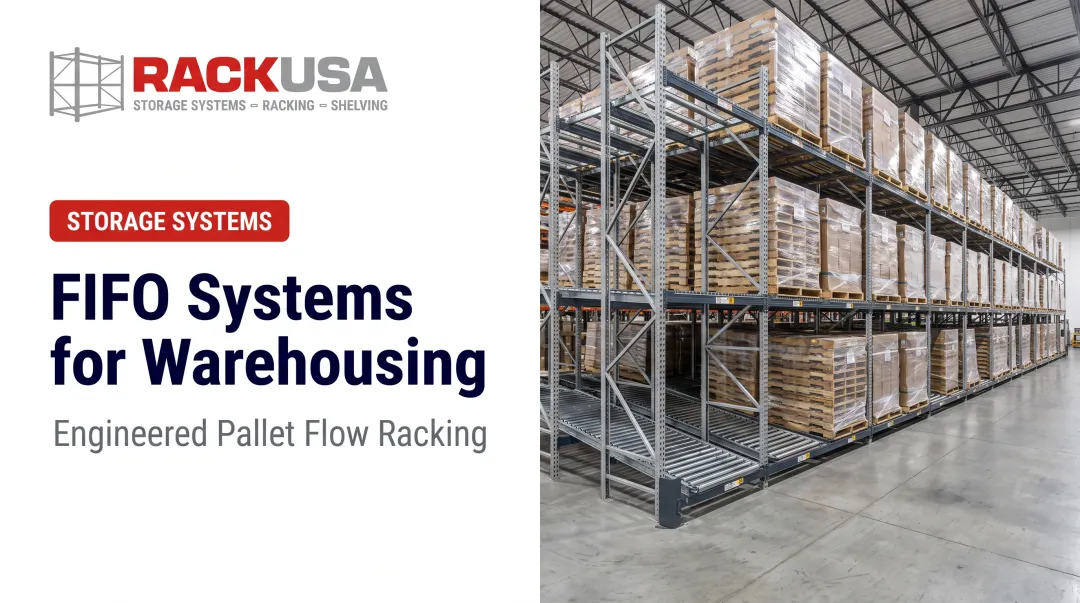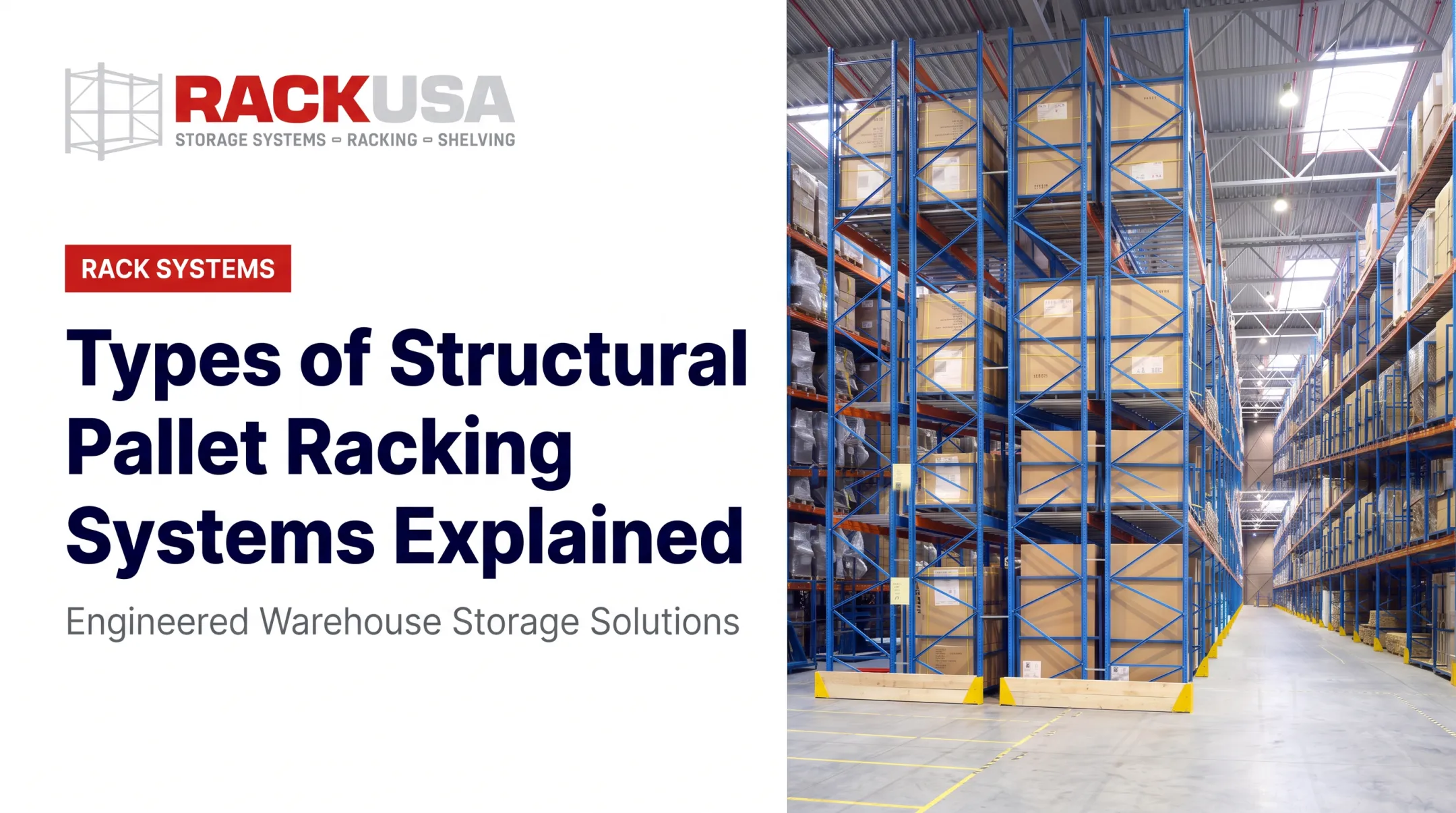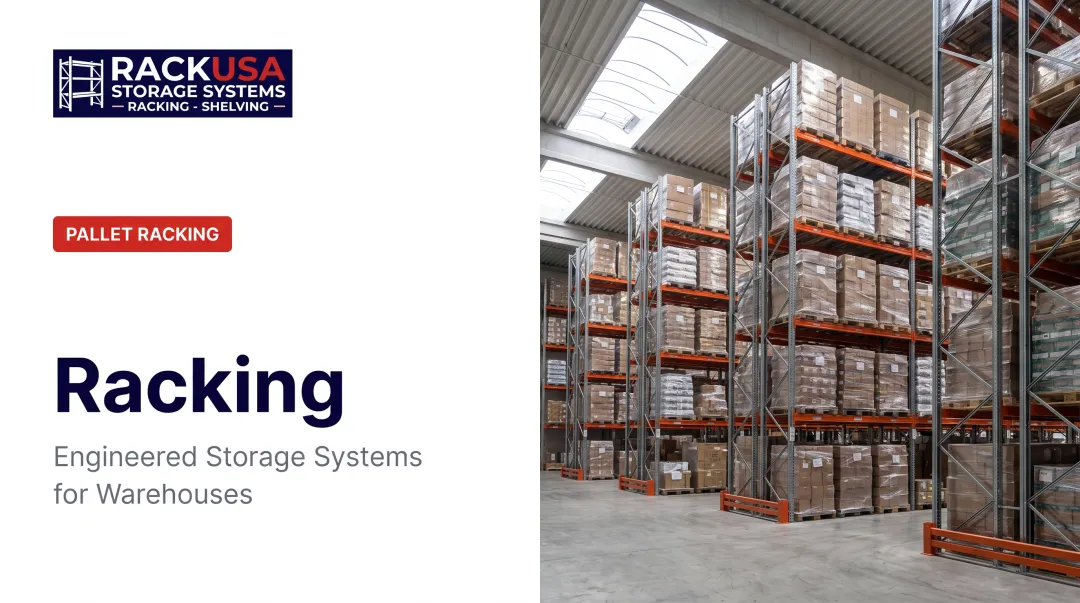

Many operators default to FIFO selective racking without realizing that a LIFO system can pack dramatically more pallet positions into the exact same footprint. According to RMI's 2025 breakdown of LIFO rack systems, homogeneous, non-expiring inventory is the ideal candidate for last-in, first-out storage.
This guide covers what LIFO racking is, the four main system types, and how to figure out which one fits your operation.
Key Takeaways
- LIFO racking loads and unloads pallets from the same aisle, cutting wasted travel time
- Works best for homogeneous, non-perishable SKUs such as building materials, beverages, and packaging
- Choose among double-deep selective, push-back, drive-in, and double-wide drive-in based on density and SKU mix
- Push-back systems can deliver up to 90% more storage than selective rack, per Steel King
- RackUSA designs and installs custom LIFO layouts matched to your inventory and turnover profile
What Is a LIFO Pallet Racking System?
LIFO stands for last-in, first-out. The most recently loaded pallet is the first one pulled back out. That's the opposite of FIFO, where the oldest stock ships first.
The defining feature: loading and unloading happen from the same aisle. FIFO systems, by contrast, use separate aisles at opposite ends of the rack row to keep stock rotating in order.
This makes LIFO a poor fit for anything with an expiration date or shelf-life concern. But for the right inventory, it maximizes storage density.
Best-fit use cases include:
- Homogeneous SKUs stored in bulk quantities
- Non-perishable, non-expiring goods
- High-volume, low-variety inventory — think building materials, bottled beverages, or packaging supplies
Curious how FIFO stacks up in more detail? Jump to the FAQ section below.
Key Benefits of LIFO Pallet Racking Systems
Maximized Storage Density
Eliminating dedicated unloading aisles frees up floor space for more pallet positions. Steel King reports its push-back system delivers up to 90% more product storage than selective rack, while RMI's research cites space utilization gains as high as 95% for push-back configurations.
RackUSA's Drive-In and Drive-Thru systems apply the same approach: cut unnecessary aisles and roughly double capacity versus standard selective racking.
Reduced Travel Distance and Labor Time
Same-aisle load and unload means forklift operators cover less ground per cycle. RMI notes this directly reduces operator travel, and manufacturer Hannibal reports its double-wide drive-in system cuts travel by 50% by moving two pallets per trip instead of one.
Less travel time means:
- Faster put-away and retrieval cycles
- Fewer forklift hours logged per shift
- Lower fuel or battery consumption on equipment
Lower Cost Per Pallet Position
Drive-in racking uses continuous rail supports instead of the extra steel and aisle space selective racking needs. You get a lower installed cost per pallet position, which is why bulk-storage operators favor LIFO when SKU variety is low and volume per SKU is high.
Improved Space Utilization in Tight Footprints
A selective rack layout can need twice the floor area to hold the same pallet count as a drive-in system. In buildings with fixed square footage or low clear height, that density gap often decides whether you expand the footprint or reconfigure in place.
Reduced Honeycombing Risk (When Slotted Correctly)
Honeycombing happens when a lane is only partially filled, leaving unusable gaps. Proper slotting — matching lane depth to actual SKU velocity — keeps this risk low. Apex Warehouse Systems warns that mixing SKUs in one lane or overestimating quantity creates permanent dead space, so lane planning matters as much as rack selection.

4 Main Types of LIFO Pallet Racking Systems
LIFO pallet racking packs more pallets into the same footprint by storing deeper in each lane. The four systems below differ mainly in depth, equipment needs, and how many SKUs you can run per lane.
Double-Deep Selective Rack
Double-deep racking stores two pallets back-to-back in a single position, roughly doubling density over standard single-deep selective rack. It requires a double-deep reach forklift, and the truck's outrigger dimensions must match the rack's bay opening.
According to Apex Warehouse Systems, some configurations need a bottom beam at a 96-inch bay opening, while widening the opening to 102-104 inches can eliminate that requirement. Lock bay opening and truck specs in during design—before steel is ordered.
Push-Back Rack (Roller or Cart-Based)
Pallets rest on inclined rails or wheeled carts. Load a new pallet, and it pushes the row behind it back one position. Lanes typically hold 2 to 6 pallets deep, and RMI's research points to space utilization gains as high as 95% in some layouts.
Two common mechanisms:
- Roller-based: Tolerates mixed pallet sizes with simpler upkeep
- Cart-based: Each pallet rides its own wheeled cart; systems such as UNARCO's handle damaged, odd-sized, or custom containers
Choose based on pallet condition and how consistent your loads are.
Drive-In Rack
Forklifts drive straight into the rack structure along continuous rail supports, with no intermediate beams blocking the path. Lanes commonly run 6 to 8 pallets deep, though depth depends on building dimensions and load requirements.
Drive-in works well for products like bottled water or packaging materials: high-volume, single-SKU inventory. The tradeoff is lower selectivity: since one lane holds one SKU, you need enough volume to fill it without creating honeycomb gaps.
Double-Wide Drive-In Rack
This configuration uses quad-fork trucks (sometimes called "Single-Double" attachments) to load and unload two pallets simultaneously. Hannibal Industries reports conversions from single-wide to double-wide can boost capacity by 50-150%, often while cutting required square footage in half.
This is the go-to setup for high-volume beverage distribution and similar bulk operations where throughput matters more than SKU variety.

Choosing the Right LIFO System for Your Warehouse
Matching a LIFO system to your warehouse comes down to four variables:
- SKU variety: More SKUs favor double-deep or push-back; single-SKU bulk favors drive-in
- Product velocity: Fast-moving, high-volume goods suit drive-in and double-wide drive-in
- Available equipment: Double-deep requires deep-reach trucks; double-wide drive-in requires quad-fork attachments
- Ceiling height and floor space: Limited square footage pushes toward higher-density options
| Warehouse Profile | Best-Fit System |
|---|---|
| Moderate SKU count, need some access | Double-deep or push-back |
| Single-SKU bulk storage, high volume | Drive-in |
| Very high throughput, paired-pallet handling | Double-wide drive-in |
Getting the match wrong is expensive. Retrofitting rack after installation costs far more than designing the right layout up front.
RackUSA's engineering and design team works through this profile-matching process with clients, building custom layouts around space, load requirements, and how inventory actually moves through the facility.

LIFO vs. FIFO: Quick Comparison
The core difference comes down to aisle configuration. LIFO uses one aisle for both loading and unloading. FIFO separates the two, keeping stock rotating in order.
- Choose LIFO for homogeneous, non-expiring inventory where storage density matters more than strict rotation
- Choose FIFO for perishables, date-coded goods, or anything requiring guaranteed first-in-first-out movement
- Choose a hybrid when you need both—pallet shuttle systems like RackUSA's Matador APS can run FIFO or LIFO by configuration
If most of your SKUs need strict rotation, don't force a LIFO system onto them just for the density gains. It'll cost you more in fulfillment headaches than it saves in square footage.
Safety and Maintenance Considerations for LIFO Racking
Tighter maneuvering in drive-in and double-deep systems raises the stakes for operator training. OSHA's 1910.176 standard on material handling requires safe clearances, marked aisles, and stable storage — baseline requirements that apply regardless of rack type.
Ongoing maintenance essentials:
- Routine rack inspections, with damage-prone areas checked more frequently than the rest of the system
- Load capacity verification against the rack's rated plaques
- Narrow-lane forklift training for drive-in operators, since rack-contact risk runs higher in tight lanes
With RackUSA LIFO projects, engineering support and rack repair can be bundled so systems stay safe as they age. Since capacity plaques can become inaccurate after modifications, any layout change should go through a qualified rack engineer before reloading.

Frequently Asked Questions
What is a FIFO pallet racking system?
FIFO (first-in, first-out) racking uses separate loading and unloading aisles so the oldest stock ships first. It's the standard choice for perishable or expiring goods.
Is push-back racking LIFO or FIFO?
Push-back is a LIFO system. The last pallet loaded into a lane is the first one retrieved, since pallets nest on rails or carts and shift backward as new stock arrives.
How deep can a LIFO drive-in rack system go?
Most drive-in lanes run 6 to 8 pallets deep, though actual depth depends on pallet size, forklift reach, and building dimensions.
What products are best suited for LIFO storage?
Homogeneous, non-perishable goods work best — think building materials, bottled beverages, and packaging supplies where strict rotation doesn't matter.
Does LIFO racking require special forklifts?
Yes, in most configurations. Double-deep needs a deep-reach truck, and double-wide drive-in needs a quad-fork attachment to move two pallets at once.
How much storage density can LIFO racking add compared to selective racking?
Gains vary by system: push-back can add up to 90% more storage, and double-wide drive-in conversions have shown 50–150% capacity increases.