
FIFO warehouse storage means the oldest inventory gets picked and shipped first. It sounds simple, but the racking system you choose either makes that automatic or makes it a guessing game your staff loses. This article covers FIFO fundamentals, the racking systems that actually enforce it, the benefits worth chasing, and how to implement it without guesswork.
Key Takeaways
- FIFO depends on physical warehouse flow; software settings alone cannot enforce it
- Gravity flow and drive-through racking enforce rotation automatically; selective racking doesn't
- Federal rules require oldest-stock-first rotation for regulated pharmaceutical products
- Match rack type to SKU turnover instead of chasing maximum density
- Engage a qualified engineering partner to avoid costly rack-code and seismic-design mistakes
What Is FIFO Warehouse Storage?
FIFO, or first-in, first-out, is an inventory method where the stock received earliest is picked and shipped first. At rack level, it's the warehouse version of "don't let things go stale in the back of the fridge."
Certain industries can't afford to get this wrong:
- Food and beverage — product ages fast; USDA estimates food loss at 30–40% of the U.S. food supply
- Pharmaceuticals — federal cGMP rules (21 CFR 211.86 and 211.150) require oldest approved components and drug stock to be used or distributed first
- Cosmetics and chemicals — shelf life and lot control often dictate rotation requirements
- Apparel and electronics — these don't spoil, but they go obsolete just as fast
Here's the part people miss: FIFO is both a management philosophy and a physical racking design challenge. You can't rotate stock properly unless the layout has a distinct load side and a separate unload side.
Selective racking gives direct access to every pallet, but it doesn't force rotation. Someone still has to know which pallet is oldest and choose to pick it.
FIFO vs. LIFO: Understanding the Difference
LIFO (last-in, first-out) is the opposite approach: the newest stock goes out first. That sounds backward until you consider what it's built for.
Drive-in racking, for example, has a single entry point. You load and unload from the same aisle, so the last pallet in is physically the first one out. That's fine for bulk, non-perishable, homogeneous SKUs like steel coil or dry building materials where age doesn't matter.
| Method | Physical Flow | Best Rack Type | Ideal Products |
|---|---|---|---|
| FIFO | Oldest out first | Drive-through, pallet flow, carton flow | Perishables, lot-controlled, expiration-dated goods |
| LIFO | Newest out first | Drive-in, push-back | Bulk, non-perishable, homogeneous stock |

Most warehouses don't pick one system and stop there. They run hybrid layouts: FIFO zones for date-sensitive SKUs and LIFO zones for bulk commodity items, based on what each SKU actually needs. Push-back racking, which stores two to six pallets deep per lane with single-aisle access, is a common LIFO choice for these bulk zones.
FIFO/LIFO in a warehouse describes physical material flow. It's a completely different concept from LIFO as an accounting method under IRS rules. Don't let your finance team's inventory valuation method dictate your rack design, and vice versa.
Types of FIFO Racking Systems
Not every rack enforces FIFO. Here's what actually does, ranked roughly from most flexible to most automated.
Selective Pallet Racking
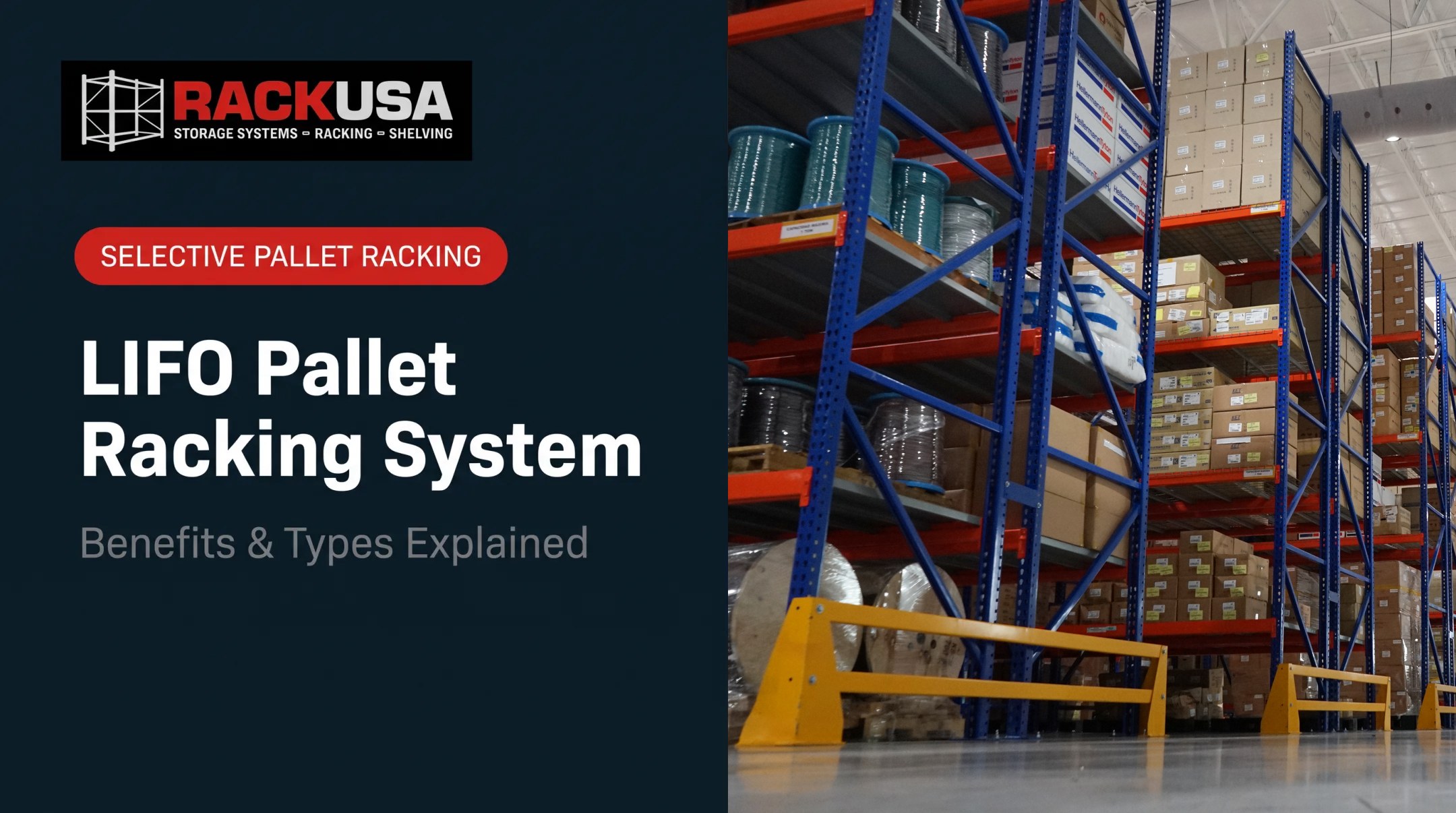
Available in roll-formed or structural configurations, selective racking gives direct access to every single pallet. It's the most flexible option for facilities running high SKU variety, but that flexibility costs you storage density since every lane needs its own access aisle.
FIFO is possible here, but it depends entirely on labeling discipline and staff following the rules. The rack itself won't stop someone from grabbing the wrong pallet.
Drive-Through Racking
Load from one end, unload from the other. This dual-access design reaches up to 2x the density of selective racking while still enforcing a lane-level FIFO path. Compare that to drive-in racking, which has only one entry point and naturally defaults to LIFO.
Gravity Flow Systems (Pallet Flow & Carton Flow)
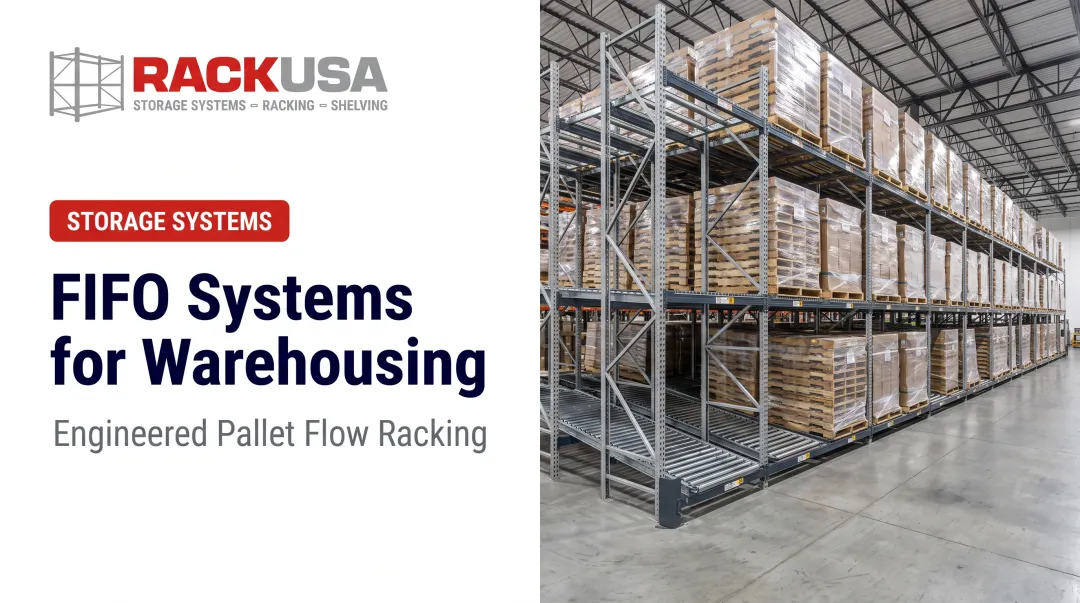
This is where FIFO gets automatic. Inclined rails or rollers move product from the load side to the pick side using gravity alone, with no forklift or external power needed for internal movement.
- Pallet flow handles full pallets; a strong fit for cold storage, food and beverage, and pharma operations needing strict expiration management
- Carton flow handles smaller cartons and totes, reducing manual restocking and operator fatigue during piece-picking
Pallet flow lanes can deliver up to 60% more storage than conventional selective racking, according to internal design comparisons, while keeping rotation completely hands-off.

Pallet Shuttle/Runner Systems
Semi- or fully automated shuttle carts move pallets within lanes, combining drive-in-level density with faster cycle times. RackUSA's Matador APS shuttle system, manufactured in Gómez Palacio, Durango, runs in both semi-autonomous and fully autonomous modes. Each pallet gets a unique ID for real-time tracking, and the system integrates with existing WMS, WCS, or WES platforms without requiring downtime during rollout.

RackUSA engineers the full range above: selective, drive-through, pallet flow, carton flow, and Matador pallet shuttle, tailored to a facility's throughput and budget. If you're comparing options, ask your provider for a density-versus-selectivity chart specific to your SKU mix. It's the fastest way to see the real tradeoffs side by side.
Key Benefits of FIFO Product Flow
With food loss estimated at 30-40% of the US food supply, age control isn't a nice-to-have. FIFO product flow keeps old stock from hiding behind newer pallets and improves how you use space and labor.
Typical gains include:
- Reduced spoilage and obsolescence as older pallets stop hiding behind newer stock
- Higher density than random-access storage, since gravity flow lanes don't sacrifice floor space to reach every pallet
- Easier cycle counts and SKU visibility when each flow lane holds one SKU
- Faster picking with less forklift travel from a fixed pick face
- Stronger compliance with expiration-sensitive rules in food safety and pharma
- Fewer write-offs from products that age out before they sell

One caveat: don't expect a universal percentage improvement from switching rack types alone. The real gains depend on your baseline — current shrinkage, pick times, and space utilization — before the new system goes in.
Best Practices for Implementing FIFO in Your Warehouse
FIFO holds only when receiving, layout, software, and people enforce the same rotation rules. Build those habits in from day one:
- Label everything at receiving. Capture arrival date, lot number, and expiration date where applicable. Guesswork during picking is where FIFO breaks down fastest.
- Design for one-way flow. Dedicate a load side and a discharge side. Don't let staff shortcut by loading and unloading from the same aisle.
- Integrate a WMS. Configure it to reserve the oldest eligible lot automatically and flag exceptions. Matador APS, for example, assigns each pallet a unique ID so the system always knows what's oldest.
- Train staff and audit regularly. Even the best rack design drifts if nobody checks that pickers are actually following the rotation.
- Slot fast movers without skipping age. Keep your highest-velocity SKUs in the most accessible lanes, but never bypass older stock still waiting to ship.
Choosing the Right FIFO Storage Partner
A rack that looks right on paper can still fail if it's not engineered for your building, your seismic zone, and your load requirements. Before signing off on a system, check that your provider can deliver:
- Facility layout design and structural/seismic analysis specific to your site
- PE-stamped drawings where your jurisdiction requires them
- Manufacturing, installation, and ongoing maintenance under one roof, rather than juggling separate vendors
RackUSA has manufactured storage systems since 1972 out of Gómez Palacio, Durango, with operations spanning the US, Mexico, and Central America. Its drive-in and drive-through systems carry RMI R-Mark certification and meet ANSI MH16.1-2023 standards.
Every design is calculated against seismic zone, total load, and the geometry of the uprights, beams, and bracing. Look for that same documented path—from SKU review through installation and preventive maintenance—whether you work with RackUSA or another manufacturer.
Frequently Asked Questions
What is an example of FIFO in a warehouse?
A food distributor loading pallet flow racks from the back and picking from the front is a classic example. The oldest pallet always reaches the pick face first, with no manual sorting required.
What racking system is best for FIFO?
Gravity flow systems (pallet flow and carton flow) enforce true FIFO automatically. Drive-through racking is a close second, offering dual-access rotation without the added mechanical components.
Is FIFO better than LIFO for a warehouse?
It depends on what you're storing. FIFO fits perishable or time-sensitive goods; LIFO works fine for bulk, non-perishable inventory where age doesn't affect value.
How much does a FIFO racking system cost?
Cost varies based on system type, storage density needs, and whether you're adding automation like pallet shuttles. Get a project-specific quote rather than relying on generic per-pallet pricing.
Can FIFO be combined with automation?
Yes. Pallet shuttle systems like Matador APS move pallets within lanes automatically, improving pick speed and rotation accuracy while cutting down on manual forklift work.
What industries benefit most from FIFO storage?
Food, beverage, and pharmaceutical industries have the strongest case, given spoilage risk and federal rotation requirements. Cosmetics, chemicals, and other shelf-life-sensitive goods benefit as well.