
That's where narrow aisle pallet racking comes in. It's a proven way to add pallet positions without adding square footage, but the racking itself is only half the equation. Choosing the right configuration and the right manufacturer matters just as much.
This guide covers what narrow aisle racking actually is, the exact aisle-width specs you need to know, the real benefits, what to consider before buying, and how to pick a manufacturer that can deliver a complete, code-compliant system.
Key Takeaways
- Narrow aisle racking boosts storage density up to 50% over standard selective racking
- Aisle width dictates equipment: reach trucks need 8-10 ft, turret/swing-reach trucks need 5-6 ft
- Full pallet selectivity and FIFO rotation are preserved, unlike drive-in or block-stacked storage
- Floor flatness, truck guidance, and operator training are non-negotiable requirements for VNA systems
- A site-specific engineering review determines the true minimum aisle width for your operation
What Is Narrow Aisle Pallet Racking?
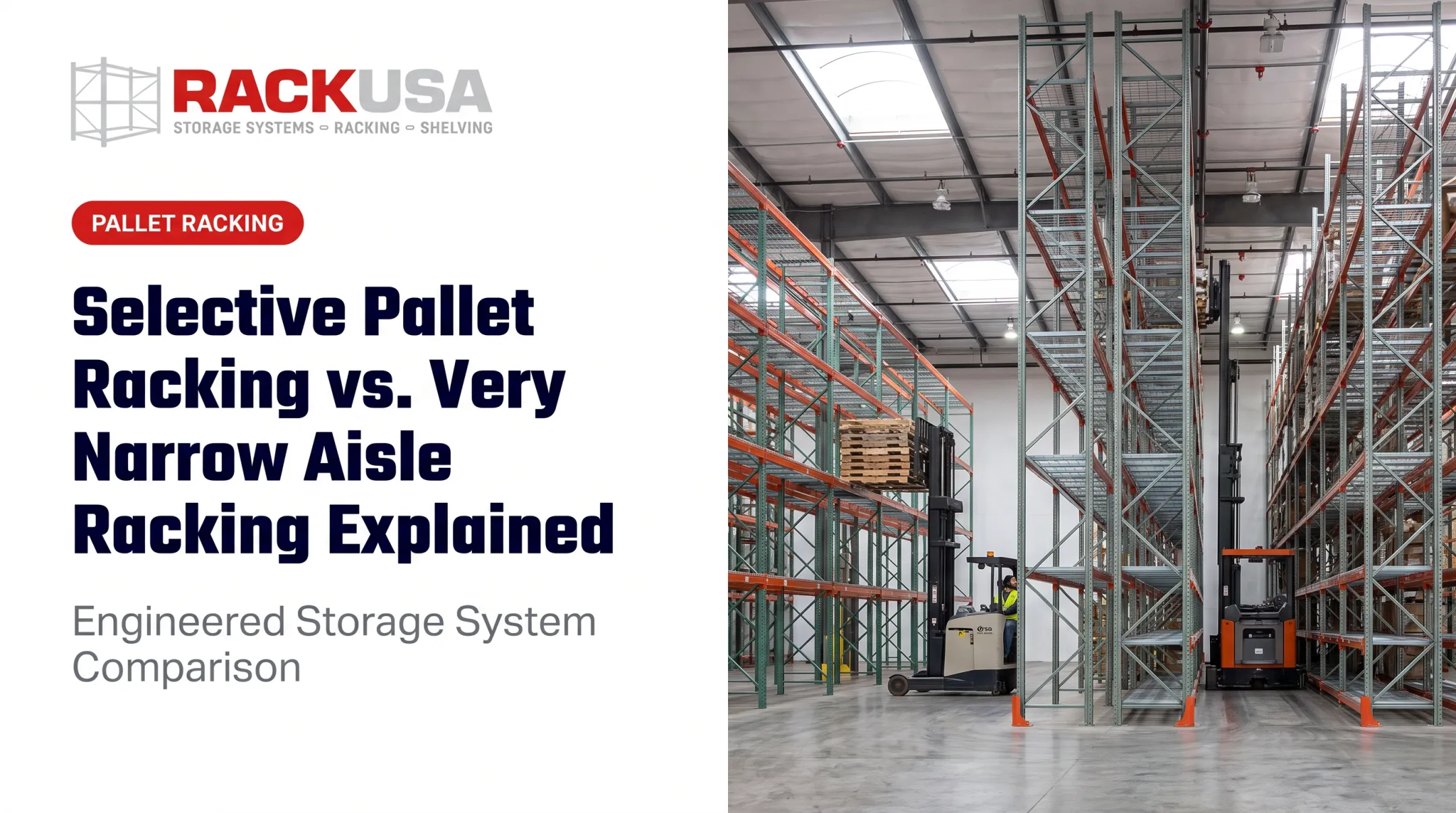
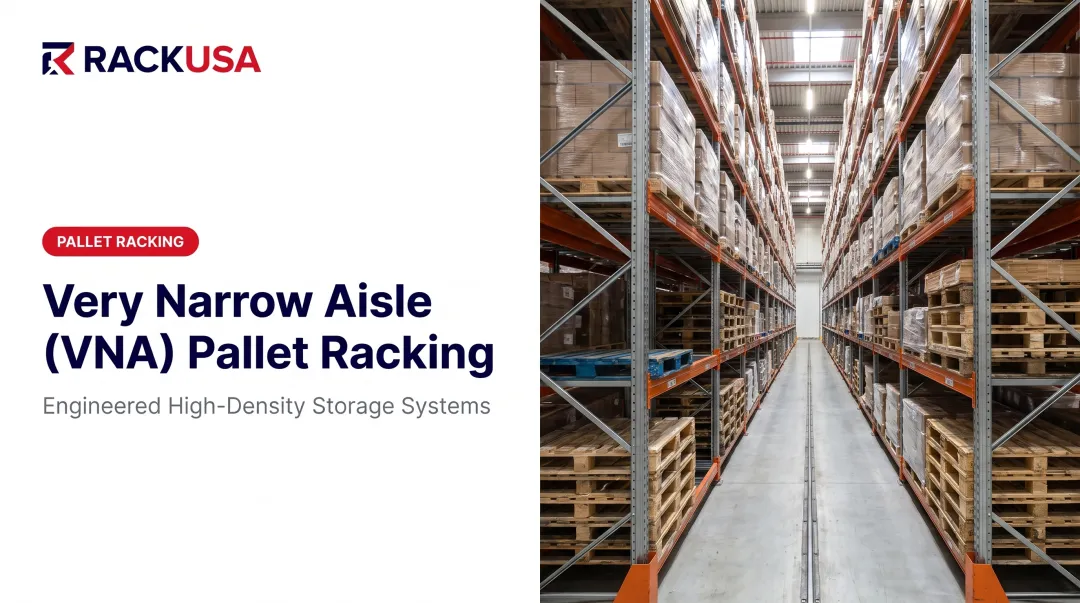
Narrow aisle pallet racking is a selective rack configuration built around tighter aisle widths. Instead of the standard 10-13 ft aisle needed for a counterbalance forklift, narrow aisle systems typically run 8-10 ft, while very narrow aisle (VNA) systems drop to roughly 5-6 ft. That difference lets you fit more rows of rack into the same footprint.
The key advantage: you're not sacrificing access. Unlike drive-in racking or block stacking, narrow aisle configurations keep every pallet position directly reachable. You get full selectivity and FIFO rotation, just in a tighter footprint.
Narrow Aisle vs. Very Narrow Aisle (VNA)
These terms get used interchangeably, but they're not the same thing.
| Type | Aisle Width | Equipment |
|---|---|---|
| Narrow aisle (NA) | 8-10 ft | Reach trucks |
| Very narrow aisle (VNA) | 5-6 ft | Turret or swing-reach trucks, often with wire- or rail-guidance to keep the truck centered |
The equipment reflects that difference. A reach truck can operate in a standard aisle if needed, but a turret truck generally cannot, since its entire design (rotating forks instead of a turning chassis) is built around operating in a fixed, guided path.
Equipment That Makes It Possible
Narrow aisles work because specialized trucks eliminate the need for a forklift to turn 90 degrees into the rack face. Common options include:
- Reach trucks for 8-10 ft aisles
- Swing-reach or turret trucks for 5-6 ft VNA aisles, which rotate forks on the mast rather than turning the truck body
- Order pickers (high- or low-level) for pick-heavy VNA operations
- Wire- or rail-guidance systems that keep VNA trucks centered and safe at speed
RackUSA engineers narrow aisle configurations as part of its selective racking portfolio, tailoring beam spans, upright depth, and load capacity to the client's pallet dimensions and truck type. Every warehouse's pallet mix and equipment differ, so the layout gets built around your specific loads rather than a generic template.

Aisle Width Guide: Narrow, Very Narrow, and Wide Aisle Racking Compared
Aisle width is calculated based on the truck that will run in it. Toyota's aisle width guide defines the minimum aisle as the space a loaded truck needs to complete a 90-degree turn, factoring in turning radius, load width and length, and required safety clearance.
Here's how the three categories typically break down:
| Aisle Type | Typical Width | Truck Required | Relative Density |
|---|---|---|---|
| Wide/Standard | 10-13 ft | Counterbalance forklift | Lowest, maximum flexibility |
| Narrow Aisle (NA) | 8-10 ft | Reach truck | Moderate |
| Very Narrow Aisle (VNA) | 5-6 ft | Turret/swing-reach truck, order picker | Highest |
Wide Aisle: Maximum Flexibility
Standard selective racking at 10-13 ft accommodates almost any counterbalance forklift on the market. It's the most flexible layout, but it also uses the most floor space per pallet position. If your operation runs a mixed fleet or high truck turnover, wide aisles keep things simple.
Narrow Aisle: The Common Upgrade Path
At 8-10 ft, narrow aisle racking is often the sweet spot for warehouses looking to add density without overhauling their entire equipment fleet. Reach trucks are widely available, and the transition from standard racking doesn't require guidance systems or major floor work in most cases.
Very Narrow Aisle: Maximum Density, Maximum Specificity
The turret or swing-reach truck's turning and load-handling specs determine VNA aisle width at 5-6 ft, not the rack itself. Two trucks with different mast designs might require different minimum widths even in the same warehouse.
The final number also depends on pallet overhang, truck mast height, and ceiling clearance. That's why RackUSA bundles a site-specific engineering review with every narrow aisle rack purchase, so your actual minimum aisle width is confirmed before you buy — not estimated from a generic chart.
Top Benefits of Narrow Aisle Pallet Racking
The core appeal of narrow aisle racking is simple: shave off aisle width, and you gain pallet positions in the same building. According to Modern Materials Handling, VNA systems can increase storage density by up to 50% compared to conventional layouts.
Crown's own modeling shows a 25% increase in pallet positions (from 192 to 240 in a same-footprint, four-level comparison) when narrowing aisles from 2.7 m to 1.8 m (about 9 ft to 6 ft), according to Crown's VNA truck brochure. Real-world gains vary by ceiling height and layout, but the direction holds: narrower aisles mean more pallet positions.

More Height, Not More Footprint
Narrow aisle systems also support vertical expansion. Because VNA trucks are built for high-level lifts, warehouses can add storage height instead of chasing additional square footage, which matters most where land or lease costs are climbing.
A smaller building footprint also trims overhead costs, including heating and cooling, lighting, and general facility maintenance.
Shorter Travel, Faster Picks
Narrower aisles put more rack faces within reach of each travel path. That means:
- Less distance between rows during picking runs
- Every SKU stays directly accessible (no digging through deep lanes)
- Fewer wasted trips across the warehouse floor
FIFO Stays Intact
Unlike block-stacking or deep-lane storage, narrow aisle racking doesn't force a trade-off on stock rotation. You keep full pallet selectivity and FIFO access, which matters for any operation handling perishables, date-coded inventory, or high SKU counts.
RackUSA engineers its narrow aisle racking to deliver these density and access gains while meeting ANSI MH16.1 and seismic design standards.
Important Considerations Before You Buy Narrow Aisle Racking
Narrow aisle racking isn't a drop-in upgrade. A few practical realities deserve attention before you commit.
Equipment investment. Reach and turret trucks cost more upfront than standard counterbalance forklifts, and ongoing maintenance tends to run higher too, since these trucks operate with tighter tolerances and more specialized components.
Training and guidance. Operators need training specific to narrow aisle equipment, and VNA applications often require wire- or rail-guidance installation to keep trucks centered and safe at higher lift heights. RackUSA bundles engineering and installation support with narrow aisle rack purchases, but operator certification is usually arranged through your equipment dealer or a specialized trainer.
Floor flatness. VNA trucks run in fixed, defined paths, which means floor tolerance requirements are stricter than for standard forklift traffic. ASTM E1155 flatness testing isn't designed for fixed-path systems, so VNA floors typically need a project-specific tolerance review rather than a generic flatness number.
None of this makes narrow aisle racking a bad investment. It means budgeting for equipment, training, and floor prep from day one, not after the rack arrives.

Narrow Aisle vs. Standard Selective Racking: Which Fits Your Operation?
Both systems store pallets on a fully selective basis. The difference comes down to how you trade flexibility for density.
In the same footprint:
- Standard selective racking (10-13 ft aisles) offers maximum flexibility. Any counterbalance forklift can run in it.
- Narrow aisle/VNA trades some of that flexibility for meaningfully more pallet positions per square foot.
Who fits each layout best:
- Narrow aisle suits high SKU count operations with moderate-to-low pallets per SKU
- Narrow aisle suits facilities where floor space costs more than equipment upgrades
- Standard aisles suit high-throughput, high-turnover operations that need truck fleet flexibility
- Standard aisles suit facilities running mixed operations where counterbalance trucks handle other tasks beyond racking
Here's something many buyers don't realize: existing standard selective rack can often be reconfigured into a narrow aisle layout. It's not automatic though. A supplier engineer needs to verify current rack condition and beam capacity before signing off on the conversion, since narrower spacing and taller configurations change the load math.
Buying Narrow Aisle Pallet Racking: Why Work With RackUSA
Getting the aisle width right is only useful if the racking behind it is engineered correctly. RackUSA has manufactured storage systems since 1972, and its narrow aisle configurations carry MHI R-Mark certification, giving buyers assurance that the system meets recognized industry standards for cold-formed steel racking.
For narrow aisle projects specifically, RackUSA's engineering services include:
- Facility layout design tailored to your pallet dimensions and truck type
- Structural load analysis to confirm beam and upright capacity
- Seismic analysis for facilities in higher-risk zones
- PE-stamped drawings to support your permitting process
RackUSA also runs a turnkey model, bundling design, manufacturing, installation, and ongoing maintenance and safety audits into a single project instead of routing them through separate vendors.
With offices and warehouses across the United States and Mexico, plus representation in Guatemala, El Salvador, and Costa Rica, RackUSA supports buyers across the Americas without the coordination headaches of managing multiple regional suppliers. That regional footprint matters once you're ready to move from research to an actual project.
If you're weighing narrow aisle against standard selective racking, the smartest first step is a custom layout and quote. It's the only way to know the right aisle width, upright depth, and truck pairing for your actual pallet loads, not a generic estimate.

Frequently Asked Questions
What is narrow aisle pallet racking?
Narrow aisle pallet racking is a selective racking configuration with reduced aisle widths, roughly 5-10 ft, that increases pallet storage density while keeping full pallet selectivity. Reach or turret trucks are required for access.
What are the typical and minimum aisle widths for narrow aisle pallet racking?
Wide aisles run 10-13 ft, narrow aisles run 8-10 ft, and very narrow aisles (VNA) run roughly 5-6 ft. The true minimum in any case is set by your handling truck's turning and load specs, not the rack alone.
What forklift do I need for narrow aisle racking?
Reach trucks handle standard 8-10 ft narrow aisles. Very narrow aisle systems require swing-reach or turret trucks, often paired with wire- or rail-guidance to keep them centered safely.
How much more storage capacity does narrow aisle racking provide?
Gains vary by layout and ceiling height, but VNA systems can increase density by up to 50% compared to standard selective racking. A same-footprint layout comparison will give you a project-specific figure.
Is narrow aisle racking worth the investment for a small warehouse?
It depends on your SKU count, pallet volume, and growth plans. A supplier layout comparison, weighing added density against equipment and floor costs, is the clearest way to gauge ROI before committing.
Can I convert my existing selective rack to narrow aisle racking?
Often, yes, provided a supplier engineer verifies the rack's condition and load ratings first. You'll also need a new truck fleet suited to the narrower aisle and a revised engineered layout.