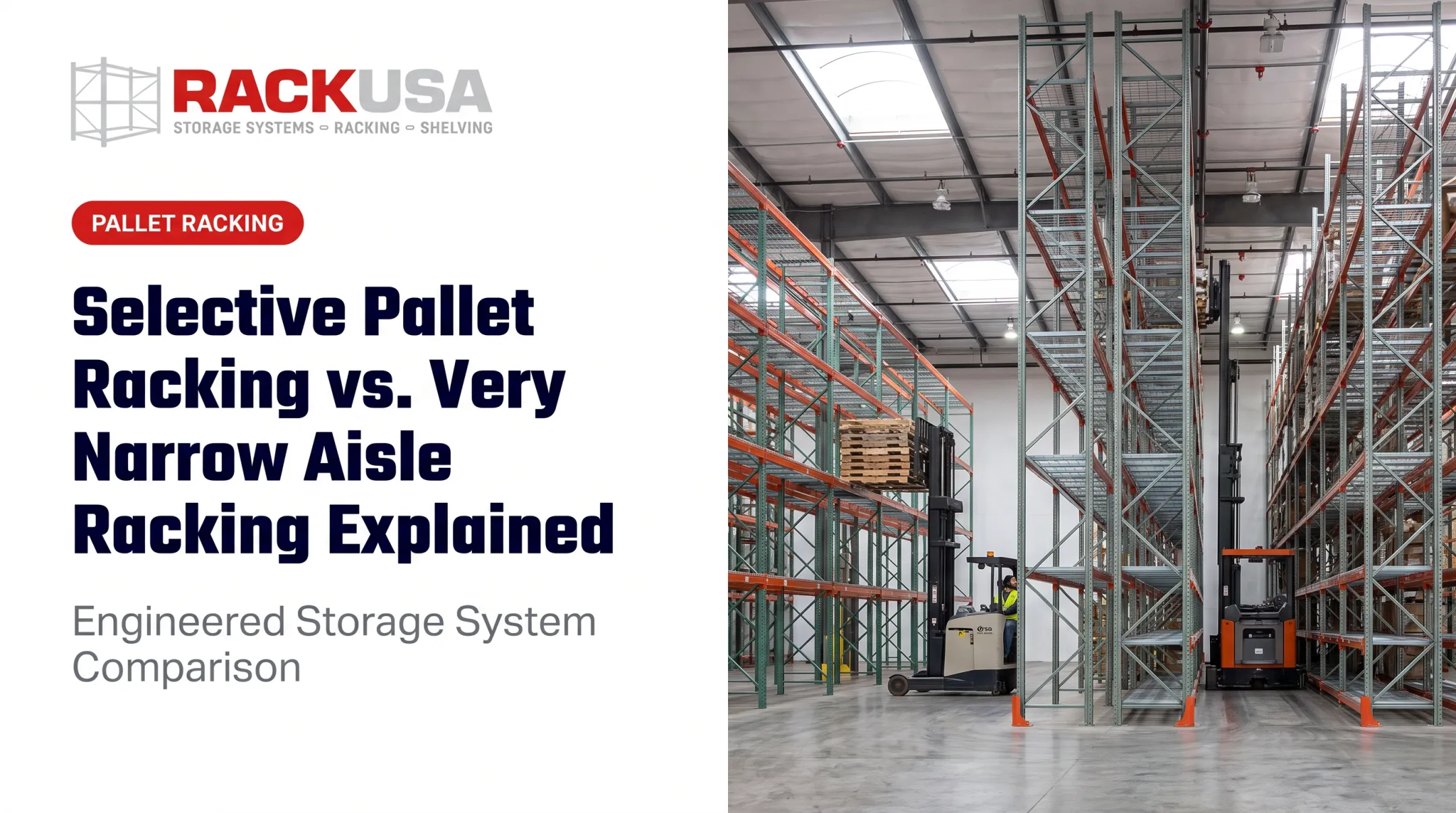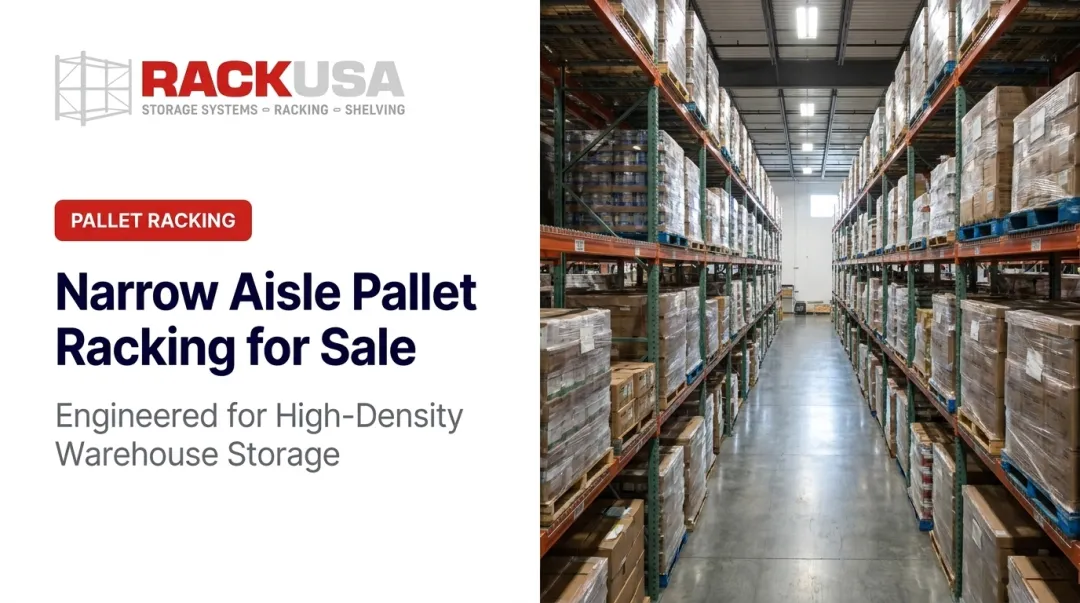

Very Narrow Aisle (VNA) pallet racking solves this without adding a single square foot. By shrinking aisle widths to roughly half of standard configurations, VNA systems pack more pallet positions and pick faces into the same footprint.
This guide breaks down how VNA racking actually works, what it costs versus what it saves, how it stacks up against narrow aisle and standard selective racking, and how to tell if your operation is a good fit.
Key Takeaways
- VNA aisles shrink to 60"-78" (1.5-1.9m), roughly half the width of standard 10-12 ft aisles.
- Turret trucks with wire or rail guidance are required; standard forklifts can't run these aisles.
- Full pallet selectivity stays intact (unlike double-deep or drive-in), but picking flexibility drops.
- Higher equipment costs are typically offset by avoiding facility expansion or relocation.
- 3PLs, retail DCs, and high-SKU e-commerce operations see the strongest returns.
What Is VNA Pallet Racking?
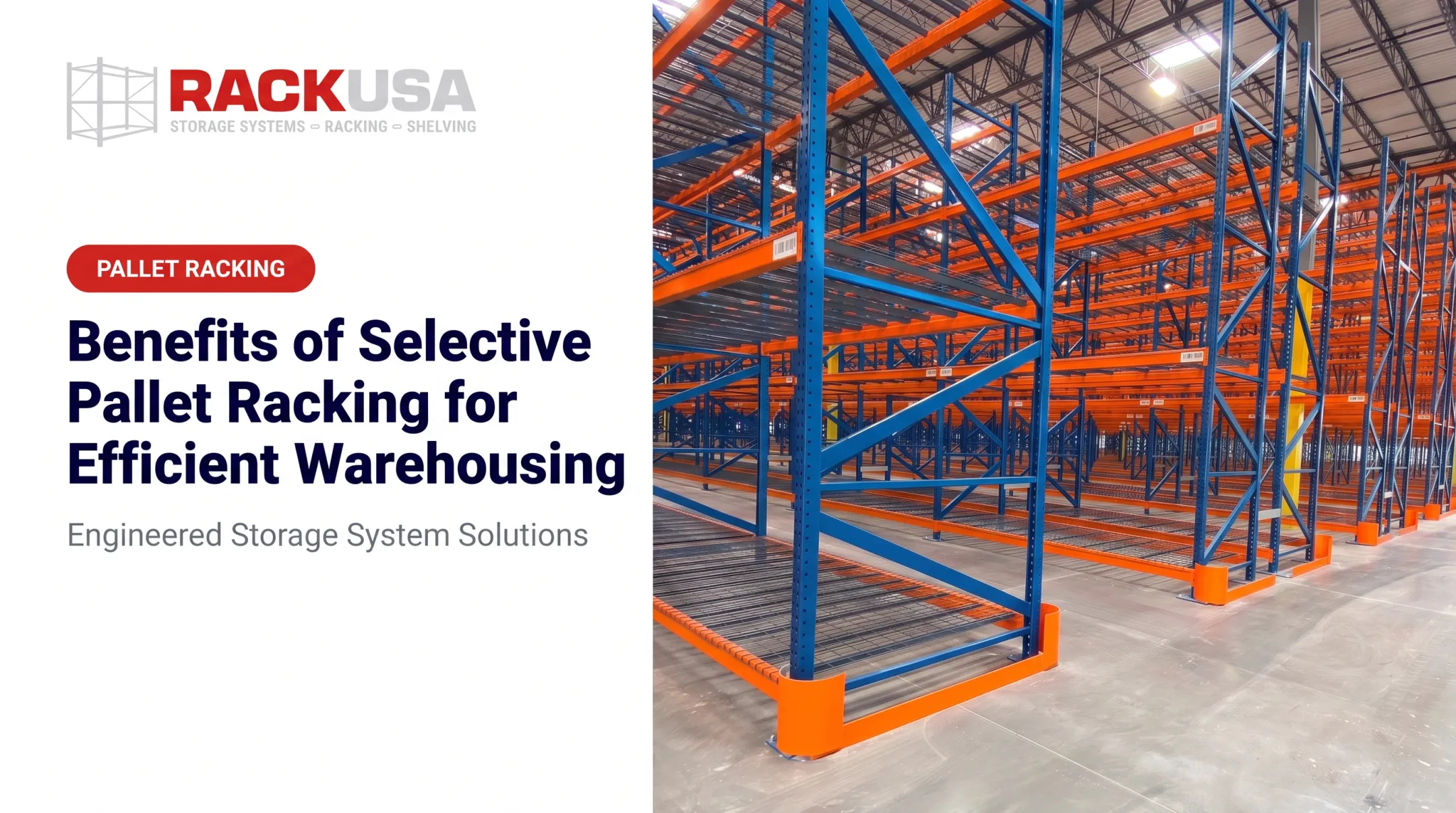
VNA stands for Very Narrow Aisle, and it describes a configuration, not a separate racking category. It's still adjustable selective pallet racking, the same system found in most warehouses, just installed in aisles far tighter than standard designs allow.
How Narrow Is "Very Narrow"?
According to Mecalux's 2024 breakdown of VNA systems, typical VNA aisles run 1.50 to 1.90 meters (about 5 to 6.2 feet). Compare that to standard selective racking, which needs aisles closer to 10-12 feet for a sit-down forklift to turn and maneuver. That difference is the entire point of VNA: less aisle, more rack.
Still Fundamentally Selective Racking
Here's what trips people up: VNA isn't a high-density system like drive-in or push-back racking. It's single-deep selective racking, which means:
- Every pallet is directly accessible, with no digging through blocked positions
- First-in, first-out (FIFO) inventory rotation is preserved
- 100% pallet selectivity remains intact, just in a tighter footprint
One important limitation: double-deep racking cannot be used in VNA layouts. Turret trucks physically can't reach a second pallet position stacked behind the first, so VNA stays single-deep by design.
A Hybrid of Density and Selectivity
VNA combines the pick-anything flexibility of conventional selective racking with the space efficiency usually reserved for high-density systems. Most racking configurations force a trade-off between those two things. VNA narrows the gap.
REB's comparison of VNA to standard selective racking found that converting a five-level warehouse layout from standard aisles to VNA aisles (same footprint, same height) added roughly 1,000 additional pallet positions. That gain comes directly from aisles shrinking from around 12 feet down to 6 to 6.5 feet.

How VNA Racking Systems Work: Trucks and Guidance Technology
Standard forklifts can't turn inside a 60-inch aisle. VNA depends on equipment built for tight-clearance work.
Trilateral vs. Bilateral Turret Trucks
Two truck types dominate VNA operations, and they're not interchangeable:
- Trilateral trucks use a rotating fork head that reaches both rack faces plus the front of the aisle. They can also set pallets on the floor for staging or cross-docking.
- Bilateral trucks use telescopic forks housed in a cradle. They can't place pallets frontally or on the floor, but they operate in even narrower aisles than trilateral trucks and often cycle faster.
The right choice depends on how your aisle-end transfers work and whether floor-level staging matters to your workflow.
Keeping Trucks Aligned: Guidance Systems
Because clearance is measured in inches, not feet, trucks need help staying centered. Two guidance methods handle this:
- Mechanical (rail) guidance: a physical rail or profile anchored to the floor, with guide rollers on the truck riding along it.
- Wire guidance: a powered wire embedded in the floor creates a magnetic field that truck sensors detect, actively steering the vehicle through the aisle.
Toyota's guidance system comparison notes that wire guidance usually costs more upfront: it needs truck-mounted sensors plus facility wiring, while rail systems lean on physical infrastructure. Choose based on facility layout, retrofit cost, and fleet size.
Why Structural Steel Matters at Height
Taller VNA systems face more load stress and a higher risk of collision damage from even slightly misaligned trucks. That's why VNA racking is typically built with structural (hot-rolled) steel rather than roll-formed steel.
RackUSA manufactures both roll-formed and structural steel selective racking. Structural configurations are generally recommended once loads exceed roughly 3 metric tons per level (~6,600 lb) or when frequent forklift contact is a realistic risk—both common in VNA environments with thin clearance margins.
Floor Conditions and Automation Upgrades
Before trucks or automation enter the picture, the floor has to support high-lift stability. A level, smooth concrete floor is non-negotiable: even minor unevenness becomes dangerous once pallets are 30, 40, or 50 feet up. A slight tilt at ground level turns into significant sway at height.
From that base, VNA layouts can add AS/RS trilateral stacker cranes. These integrate into existing manual VNA systems to cut retrieval error and steady cycle times.
Key Benefits of VNA Pallet Racking
The appeal of VNA comes down to one core trade: give up some aisle width, gain a lot of usable space. Here's where that trade pays off.
- Narrower aisles free floor area for additional storage rows; companies that switch commonly report capacity gains of 30-50%, depending on aisle width, ceiling height, and layout
- Turret truck masts reach higher than standard forklifts, so racking grows upward instead of outward when real estate is costly or the building footprint is fixed
- More individual pick faces in the same square footage help retailers, 3PLs, and e-commerce centers with thousands of SKUs pick faster and with fewer errors
- Every pallet stays directly accessible (unlike deep-lane or double-deep systems), so putaway and picking move faster with no digging behind a blocking load
- Guided trucks on fixed paths cut cross-traffic collisions common in open-aisle warehouses and improve operator visibility through consistent rack-to-aisle alignment
- Densifying existing space avoids the capital cost of expanding or relocating—a point finance teams weigh heavily, since avoided facility spend often outweighs the higher equipment investment

Key Considerations Before Investing in VNA Racking
VNA isn't the right call for every warehouse. A few trade-offs are worth weighing honestly before committing.
- Higher upfront investment. Specialized turret trucks cost more than standard sit-down forklifts, and wire-guidance installation adds further expense: sensors, floor wiring, and electrical work all factor in.
- Reduced picking flexibility. VNA aisles accommodate exactly one truck at a time. No simultaneous foot-picking, no extra forklifts squeezing through, no pallet jacks running parallel operations.
- Product and SKU suitability. VNA performs best with fairly uniform pallet sizes and weights. Irregular, oversized, or unstable loads are harder to handle in tight, guided aisles.
- Building requirements. Floor flatness and adequate ceiling height are prerequisites, not optional extras. VNA gains come from going taller as much as narrower, so low clearance limits the whole strategy.
If any of these is a hard constraint for your operation, flag it early, before equipment gets ordered.
VNA vs. Standard Selective and Narrow Aisle Racking: Which Fits Your Warehouse?
Three racking configurations sit on a spectrum, trading density against flexibility and cost.
| System | Typical Aisle Width | Truck Type | Density | Flexibility |
|---|---|---|---|---|
| Standard Selective | ~10-12 ft | Sit-down forklift | Lowest | Highest |
| Narrow Aisle (NAR) | ~8.5-9.5 ft | Reach truck | Mid-range | Mid-range |
| VNA | ~5-6.5 ft (60"-78") | Turret/wire-guided truck | Highest | Lowest |
Standard selective racking offers the lowest density, lowest cost, and most operational freedom—any forklift can drive the aisle. NAR splits the difference, using reach trucks in mid-range aisles for a moderate density boost without dedicated guidance systems.
VNA anchors at the far end: maximum density, but it demands dedicated turret trucks and, often, wire or rail guidance.
Quick decision framework:
- Need high selectivity and vertical storage with fairly consistent pallet loads? VNA is worth the equipment investment.
- Need multiple picking methods running at once, or handle irregular pallet sizes? NAR or standard selective will serve you better.
- Working with a mixed truck fleet and a tighter equipment budget? Standard selective keeps cost and complexity lowest.
Is VNA Racking Right for Your Operation?
VNA delivers the most value in a specific set of operations:
- 3PL warehousing, where maximizing billable storage per square foot directly affects margin
- Retail distribution centers juggling seasonal SKU spikes
- E-commerce fulfillment, where pick-face count often matters more than raw pallet count
- Manufacturers managing high SKU counts or fast-turnover components
A few warning signs suggest your warehouse is a strong candidate:
- Floor space is consistently maxed out, with no room left for new rack rows
- SKU counts keep climbing, but the building isn't getting bigger
- Expansion or relocation costs feel harder to justify every year that passes
What a Conversion Actually Involves
Converting from standard selective to VNA doesn't necessarily mean buying all-new racking. Existing rack components can often be reused, depending on their condition and load ratings. That said, the process still requires unloading inventory, dismantling the current layout, and reinstalling components in a new, tighter configuration. It's not a simple retrofit.
A turnkey partner simplifies that transition. RackUSA handles it end-to-end: facility layout design, structural and seismic engineering analysis, and PE-stamped drawings are bundled into the project rather than sold as separate line items.

Installation is matched to your space, SKU mix, and budget. You get one point of contact from initial design through final install, instead of juggling separate vendors for engineering, guidance systems, and installation.
Frequently Asked Questions
What does VNA stand for in a warehouse?
VNA stands for Very Narrow Aisle, a pallet racking configuration with aisles narrowed to roughly 60 to 78 inches (about 5 to 6.5 feet) to maximize storage density within an existing footprint.
How narrow are the aisles in a VNA racking system?
Aisles typically run 60 to 78 inches (1.5 to 1.9 meters), though the exact width depends on the specific truck model and rack design in use.
What type of forklift is needed for VNA racking?
VNA requires specialized turret trucks (trilateral or bilateral) guided by wire or rail systems, since standard sit-down forklifts can't maneuver in these narrow spaces.
Is VNA racking more expensive than standard pallet racking?
Yes, upfront costs run higher due to specialized trucks and guidance systems. That said, avoided expansion or relocation costs typically offset the difference over time.
Can a VNA racking system be automated?
Yes. VNA layouts can incorporate AS/RS trilateral stacker cranes, which integrate with existing manual systems to handle retrieval with less error and more consistency.
What is the difference between narrow aisle and very narrow aisle racking?
Narrow aisle racking (NAR) uses wider aisles (roughly 8.5-9.5 ft) with reach trucks, offering moderate density gains. VNA narrows aisles further (under 6.5 ft) using dedicated turret trucks, delivering the highest storage density of the two.