
But pallet flow racks introduce risks that standard selective racking doesn't have. Pallets roll. Speed needs controlling. Loads transfer from one lane position to another under gravity, not by hand. Standard rack safety rules don't fully address that.
This article breaks down the OSHA standards that apply, the ANSI/RMI engineering references OSHA relies on, spacing and anchoring requirements, inspection best practices, and where enforcement is headed as OSHA's warehousing National Emphasis Program continues into 2026.
Key Takeaways
- Pallet flow racks fall under OSHA's general material handling rule, 29 CFR 1910.176, not a dedicated racking standard.
- ANSI MH16.1 / RMI standards are the technical reference OSHA cites for structural safety and anchoring.
- Violations can range from roughly $1,085 to over $165,000 per citation depending on severity.
- Schedule weekly visual checks and at least one annual professional inspection.
- Velocity controls, pallet stops, and verified load ratings lower liability when systems are engineered correctly.
What Are Pallet Flow Racks and Why OSHA Attention Matters
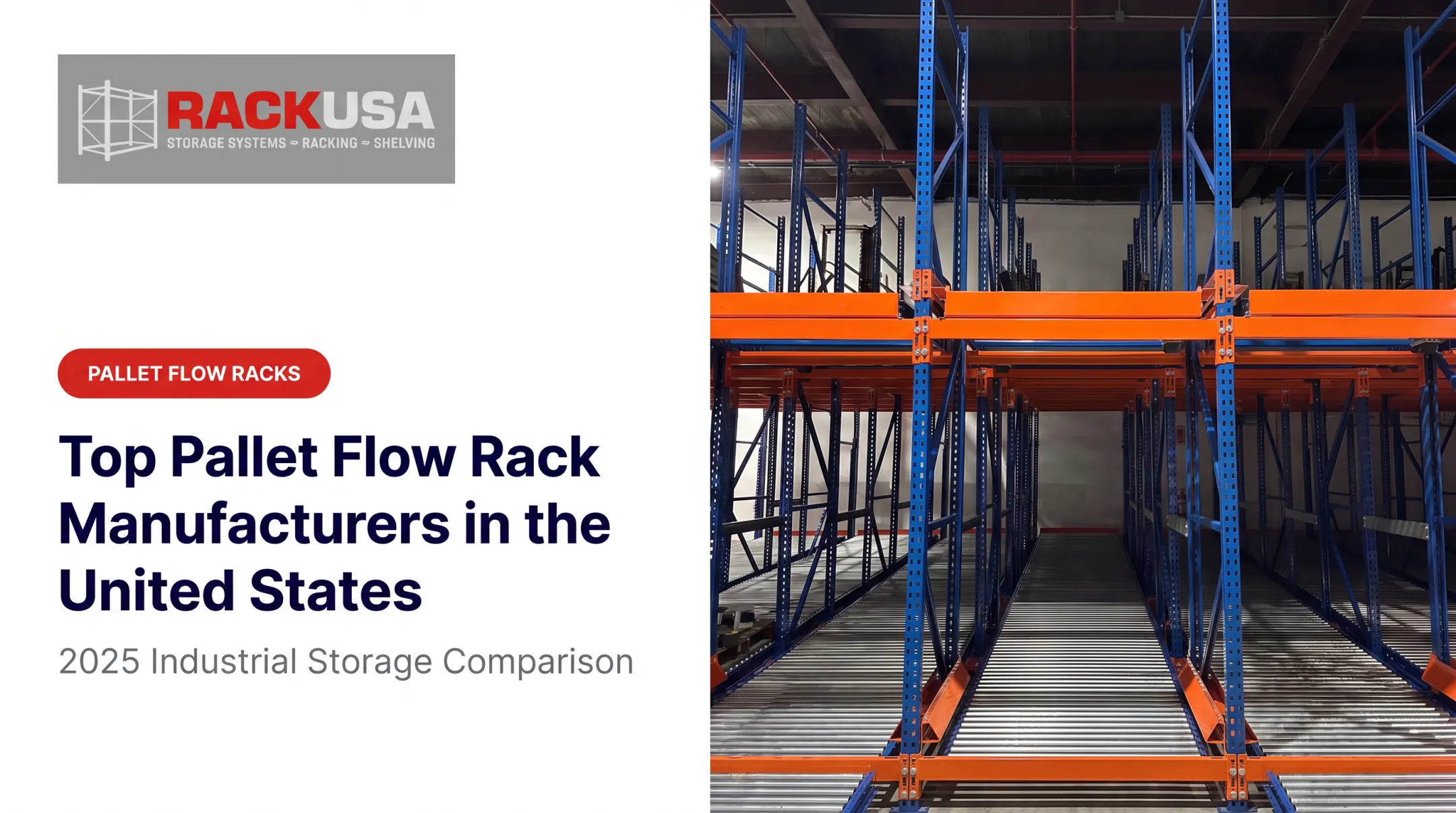
Pallet flow racks use inclined rails fitted with rollers or wheels. Pallets are loaded at the high end and roll by gravity toward the pick face, creating a natural FIFO system. Loading and unloading happen on opposite sides of the rack, which separates the two work zones automatically.
That gravity-fed motion is exactly what makes these systems riskier than static selective racking.
Unique hazard points include:
- Pallet runaway speed if brakes or speed controllers fail
- Impact zones at the rack's discharge end
- Uneven flow causing pallets to jam or tip mid-lane
- Load concentration on rollers and rail beds instead of distributed shelving
Because loads move constantly rather than sit still, these systems need tighter structural review, precise velocity control, and careful attention to how loads transfer from lane to lane. Those moving-load risks are why OSHA and inspectors treat pallet flow installations differently from static racking.

Common Industries Using Pallet Flow Racks
Cold storage facilities, high-throughput distribution centers, and FIFO-critical sectors like food and pharma are the primary adopters.
One documented example: Wisconsin food manufacturer GLK Foods installed a pallet flow system reaching 27.5 feet high with five levels and storage for 850 pallets. The goal was to triple capacity and streamline FIFO handling during harvest season (Modern Materials Handling).
OSHA Standards Governing Pallet Flow Rack Requirements
OSHA has no rack-specific regulation. Instead, pallet flow racks fall under the general material handling standard, supplemented by industry engineering references.
29 CFR 1910.176 breaks into three relevant parts:
- (a) Use of mechanical equipment — requires safe clearances for aisles, loading docks, and passages servicing flow rack lanes; aisles must stay marked, clear, and in good repair.
- (b) Secure storage — storage "shall not create a hazard," so rollers, stops, and speed controls must keep dynamic pallet loads stable throughout travel, not only when static.
- (c) Housekeeping — flow lanes and load/unload zones must stay free of debris, obstructions, and tripping hazards.
Where 1910.176 leaves gaps, OSHA applies the General Duty Clause (Section 5(a)(1)). Employers have been cited for unanchored racks or missing capacity plaques, with ANSI MH16.1 treated as the recognized engineering standard for abatement (OSHA citation record).
1910.178 adds forklift rules for trucks that service flow lanes. Powered industrial trucks must:
- Handle only loads within rated capacity
- Keep forks placed as far under the load as possible
- Maintain sufficient headroom clearance and unobstructed fire aisles
- Get manufacturer approval before any modification affecting capacity
2026 Enforcement Update
OSHA's updated National Emphasis Program on Warehousing and Distribution Center Operations took effect July 31, 2026. It covers warehousing, distribution centers, and parcel-delivery operations.
Targeted hazards include powered industrial vehicle operations and material handling/storage, both directly relevant to pallet flow lanes (OSHA CPL 03-00-026). The directive runs for five years, with a review at year four to determine continuation.
Spacing, Clearance, and Structural Requirements for Pallet Flow Racks
OSHA's language on clearance is a performance standard, not a fixed number. 1910.176(a) requires "sufficient safe clearance" for mechanical equipment servicing the lanes. Exact dimensions typically come from ANSI/RMI guidance and your forklift's specifications.
Anchoring and base plates fall under ANSI/RMI MH16.1. RMI guidance states that all pallet rack columns, including flow rack uprights, should be anchored with bolts and fitted with base plates engineered for applicable forces, including seismic loads and forklift impact.
Load rating and signage requirements:
- Size capacity plaques to at least 50 square inches
- Show maximum unit load, total bay load, and configuration details
- Post plaques at every system entry point or configuration change
- Update plaques after any beam-level change that alters capacity

Velocity control is the piece unique to pallet flow. Rollers, wheel tracks, brakes, and separators keep pallets moving at a safe, consistent speed. Without them, "storage shall not create a hazard" under 1910.176(b) becomes difficult to satisfy: a runaway pallet is a textbook hazard.
Those details only hold up when the system is engineered correctly up front. With a RackUSA pallet flow system, structural load analysis, seismic analysis, and PE-stamped drawings are bundled into the design so spacing, anchoring, and load ratings are verified before installation, not after an inspector finds a gap.
Inspection, Maintenance, and Compliance Best Practices
Rack Manufacturers Institute guidance doesn't set one universal interval for every facility. Frequency depends on traffic, activity, and damage history. That said, a practical baseline works for most operations:
- Weekly visual checks: walk every aisle to confirm the system looks intact
- Monthly inspections for high-traffic aisles or areas with prior damage
- Annual professional inspection: a documented, third-party review

Pallet flow-specific damage points to watch:
- Roller and wheel tracks (wear, debris buildup)
- Speed controllers and brakes
- End stops and separators
- Frame and upright damage from forklift impact
Floor staff should be trained to report damage immediately rather than waiting for the next formal walkthrough. A documented maintenance trail matters if OSHA asks for records during an inspection. RackUSA supports that cycle with engineered pallet flow systems and bundled technical support that help facilities keep inspection and repair work on track.
Penalties for Non-Compliance
OSHA penalty amounts are updated annually. As of the 2026 adjustment memo, current ranges are:
| Violation Type | Penalty Range |
|---|---|
| Serious | $1,085 – $16,550 |
| Other-than-serious | $0 – $16,550 |
| Repeat | $4,256 – $165,514 |
| Willful | $11,823 – $165,514 |
| Failure to abate | $16,550/day (capped ~30 days) |
There's no separate penalty tier for racking violations specifically — a pallet flow citation gets classified the same way any other hazard would, based on severity and history.
What triggers escalated penalties:
- A prior citation for the same or similar hazard that became a final order
- Willful disregard for a known hazard
- Worker injury or fatality tied to the violation
Repeat violations carry no good-faith reduction, and OSHA can apply multipliers of up to 10x for larger employers when deterrence is warranted (OSHA penalties page).
Frequently Asked Questions
What are OSHA requirements for pallet flow racks in the United States?
OSHA applies the general material handling rule, 29 CFR 1910.176, along with the General Duty Clause. Since there's no dedicated pallet flow rack regulation, OSHA references ANSI/RMI MH16.1 for structural and anchoring details.
What OSHA warehousing enforcement updates apply in 2026?
OSHA's updated National Emphasis Program for warehousing and distribution centers took effect July 31, 2026, targeting hazards like powered industrial vehicle operations and material handling/storage in covered facilities.
What spacing and clearance does OSHA require between pallet racks?
OSHA requires "sufficient safe clearances" under 1910.176(a) without specifying exact dimensions. Actual measurements typically come from ANSI/RMI standards and your forklift equipment's turning and lift specifications.
Do pallet flow racks need to be anchored to the floor?
OSHA's text doesn't explicitly mandate anchoring, but it's standard industry practice under ANSI/RMI MH16.1 and manufacturer specifications. OSHA has cited unanchored racks under the General Duty Clause when they created a hazard.
How often should pallet flow racks be inspected?
Best practice is weekly visual checks by staff, with more frequent checks in high-traffic areas, plus at least one annual professional inspection. Facilities with prior damage should inspect more often.
Can OSHA fine a company for a non-compliant pallet flow rack system?
Yes. OSHA can issue citations ranging from roughly $1,085 for serious violations up to over $165,000 for willful or repeat violations, depending on severity and prior history.