
Buyers often mix up bays, runs, uprights, and beams when ordering, which leads to shortages, incompatible parts, or racks that don't reach the capacity they expected. This article breaks down what a bay actually is, its components, standard dimensions, the difference between starter and add-on units, and how to plan bay count for your facility.
Key Takeaways
- A pallet racking bay is the clear space between two upright frames, set by the beam levels that hold your pallets.
- Bays link into "runs"; a cost-efficient run uses one starter unit plus add-on units.
- Bay depth, height, and beam length depend on pallet size and load—measure before you order.
- Specify load requirements up front so a manufacturer like RackUSA can engineer each bay to suit.
What Is a Pallet Racking Bay?
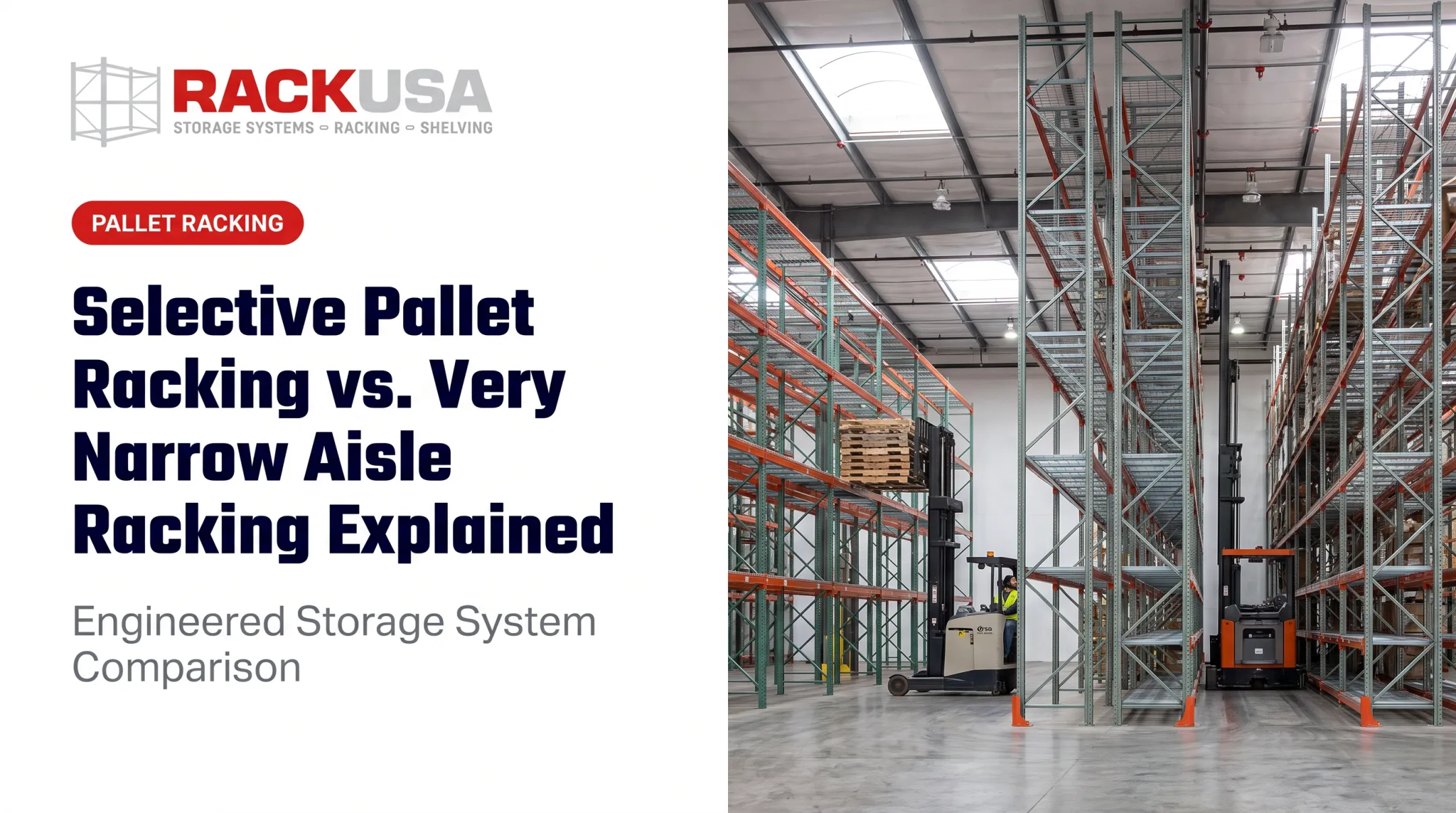
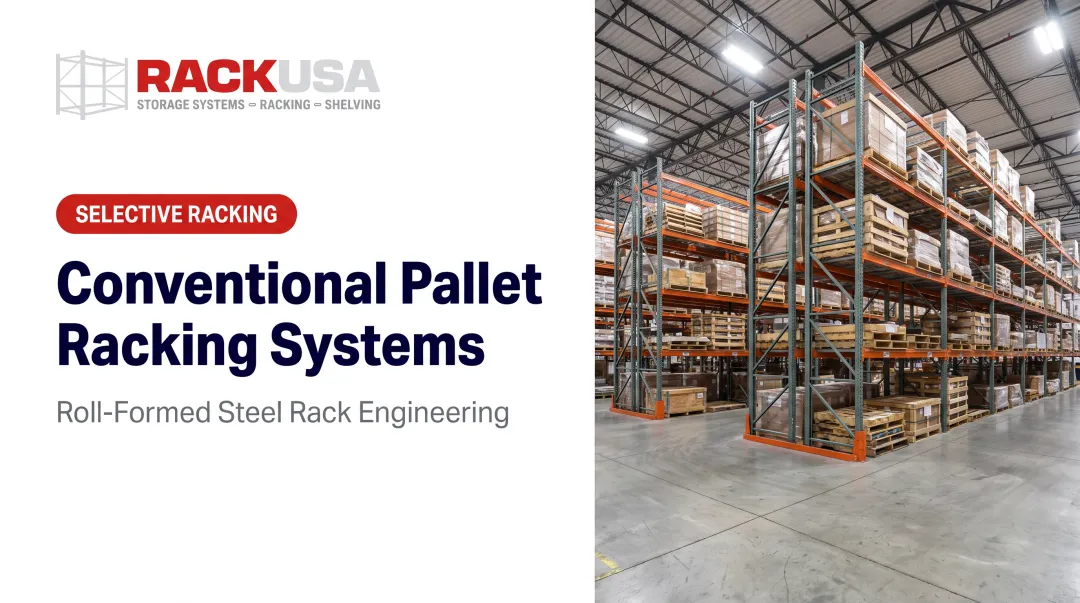
A bay consists of two upright frames connected by pairs of horizontal beams, creating levels where pallets sit. Picture two vertical ladder-like frames standing a set distance apart, with beams running between them at various heights. That's your bay, sometimes called a "storage bay" or "pallet racking section" depending on the manufacturer's catalog.
A single bay is the basic building block of a racking system. Connect several bays end-to-end and you get a run (also called a row). A run stacks beam levels to match your pallet needs, but stability depends on rack design, anchorage, and site conditions—not one fixed rule.
Visualizing a bay:
- Two upright frames (the vertical "posts" with diagonal bracing)
- Horizontal beams connecting the frames at each level
- Pallet positions sitting on or between the beams
- Footplates anchoring everything to the floor

Related Term: What Is the Space Between Racks Called?
This is the aisle, not the bay. Bay width is the horizontal distance along the rack between upright frames. Aisle width is the open travel space between two facing rows of racks, used by forklifts and pickers. Confusing the two is a common mistake that throws off floor plans.
Key Components That Make Up a Bay
Every bay relies on a handful of parts working together. Miss one, and the whole structure's capacity is compromised. Upright frames are the two vertical legs, braced diagonally, that bear the vertical load of everything stacked in the bay. Footplates at the base anchor each frame to the concrete floor, which matters for both everyday stability and seismic performance. Horizontal beams connect the frames and create your shelf levels. Beams are what actually support pallet weight across the span of the bay, and most systems allow beam height adjustment in small increments. RackUSA's selective systems adjust in 2-inch increments, so you can accommodate different pallet sizes without buying new frames. Load capacity comes from two sources working together:
- Beam capacity — the uniformly distributed load (UDL) a pair of beams can hold
- Upright capacity — how much vertical load the frame itself can bear Published manufacturer examples vary widely by beam length and steel gauge. UNARCO's capacity charts show a range from roughly 12,593 lb at 48 inches down to 2,220 lb at 144 inches per beam pair, depending on the beam profile. RackUSA's own selective racking example, a 96" wide × 42" deep × 240" high configuration with 4.5-inch beams, supports approximately 6,800 lb per level. Capacity is project-specific, calculated from your actual pallet weights rather than a one-size-fits-all figure.

Standard Pallet Racking Bay Dimensions
Bay dimensions aren't arbitrary. They're driven by your pallet size, ceiling height, and how many pallets you need per level.
Depth and Height
Frame depth is typically sized close to your pallet's footprint. A common industry reference point is a 42-inch frame supporting a 48-inch-deep GMA pallet, though depth should always be confirmed against your actual pallet dimensions.
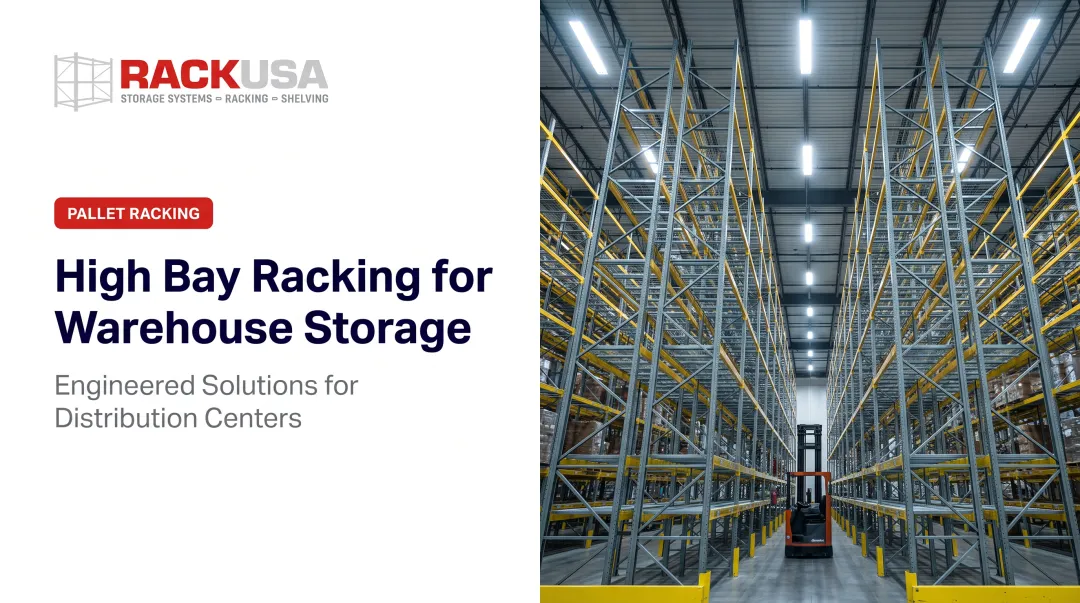
Height spans a wide range. Selective rack systems commonly run from 6 feet up to 32 feet for standard uprights. High-bay and clad-rack systems go well beyond that when ceiling clearance allows.
Your available clear height, sprinkler placement, and forklift lift capability all shape the final height choice.
Beam Length
Beam length depends on how many pallets you want across a single level. Common manufacturer lengths include:
- 48 inches for single-pallet positions
- 96 inches for two pallets per level
- 144 inches for three pallets per level
Longer beams hold more pallets per level, but per-beam capacity drops as span increases.
Aisle and Clearance Space
OSHA's 29 CFR 1910.176 requires "sufficient safe clearances" for mechanical handling equipment in aisles and passageways, but it doesn't set one fixed number. Aisle width depends heavily on your forklift type:
- Standard counterbalance trucks typically need wider aisles, often around 12 feet
- Reach trucks can operate in aisles as narrow as 7 feet, depending on the model and load
- Very narrow aisle (VNA) turret trucks can work in aisles under 6 feet

Always verify against your specific forklift's turning radius before finalizing bay spacing.
Starter Bays vs. Add-On Bays
This is where a lot of first-time buyers get their orders wrong.
A starter bay has two complete upright frames and can stand alone or begin a new run.
An add-on bay (sometimes called an "adder") has only one upright frame. It shares the neighboring frame with the bay next to it, so it must attach to a starter or another add-on to complete a run.
Worked example: Say you need an 8-bay run. You don't need eight sets of frames. You need:
- 1 starter bay (two frames)
- 7 add-on bays (one frame each, sharing with the adjacent unit)
That's 9 total frames instead of 16—a real savings in steel and cost. The same starter/add-on logic applies to cantilever racking and industrial shelving, not only selective pallet rack.

How to Plan the Right Number of Bays for Your Warehouse
Before calculating bay count, measure three things:
- Available floor space — total square footage dedicated to racking
- Ceiling height — your usable clear height after accounting for sprinklers and lighting
- Required aisle clearance — based on your forklift type and turning requirements
From there, bay count also depends on three operational drivers:
- SKU count
- Total pallet volume
- Picking method (FIFO vs. LIFO)
A FIFO (first-in-first-out) operation, common with perishable or date-sensitive inventory, often needs different lane depths and access points than a LIFO (last-in-first-out) setup. That choice changes how many bays fit per run and how many runs fit per aisle.
Layout engineering tied to your racking project is what locks these numbers in. RackUSA's process typically starts with an on-site assessment of space, load requirements, and forklift access, then builds a custom layout with PE-certified engineering. Seismic design is included up front, based on your warehouse's seismic zone, total system load, and frame geometry.
Getting this step right avoids the two costliest mistakes: under-ordering (running out of storage) and over-ordering (paying for capacity you'll never use).
Pallet Racking Bay Costs
Racking cost varies by upright height, beam length, load capacity, and current steel pricing. There's no single sticker price, but published industry benchmarks give a useful starting point for budgeting.
| Source | Cost per Pallet Position | Notes |
|---|---|---|
| Speedrack West (2023) | $50–$200 | Single-deep selective rack |
| AK Material Handling (2024) | $70–$100 average | Varies by component and capacity |
| Hammerhead (2026) | $80–$100 (non-seismic); $100–$120 (seismic) | New selective rack |
Treat these as order-of-magnitude budgeting figures, not quotes. Your actual cost depends on height, capacity, single-deep vs. back-to-back configuration, and whether seismic engineering is required for your region.
How you buy also shapes total cost. Bundling engineering and installation with the rack purchase helps avoid hidden costs from mismatched components or field rework.
RackUSA folds engineering, load calculations, and compliance checks into the design phase upfront, so bay specs match your pallets and building conditions from day one.
Frequently Asked Questions
What is pallet racking?
Pallet racking is a storage system of upright frames and horizontal beams that holds palletized goods in rows and levels. Options range from selective rack to high-density drive-in and flow systems.
How much does pallet racking cost?
Cost depends on rack type, height, and load capacity, generally falling between $50 and $200 per pallet position for standard selective racking. Seismic requirements and steel pricing can push costs toward the higher end.
How much space do you need between pallet racks?
OSHA requires "sufficient safe clearance" for handling equipment but doesn't set a fixed number. Reach trucks may need aisles as narrow as 7 feet, while standard counterbalance forklifts often require closer to 12 feet.
What is the standard depth of pallet racking?
Frame depth is typically matched to pallet footprint, with 42 inches being a common example for a 48-inch-deep GMA pallet. Always confirm depth against your actual pallet dimensions and overhang requirements.
What is the space between racks called?
That's the aisle, the open travel space between two rack rows. It's distinct from bay width, which is the horizontal span between upright frames within a single rack row.
How many bays are needed to start a warehouse racking run?
A basic run needs one starter bay (two upright frames) and one add-on bay (one frame). Longer runs add more add-on bays to that starter.