
Many facilities still rely on random or manual placement, trusting warehouse staff to remember which pallets arrived first. That approach breaks down fast as SKU counts grow and turnover accelerates. True first-in, first-out rotation isn't a policy you post on a wall. It's a physical outcome that depends on rack design.
This guide breaks down what FIFO means as both an accounting method and a warehouse strategy, the racking systems built to enforce it, and how to match the right solution to your facility.
Key Takeaways
- FIFO keeps the oldest inventory moving first, cutting spoilage, obsolescence, and shrinkage losses
- Accounting FIFO and physical warehouse FIFO are different concepts that must align for accurate inventory control
- Pallet flow, carton flow, drive-through, and pallet shuttle racks are purpose-built to guarantee rotation order
- Choose the system by product turnover, facility layout, and maintenance capacity to keep FIFO reliable long term
What Is a FIFO System?
In warehousing, FIFO means the first unit load placed into storage is the first one removed. That's it. No exceptions, no "we'll grab whichever pallet is closest today." The goal is continuous, predictable rotation that mirrors how the product actually ages.
FIFO also exists as an accounting term, and the two meanings get confused constantly. As a cost-flow assumption, FIFO values cost of goods sold and ending inventory by assuming the oldest costs are recognized first. It's a financial calculation, not a physical process, though the name overlaps.
Is FIFO allowed under GAAP? Yes. Both US GAAP and IFRS permit FIFO as an inventory valuation method. LIFO, however, is allowed under GAAP but prohibited under IFRS's IAS 2 standard, which permits only FIFO or weighted-average cost for interchangeable inventory.
If your company operates internationally or reports under IFRS, that distinction matters for compliance, not just warehouse layout.
On the floor, physical FIFO is a separate requirement—and in several industries it is non-negotiable:
Industries where physical FIFO rotation is non-negotiable:
- Food and beverage — shelf life and expiration dates drive product value directly
- Pharmaceuticals — federal rules (21 CFR 211.150) require distributing the oldest approved stock first
- Chemicals — degradation can affect potency, stability, or safety
- Cosmetics — formulations break down or separate over time
- Fashion and apparel — seasonal relevance decays even when the product itself doesn't
Accounting FIFO vs. Physical Warehouse FIFO
Here's where warehouses get tripped up. A company can use FIFO accounting on its books while its actual storage layout lets newer pallets get picked first. The accounting method values inventory correctly on paper. It does nothing to control which physical unit leaves the dock.
Unless the racking system itself forces older stock forward, physical FIFO doesn't happen automatically. That's the gap dedicated FIFO racking exists to close.

Why FIFO Matters for Warehousing Operations
Poor rotation isn't a minor inefficiency. It's a direct hit to profitability.
The USDA estimates 31% of the US food supply is lost at the retail and consumer level, amounting to roughly 133 billion pounds and $161 billion in retail value annually. Poor stock rotation isn't the sole driver of that figure, but it's a meaningful contributor across food, beverage, and pharma operations.
Operational benefits of enforced FIFO rotation:
- Reduced waste from spoilage, expiration, or product obsolescence
- Protected warranty windows for electronics, batteries, and manufactured goods with age-sensitive coverage
- More predictable inventory value, since older stock doesn't quietly accumulate and lose worth
- Simplified recalls and audits — lane- or SKU-based organization makes lot tracking straightforward instead of a warehouse-wide search
Traceability is another major payoff. When a lane or bay is dedicated to a single lot, tracing a contaminated batch or a recalled component takes minutes instead of days. That matters most in pharmaceutical and food operations, where regulators expect documented chain-of-custody, but it pays off in any warehouse running quality audits.
FIFO Racking System Options for Warehouses
The defining feature separating true FIFO racking from standard storage is simple: separate loading and unloading points. When a rack forces product in one end and out the other, older inventory physically can't get bypassed. Single-aisle systems, by contrast, let whoever's closest to the front get picked first, regardless of age.
Selective Pallet Racking
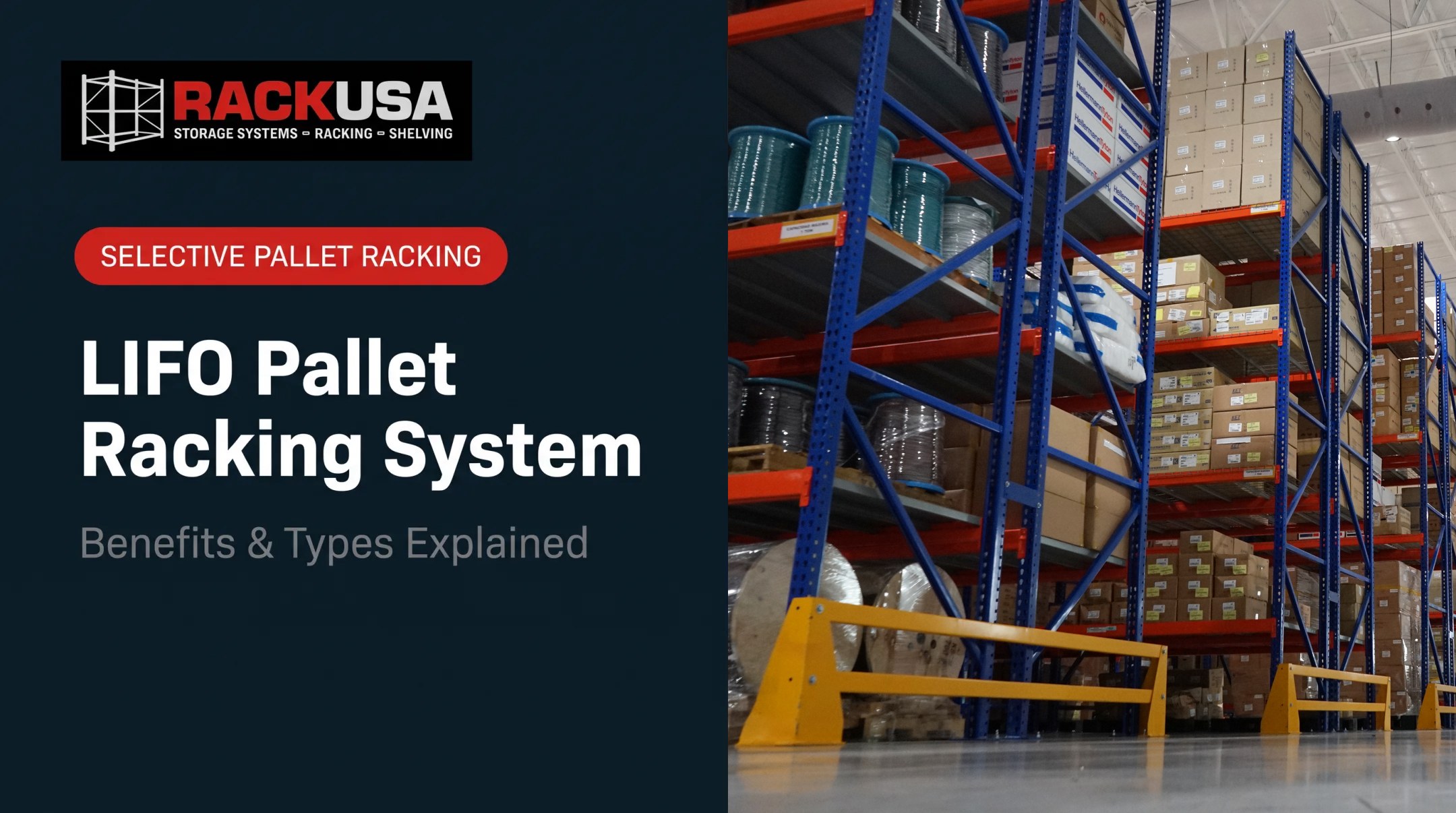
Selective rack gives forklifts direct, simultaneous access to every pallet position. There's no mechanical sequencing here. FIFO depends entirely on location labeling, lot controls, and disciplined picking procedures rather than the structure forcing rotation.
RackUSA manufactures this in two variants:
- Roll-formed selective racking — 1 to 3 metric tons per level; cold-rolled steel frames with boltless beams for layouts that change often
- Structural selective racking — over 3 metric tons per level; heavy-gauge steel for cold storage, humidity, and constant forklift impact
Selective rack trades storage density for selectivity. It's the right call when you need to reach any SKU at any time and can't afford to have inventory locked behind other pallets.
Drive-In and Drive-Through Racking
These two look nearly identical from the outside, but they operate on opposite rotation logic.
- Drive-in racking has a single entry and exit point. Forklifts load and retrieve from the same aisle, which means the last pallet in is the first one out. That's LIFO by design, not FIFO.
- Drive-through racking opens at both ends. Forklifts load from one side and retrieve from the other, physically forcing older pallets through the lane before newer ones can be accessed.
Both systems achieve roughly double the storage density of selective racking by eliminating aisles between bays. RackUSA builds both configurations. According to Modern Materials Handling, drive-through and drive-in racking can cut footprint by as much as 35% versus selective rack in comparable applications. The trade-off is flexibility: each lane typically holds one SKU, so this works best for bulk, homogeneous product.
Gravity Flow Systems (Pallet Flow and Carton Flow)
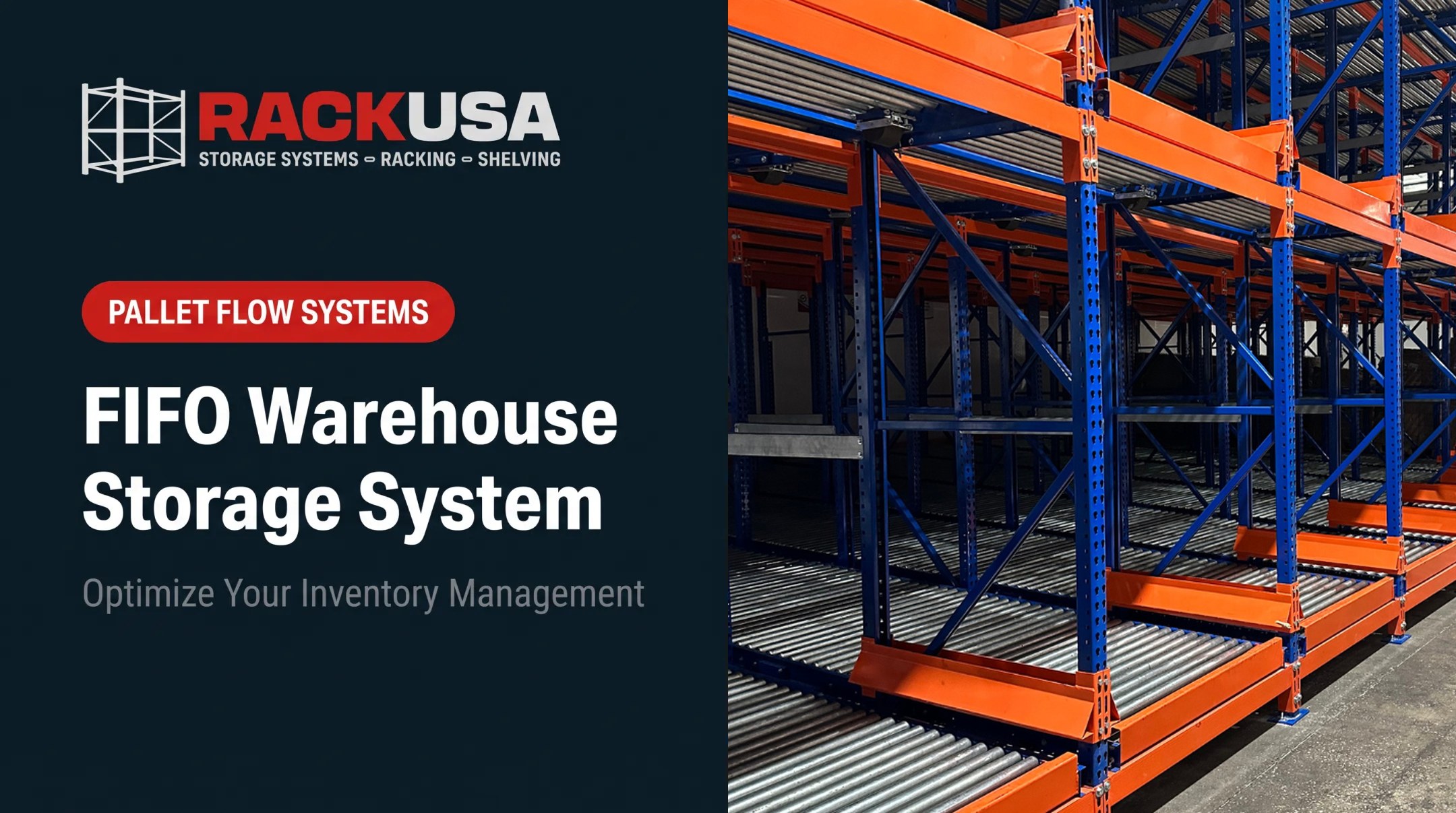
Gravity flow is the most mechanically precise FIFO solution available. Pallets or cartons load at the elevated rear of an inclined roller bed and move by gravity alone toward the picking face, with no motors or electricity involved.
RackUSA's gravity flow systems run on a 3 to 5 degree incline, calculated per project based on product weight, load surface area, and lane travel distance. Too steep, and product accelerates uncontrollably. Too shallow, and it stalls halfway down the lane.
- Pallet flow — full pallets at roughly 1 to 1.5 metric tons per level; built for food, pharma, and cold storage where date rotation is mandatory, with no electrical parts inside the cold room
- Carton flow — same gravity principle for cases; rear replenishment and front picking for e-commerce, pharma batch picks, and cross-docking
Pallet Shuttle Systems
Semi-automated pallet shuttles, such as RackUSA's Matador pallet shuttle system, use a motorized cart running inside the rack channel to load and retrieve pallets without a forklift ever entering the structure.
The Matador comes in two configurations:
- 2D (single-axis) — the shuttle moves longitudinally within one channel, suited to high-volume operations with limited SKU variety
- 4D (multi-directional) — the shuttle moves both longitudinally and transversely across multiple lanes and levels, coordinated by routing software for complex, high-throughput distribution centers
Every pallet gets measured, weighed, and scanned with a unique ID before entering the system. That record lets the shuttle software—working with any WMS, WCS, or WES—enforce true FIFO retrieval, or switch to LIFO when a product family needs it.
Typical load capacity runs 1 to 2 metric tons per level. Self-charging carts support continuous operation without manual battery swaps.
Quick comparison across the four system types:
| System | Density | Selectivity | Best Fit |
|---|---|---|---|
| Selective Rack | Low | Highest | Moderate turnover, high SKU variety |
| Drive-Through | High | Low | Bulk, homogeneous, date-sensitive goods |
| Gravity Flow | High | Low-Moderate | Perishables, pharma, high-turnover SKUs |
| Pallet Shuttle | Very High | Moderate | High-throughput, labor-constrained operations |
FIFO vs. LIFO Storage Systems
Not every product needs strict age rotation, and that's where LIFO racking still earns its place. Drive-in rack and push-back rack are the two most common LIFO configurations.
In drive-in, the single access aisle means the last pallet loaded is always the first one retrieved. Push-back rack works similarly, using nested carts on inclined rails: loading a new pallet pushes the earlier one further back, and there's no rear access to reverse that order.
LIFO makes sense when:
- Product is bulk, non-perishable, and single-SKU per lane
- Rotation order has no bearing on product value or safety
- Maximum storage density matters more than access flexibility
Plenty of warehouses run both systems side by side. A distribution center might store raw packaging materials in drive-in bays while running perishable finished goods through drive-thru or pallet flow lanes.
The decision comes down to matching each product family's shelf life and turnover rate to the storage method that fits it, rather than forcing one rack type across the entire facility.
How to Choose the Right FIFO Racking System for Your Warehouse
Picking the right system starts with the product, not the rack catalog.
Product-related factors:
- Perishability and expiration sensitivity
- Turnover velocity (how fast pallets or cases actually move)
- Pallet and case dimensions, since lane depth and roller specs depend on load geometry
Facility-related factors:
- Available floor space and ceiling height
- Aisle width and dock door configuration
- Structural and seismic requirements for the building's location
Throughput and labor costs decide whether manual gravity flow or a semi-automated shuttle makes more financial sense. Gravity flow needs no power and minimal maintenance, but it relies on forklift staff to load correctly.
A pallet shuttle system, like RackUSA's Matador, costs more upfront. In high-volume operations on extended shifts, it cuts labor hours and reduces pick errors.

System choice also depends on engineering support. Racks built without proper structural and seismic load analysis can fail under real warehouse conditions.
RackUSA's engineering team in Gómez Palacio, Durango, bundles facility layout design, PE-stamped drawings, and permitting assistance with system projects when those deliverables are required. Designs follow ANSI MH16.1-2023 and carry MHI R-Mark certification (#5190).
Once installed, FIFO integrity depends on keeping the rack itself sound. Bent frames, misaligned rollers, or damaged rails disrupt gravity flow and create safety hazards under OSHA's material handling clearance rules.
Routine inspections, prompt repair, and staff training on load limits protect both the investment and the rotation order the system was built to enforce.
Frequently Asked Questions
What is a FIFO system?
FIFO means the oldest inventory in storage is moved out first. It is both an accounting method for valuing inventory and a physical warehouse strategy enforced through rack design.
Is FIFO allowed in US GAAP?
Yes, FIFO is a GAAP-approved inventory valuation method used widely across food, pharmaceutical, and manufacturing industries. It's also permitted under IFRS, unlike LIFO.
What are common examples of FIFO?
Common applications include food and beverage, pharmaceuticals, chemicals, cosmetics, and fashion—anywhere value or safety depends on moving the oldest stock first.
What is the difference between FIFO and LIFO racking systems?
FIFO racking, such as drive-thru or gravity flow, has separate loading and unloading points that force older stock out first. LIFO racking, like drive-in, uses a single aisle where the newest pallet is retrieved first.
Which racking system is best for FIFO warehousing?
Gravity flow (pallet flow and carton flow) and pallet shuttle systems offer the most reliable FIFO enforcement. Selective racking works too, but relies on inventory controls rather than structural design.
Can FIFO and LIFO storage coexist in the same warehouse?
Yes, many facilities run both. Perishable or date-sensitive product families go into FIFO lanes, while bulk, non-perishable SKUs are stored in cost-effective LIFO configurations like drive-in racking.